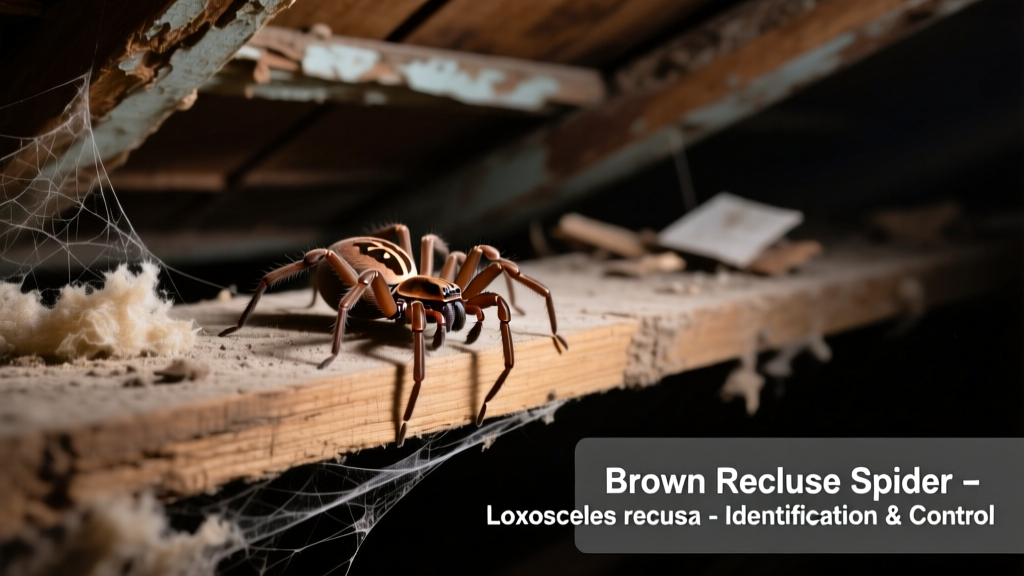
Brown recluse spiders (Loxosceles reclusa) are venomous arachnids rarely seen—but when they colonize your attic, the risk of accidental bites rises sharply. Unlike most spiders, they thrive in undisturbed, dry, cluttered spaces like insulation piles, stored boxes, and rafters—making attics ideal breeding grounds. Their bite can cause necrotic skin lesions, and because they’re nocturnal and reclusive, infestations often go unnoticed until multiple spiders are found or someone is bitten.
Identification
Brown recluse spiders are small (¼ to ¾ inch), light-to-dark brown, and defined by a violin-shaped marking on the cephalothorax—with the ‘neck’ pointing toward the abdomen. They have six eyes arranged in three pairs (unlike most spiders’ eight), uniformly colored legs with no spines or stripes, and fine grayish hairs covering their bodies.
- Look for irregular, off-white silk retreats—not symmetrical webs—in corners, under insulation, or behind stored items
- Shed exoskeletons (molts) may appear near entry points or along joists
- Bites are often painless at first but develop into a blistered, ulcerating lesion within 2–8 hours
| Feature | Brown Recluse | Cellar Spider | House Spider |
|---|---|---|---|
| Eye arrangement | Six eyes in three pairs | Eight eyes in two rows | Eight eyes in two rows |
| Violin mark | Present (dark, consistent) | Absent | Absent |
| Leg texture | Uniformly covered in fine hairs | Long, thin, banded | Hairy, no banding |
| Web type | Irregular, non-sticky retreats only | Loose, tangled, sticky | Flat, sheet-like with funnel |
What Attracts Them
Brown recluses don’t seek humans—they seek shelter, prey, and stability. Attics provide all three when conditions align:
- Temperatures between 70–85°F year-round (common in insulated attics)
- High humidity pockets near roof leaks or poorly vented soffits (they tolerate dryness but need *some* moisture)
- Abundant hiding spots: cardboard boxes, bundled insulation, old clothing, or stacked lumber
- Prey sources: silverfish, firebrats, crickets, and other small insects drawn to attic debris
According to the University of Kentucky Entomology Department’s 2022 field survey, 68% of confirmed brown recluse attic infestations occurred in homes with >10 years of unopened storage and minimal seasonal inspection.
Treatment Methods
Natural Methods
Start with non-chemical tactics—especially if you have pets, children, or health concerns. Vacuuming with a shop vac (immediately freezing or sealing the bag) removes spiders, egg sacs, and prey insects. Diatomaceous earth (food-grade) applied as a thin line along joist seams and eaves dehydrates spiders on contact. Sticky traps placed near insulation gaps or wall-floor junctions catch active spiders and help map hotspots.
- Use glue boards every 4 ft along perimeter walls and near access hatches
- Replace cardboard boxes with clear plastic totem bins—spiders avoid smooth, exposed surfaces
- Run dehumidifiers during humid months (keep attic RH below 50%)
Chemical Methods
If natural methods stall after 3 weeks—or if you find ≥5 spiders/week—targeted chemical intervention becomes necessary. Use pyrethroid-based aerosols (e.g., cypermethrin) only in cracks, crevices, and behind insulation batts—not broadcast sprays. Dust formulations (delta dust, CimeXa) last longer in dry attic environments and penetrate deep into voids. Always wear an N95 mask and gloves; never apply pesticides near HVAC intakes or electrical wiring.
"Dusts outperform liquids in attics—because they stay active in low-humidity voids for up to 10 months. Liquid sprays dry too fast and leave uneven coverage." — Dr. Richard Brenner, University of Arkansas Extension, 2021
Prevention
Preventing reinfestation means altering the attic’s ecology—not just killing spiders. Seal all entry points larger than ⅛ inch using copper mesh and caulk (brown recluses squeeze through tiny gaps around plumbing vents, soffit gaps, and roofline trim). Install ridge and soffit vents to improve airflow and reduce humidity buildup. Remove all organic clutter—including old papers, fabric scraps, and unused holiday decorations—within 6 feet of exterior walls.
- Clean attic annually—even if it’s just a 2-hour sweep with a HEPA vacuum
- Install LED motion-sensor lights: brown recluses avoid well-lit areas
- Store seasonal items in sealed, hard-sided containers—not plastic bags or cardboard
For long-term success, pair prevention with ongoing monitoring. Improve attic ventilation to reduce both moisture and insect prey, and schedule biannual attic inspections to catch early signs before colonies establish.
When to Call an Exterminator
Call a licensed pest management professional if you’ve found more than 12 spiders in one week, discovered egg sacs (off-white, papery, ~¼ inch diameter), or experienced confirmed bites with tissue necrosis. Also consult an expert if your attic has extensive rodent activity—mice attract brown recluse prey and create nesting tunnels they exploit. Licensed technicians use thermal imaging to locate hidden harborage zones and apply microencapsulated products that resist attic heat degradation.
Can brown recluses live in insulation?
Yes—especially fiberglass or cellulose insulation. They nest in compressed layers, feeding on insects drawn to the warmth and dust. Disturbing insulation without PPE risks exposure. Always wear gloves, goggles, and an N95 mask before handling attic insulation suspected of harboring recluses.
Do brown recluses build webs?
No—they don’t spin prey-catching webs. Instead, they construct irregular, silken retreats for molting and egg-laying. These look like messy, off-white patches stuck to wood or insulation—not classic orb or funnel webs.
Are brown recluses aggressive?
No. They bite only when pressed against skin—like when putting on stored gloves or reaching into a box. Most bites occur between May and October, peaking in July and August when spider activity and human attic use overlap.
Can I relocate them outside?
Not safely or effectively. Brown recluses rarely survive outdoors beyond 2 miles from human structures—they rely on stable microclimates. Relocation also risks spreading them to neighbors’ attics or sheds. Removal + exclusion is far more reliable than relocation.
How long do brown recluse infestations last?
Untreated, they persist for years. A single female lays 1–5 egg sacs per season (each holding 30–300 eggs), and juveniles mature in 10–12 months. With consistent treatment and exclusion, most infestations resolve in 3–6 months—but full eradication requires verifying zero activity for 90 consecutive days.
Do ultrasonic devices work against brown recluses?
No. The Federal Trade Commission issued warnings in 2020 about ultrasonic repellents after reviewing 17 independent lab studies—including one by Kansas State University—that showed zero behavioral change in Loxosceles species exposed to frequencies up to 120 kHz.
Attics aren’t just storage space—they’re part of your home’s defense system. Treating brown recluse spiders there isn’t about panic; it’s about precision, patience, and proactive maintenance. Start with identification and vacuuming, escalate only when needed, and lock down access points before winter sets in. For deeper guidance, see our spider control in older homes guide—and remember: if you see one, assume more are nearby, but don’t assume the worst. Most attic encounters end without incident—if you act deliberately.