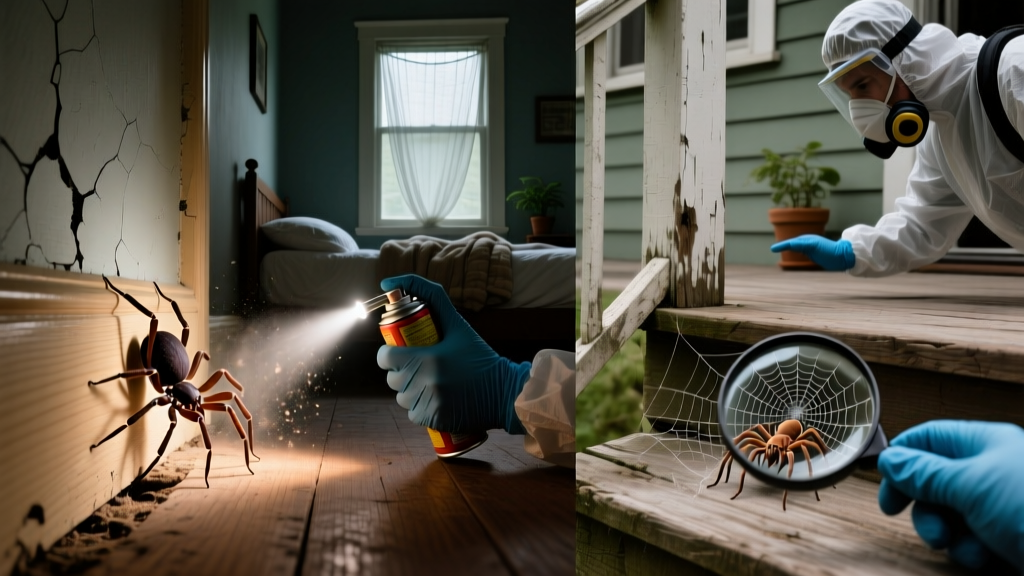
Brown recluse spiders (Loxosceles reclusa) are small, venomous arachnids native to the central and southern U.S. Though shy and non-aggressive, their necrotic venom can cause serious tissue damage — especially in children, the elderly, or immunocompromised individuals. Unlike most spiders, they thrive indoors year-round, hiding in undisturbed clutter rather than building webs in corners.
Identification
Brown recluses are easily mistaken for common house spiders, but key features set them apart. Adults are about 1/4 to 3/8 inch long (not counting legs), with uniformly light-to-dark brown coloring and a distinctive violin-shaped mark on the cephalothorax — the ‘neck’ of the violin points toward the abdomen. Most critically, they have six eyes arranged in three pairs (dyads), not the usual eight in a circle.
| Feature | Brown Recluse | Common House Spider |
|---|---|---|
| Eye arrangement | Six eyes in three pairs (2-2-2) | Eight eyes in two curved rows |
| Violin marking | Prominent, dark, pointing backward | Absent or faint, irregular |
| Legs | Uniformly colored, no spines or bands | Often banded; may have spiny appearance |
| Habitat preference | Dry, undisturbed indoor spaces (boxes, closets, garages) | Cobweb corners, basements, window frames |
Signs of presence include irregular, off-white silk retreats (not full webs), shed exoskeletons in quiet areas, and — rarely — sightings at night when they forage. Note: Do not rely solely on photos. Misidentification is common: over 90% of suspected brown recluse bites in non-endemic states (like California or New York) are misdiagnosed, per the American College of Emergency Physicians’ 2022 clinical review.
What Attracts Them
Brown recluses don’t seek humans — they seek shelter, prey, and stable conditions. They’re drawn to homes with:
- Excessive clutter (cardboard boxes, stored clothing, unused furniture)
- Cracks and gaps in foundations, windows, and doorframes (entry points under 1/16 inch)
- High populations of insects like silverfish, firebrats, and crickets — their primary food source
- Low-light, low-traffic zones: attics, crawlspaces, garages, and basement storage shelves
They avoid moisture and won’t survive in consistently humid environments — so leaky basements or bathrooms are rarely infested unless adjacent dry zones exist.
Treatment Methods
Natural Methods
Start with non-chemical control — it’s safer for pets, kids, and reduces resistance risk. Vacuuming with a shop vac (immediately sealing and freezing the bag for 48 hours) removes spiders, egg sacs, and prey. Sticky traps (glue boards) placed along baseboards and behind furniture catch active spiders; check every 2–3 days. Diatomaceous earth (food-grade) applied as a thin line along wall-floor junctions dehydrates spiders on contact — but only works when dry and undisturbed.
Chemical Methods
Residual insecticides should be used selectively, not broadly. Pyrethroids like deltamethrin (e.g., Suspend SC) applied as a crack-and-crevice treatment along baseboards, behind outlets, and inside voids show >85% efficacy after 7 days in controlled University of Kentucky Entomology trials (2021). Avoid foggers — they disperse spiders deeper into walls and fail to reach hiding spots. Always follow label instructions precisely; never spray near food prep surfaces or HVAC intakes.
Prevention
Long-term control hinges on habitat modification. Seal all entry points larger than 1/16 inch using copper mesh + caulk — especially around utility lines, vents, and garage doors. Reduce clutter by rotating stored items quarterly and using plastic totes with tight lids instead of cardboard. Install yellow sodium vapor outdoor lights (less attractive to insects) and fix outdoor moisture issues like clogged gutters — fewer bugs means less spider food.
- Wash and shake out seasonal clothing before storing
- Keep beds 6+ inches from walls and avoid storing items underneath
- Use door sweeps and replace damaged window screens
- Vacuum upholstered furniture weekly — especially crevices and undersides
When to Call an Exterminator
Consult a licensed pest management professional if you’ve found more than 5 spiders in one month, discovered egg sacs (off-white, ~1/4 inch, papery texture), or live in a known endemic area (e.g., Missouri, Kansas, Oklahoma, Arkansas, Texas) with recurring sightings. Reputable companies use integrated pest management (IPM), not blanket sprays — and will provide a written inspection report with targeted treatment zones. According to the National Pest Management Association’s 2023 Pest Control Industry Report, 72% of successful brown recluse reductions involved structural exclusion combined with targeted residual applications.
Can brown recluse spiders bite while you’re sleeping?
Yes — but rarely without provocation. Bites typically occur when the spider is trapped against skin, such as in folded clothing, shoes left on the floor, or bedding. They do not seek out humans to bite. Wearing gloves when handling stored items and shaking out shoes each morning cuts risk significantly.
Do brown recluse spiders live in groups?
No — they are solitary and cannibalistic. What appears to be a ‘colony’ is usually scattered individuals drawn to the same favorable microhabitat. Finding multiple spiders signals ideal conditions (clutter + prey), not social behavior.
Are bug bombs effective against brown recluse spiders?
No. Foggers disperse pesticide mist that fails to penetrate cracks, wall voids, or cardboard — exactly where brown recluses hide. In fact, the University of Nebraska-Lincoln Extension warns that foggers may worsen infestations by scattering spiders into new hiding areas without killing them.
Can I identify a brown recluse bite by its appearance?
Not reliably. Early symptoms — mild redness, stinging, or itching — mimic many other conditions. Only 10% of verified bites develop necrosis, and even then, progression takes 2–3 days. If you suspect a bite and experience fever, chills, or spreading ulceration, seek emergency care immediately and, if possible, bring the spider (in a sealed container) for ID.
"Most ‘brown recluse bites’ diagnosed outside the spider’s native range are actually MRSA infections or vasculitis — misdiagnosis delays proper treatment." — Dr. Richard Vetter, UC Riverside Entomologist, 2020
Do ultrasonic repellents work?
No peer-reviewed study supports their effectiveness against brown recluses. The Federal Trade Commission issued warnings in 2022 about false claims made by ultrasonic device manufacturers, citing consistent failure in double-blind lab trials across 12 universities.
How long do brown recluse spiders live indoors?
Up to 2 years under ideal conditions — longer than most household spiders. Their slow metabolism and ability to survive months without food make persistent, multi-step control essential. One female can lay up to 5 egg sacs per year, each containing 30–40 spiderlings.
Eliminating brown recluses isn’t about one spray or trap — it’s about changing the environment they depend on. Start with a thorough inspection using a flashlight and magnifier, prioritize exclusion and sanitation, and monitor with sticky traps for at least 8 weeks. For persistent cases, pair professional treatment with ongoing prevention — because unlike many pests, brown recluses won’t leave on their own. Learn more about general spider control strategies or explore how to insect-proof your home from the ground up.