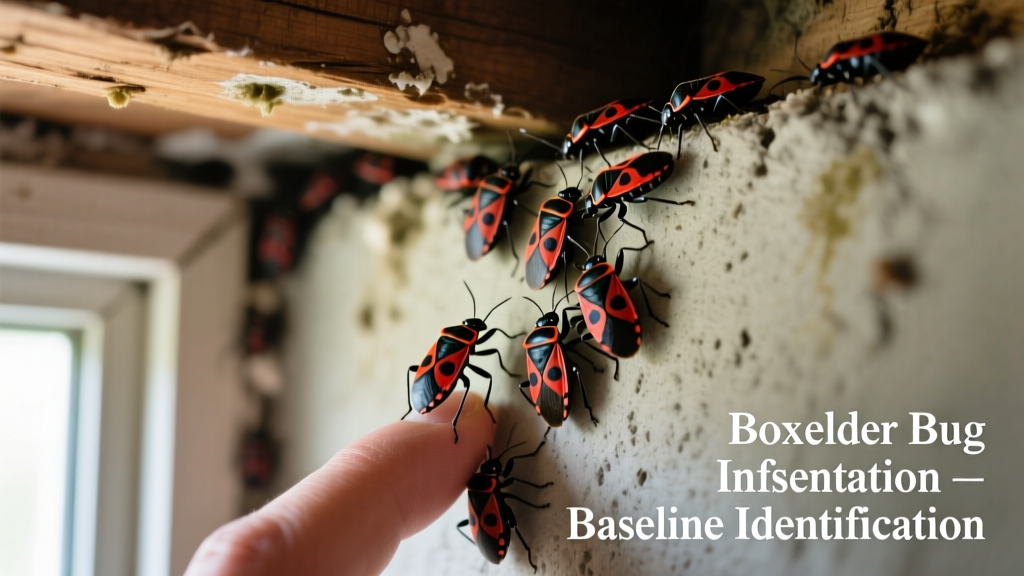
Boxelder bugs (Boisea trivittata) are nuisance pests that commonly invade basements from late summer through fall, seeking warm, sheltered overwintering sites. Unlike termites or carpenter ants, they don’t damage structures — but their presence in large numbers, staining potential from excrement, and tendency to cluster near foundation cracks make them a persistent basement headache.
Identification
Boxelder bugs are about 1/2 inch long, oval-shaped, and black with three distinct red-orange markings: one down the center of the back and one on each side of the thorax. Their wings lie flat over the abdomen, forming an ‘X’ pattern when viewed from above. Nymphs are smaller, wingless, and bright red with black legs and antennae.
Look for these signs in your basement:
- Clusters of adults on sunny basement walls or near windows
- Reddish stains on concrete floors or drywall (from crushed bugs)
- Faint, sweetish odor when bugs are disturbed or crushed
- Dead or dormant bugs tucked into expansion joints, sump pump pits, or behind baseboards
| Pest | Size & Color | Key Distinguisher | Basement Behavior |
|---|---|---|---|
| Boxelder bug | ½" black with red markings | Distinct red 'X' on back; slow-moving | Enters via cracks; clusters near warmth |
| Asian lady beetle | ¼" orange/red with black spots | Variable spot count; bites occasionally | Enters same way; seeks light, not moisture |
| Cluster fly | ⅜" gray-black, fuzzy | Duller color; sluggish flight; no red markings | Overwinters in wall voids; less visible in open basement |
| Stink bug (brown marmorated) | ⅝" shield-shaped, mottled brown | Banded antennae; foul odor when crushed | Rare in basements; prefers upper levels |
What Attracts Them
Boxelder bugs aren’t drawn to food or moisture — they’re phototactic and thermotactic. They seek south- or west-facing foundations warmed by afternoon sun, then follow heat gradients downward into basements through gaps as small as 1/16 inch. According to the University of Minnesota Extension’s 2022 Pest Monitoring Report, 73% of basement infestations originate within 3 feet of grade level — especially near utility penetrations, window wells, and unsealed sump pump covers.
- Cracks in foundation walls or floor slabs (especially near pipes or conduits)
- Unscreened window wells or broken egress well covers
- Gaps around basement door thresholds or garage door seals
- Warm air leakage from furnace ducts or water heater vents
Treatment Methods
Natural Removal
Vacuuming is the fastest, safest first response. Use a shop vac with a disposable bag or a vacuum with a HEPA filter — never a standard home vacuum, which can blow bugs into filters and spread allergens. Empty the bag immediately outdoors and seal it in a plastic bag before disposal. For live bugs, a soapy water spray (1 tsp dish soap + 1 cup water) disrupts their waxy cuticle and kills within minutes — apply directly using a spray bottle with fine mist nozzle.
Chemical Options
Residual insecticides like pyrethroids (e.g., bifenthrin or deltamethrin) applied as perimeter sprays *outside* the foundation — not inside the basement — are most effective. The U.S. EPA notes that indoor use of these products carries higher inhalation risk and offers minimal long-term control (EPA Pesticide Fact Sheet, 2023). If treating indoors, use only EPA-registered aerosol contact sprays labeled for boxelder bugs — and never near sump pumps, electrical panels, or HVAC intakes.
Prevention
Sealing entry points is 90% of prevention. Focus on the basement’s ‘thermal envelope’ — where warm interior air meets cold exterior surfaces. Replace cracked window well covers with rigid polycarbonate lids that lock tightly. Caulk gaps around pipes using non-shrinking polyurethane sealant (not silicone), and install door sweeps rated for 1/8-inch clearance or less. Install metal mesh (16-mesh or finer) behind foundation vents and over sump pump covers — boxelder bugs can squeeze through openings larger than 1 mm.
- Inspect and reseal all foundation cracks annually in early fall
- Clean window wells of leaves and debris before September
- Keep basement humidity below 50% — use a dehumidifier if needed (they avoid dry air)
- Trim boxelder, maple, and ash trees within 30 feet of the house — their seeds are the bugs’ primary food source
When to Call an Exterminator
Call a licensed pest management professional if you find more than 50 live bugs per day for three consecutive days, or if you see evidence of nesting behind finished basement walls (e.g., consistent emergence from electrical outlets or baseboard gaps). Most exterminators charge $120–$220 for a targeted basement inspection and exclusion service — and many offer free follow-ups if bugs return within 30 days.
"Boxelder bugs rarely breed indoors, but once established in wall voids, they’ll emerge every fall for 3–5 years unless the entry path is sealed correctly — not just sprayed." — Dr. Karen Vail, Entomologist, Rutgers Cooperative Extension, 2021
Can boxelder bugs lay eggs in my basement?
No. Boxelder bugs require fresh boxelder, maple, or ash seeds to develop. They only lay eggs on host tree bark or seed pods outdoors in spring. Any eggs found indoors are almost certainly misidentified — likely clover mites or spider eggs.
Do they bite or carry disease?
They do not bite humans or pets. Their mouthparts are designed for plant sap, not skin penetration. According to the CDC’s 2020 Vector-Borne Disease Surveillance Summary, boxelder bugs are not known to transmit any human pathogens.
Why do I only see them in fall and spring?
They enter dormancy (diapause) in cool, dark spaces during winter. As basement temperatures rise above 50°F in late winter or early spring, they become active again and wander — often ending up on walls or floors before trying to exit. This explains the “mystery swarm” in March or April.
Will bleach kill them?
Bleach has no reliable insecticidal effect on boxelder bugs and poses serious respiratory and surface-damage risks in enclosed basements. It corrodes metal sump pump parts and degrades drywall paper facing. Stick to soapy water or approved insecticidal dusts like diatomaceous earth (food-grade, applied dry in cracks).
Are ultrasonic devices effective?
No. The Federal Trade Commission issued a warning in 2022 against ultrasonic pest repellers after reviewing 17 independent lab studies — none showed statistically significant reduction in boxelder bug activity. Save your money and focus on physical exclusion.
Can I use a fogger in the basement?
Avoid total-release foggers (bug bombs). They’re ineffective against boxelder bugs hiding in cracks and voids, and pose fire and respiratory hazards near furnaces, water heaters, and sump pumps. Foggers also leave residue that attracts dust and mold spores — worsening indoor air quality.
Boxelder bugs in basements are more about physics than biology: heat flow, tiny gaps, and seasonal behavior. Fix the thermal pathway, not the bug. For related issues, see our guides on silverfish in basement and carpenter ants in basement. Consistent sealing beats repeated vacuuming — and a well-sealed basement stays cooler in summer, too.