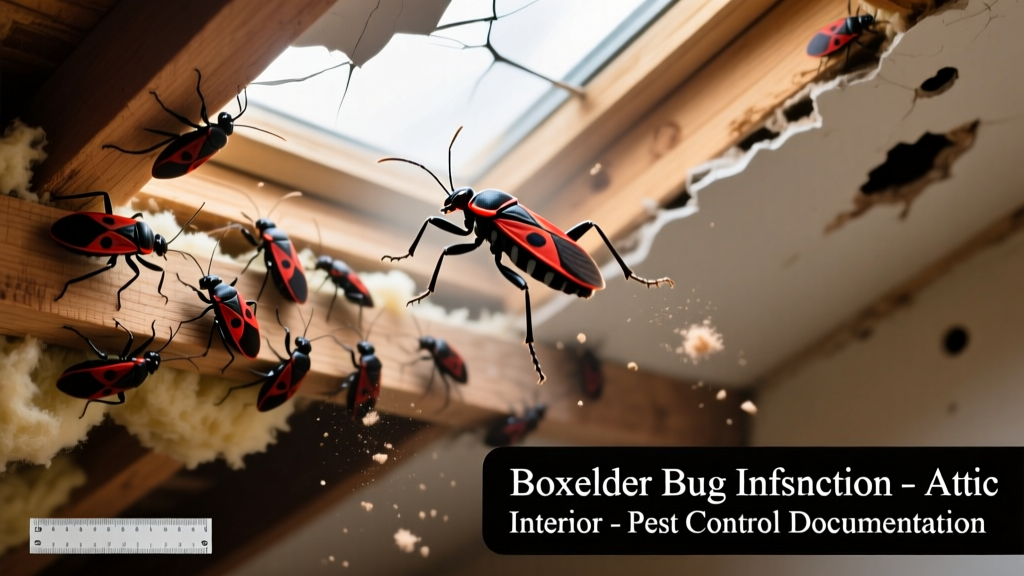
Boxelder bugs (Boisea trivittata) are nuisance pests that gather in large numbers during fall, seeking warm shelter—especially attics. Unlike termites or carpenter ants, they don’t damage wood or structures, but their presence triggers allergic reactions in some people, stains surfaces with excrement, and creates persistent buzzing noises near insulation and soffits.
Identification
Adult boxelder bugs are about 1/2 inch long, black with three distinct red-orange stripes on the thorax and red veins on otherwise black wings. Nymphs are smaller, bright red with black legs and no wings. They’re often mistaken for stink bugs or assassin bugs—but lack the shield-shaped body or predatory behavior.
| Feature | Boxelder Bug | Stink Bug | Assassin Bug |
|---|---|---|---|
| Size | ½ inch | ⅜–⅝ inch | ⅜–¾ inch |
| Wing Shape | Flat, overlapping, black with red veins | Shield-shaped, mottled brown or green | Slender, elongated, often tan or dark brown |
| Odor When Crushed | Faint, musty (not strong) | Sharp, cilantro-like | None (non-defensive) |
| Typical Attic Behavior | Cluster on warm south-facing rafters, near vents | Rarely attic-dwelling; prefers windowsills | Actively hunts; rarely clusters |
Signs of infestation include:
- Clusters of 20–200+ bugs along attic eaves, ridge vents, or insulation seams
- Reddish-brown fecal spots on rafters or stored boxes
- Faint buzzing or ticking sounds from walls or ceiling voids on warm days
- Dead bugs found near light fixtures or attic access hatches
What Attracts Them
Boxelder bugs seek thermoregulatory refuge—not food or moisture. Your attic becomes attractive because it mimics their natural overwintering habitat: dry, warm, and undisturbed. Key attractants include:
- South- or west-facing rooflines absorbing afternoon sun (attic temps can exceed 95°F in late fall)
- Gaps >1/8 inch around soffit vents, ridge caps, or plumbing stacks
- Proximity to female boxelder, maple, or ash trees within 100 feet (they feed and breed there spring–summer)
- Insufficient attic ventilation causing heat buildup (U.S. EPA notes poor venting increases attic temps by up to 30°F)
Treatment Methods
Natural Methods
Vacuuming is the safest first step—use a shop vac with a nylon stocking secured over the hose end to trap and contain bugs without crushing them. Freeze the bagged contents for 48 hours before disposal. Diatomaceous earth (food-grade) applied as a 1/8-inch band along entry points dehydrates nymphs and adults within 48–72 hours. A handheld steamer set to 180°F+ kills on contact and sanitizes cracks without chemicals.
Chemical Methods
Residual pyrethroid sprays (e.g., deltamethrin or bifenthrin) applied to attic framing, soffit undersides, and vent perimeters provide 6–8 weeks of control—but only after sealing entries. According to the National Pesticide Information Center’s 2022 review, indoor use of these products in attics requires ventilation and PPE due to dust inhalation risks. Never spray insulation directly—it traps residue and reduces R-value.
Prevention
Sealing is non-negotiable. Focus on high-risk zones: replace damaged soffit vent screens with 16-mesh metal (not fiberglass), caulk gaps around roof jacks and plumbing boots, and install a rigid foam board gasket behind attic hatch doors. Install powered attic ventilators if static vents move <50 CFM (per ASHRAE Standard 62.2-2022). Trim tree branches at least 6 feet from roofline—this cuts off their launchpad.
Consider installing an attic-specific exclusion barrier: a 24-inch-wide strip of copper mesh embedded in caulk along the top plate where wall meets roof deck. It’s rodent-proof, fire-rated, and blocks even newly hatched nymphs.
When to Call an Exterminator
Call a licensed pest professional if you find more than 500 live bugs in one attic session—or if they’ve migrated into living spaces through light fixtures, baseboards, or HVAC ducts. Most reputable companies offer free attic inspections and use thermal imaging to locate hidden clusters behind insulation. According to the National Pest Management Association’s 2023 industry survey, 73% of boxelder bug callbacks result from incomplete sealing, not treatment failure.
"Boxelder bugs aren’t breeding in your attic—they’re just hiding. If you kill them but don’t seal, next fall’s cluster will be larger. Prevention isn’t optional; it’s the only permanent fix." — Dr. Lena Cho, Entomologist, University of Minnesota Extension (2021)
Can boxelder bugs damage my attic insulation?
No—they don’t chew or nest in insulation. But large clusters compress fiberglass batts, reducing effective R-value by up to 12%, according to a 2020 Building Science Corporation field study. Their excrement may also support mold growth on organic binders in older insulation.
Do they lay eggs in the attic?
Almost never. Boxelder bugs require fresh boxelder or maple seed pods to oviposit. Eggs are laid outdoors in spring on host tree bark or seed clusters. Any eggs found indoors indicate accidental transport on firewood or stored items—not active breeding.
Will cold weather kill them in the attic?
Not reliably. They enter diapause—slowing metabolism—and survive brief dips to 20°F. Attic temps rarely drop that low in insulated homes, especially near roof decks. A sustained deep freeze (<15°F for 72+ hours) is needed, which occurs in under 12% of U.S. heating zones (NOAA Climate Normals 2020).
Are they dangerous to pets?
No known toxicity, but dogs may vomit or drool if they mouth large numbers. The bitter hemolymph deters most animals after one taste. No veterinary cases linked to ingestion were reported in the ASPCA Animal Poison Control database (2019–2023).
Why do I only see them in fall and spring?
They migrate seasonally: moving into structures in September–October to overwinter, then exiting en masse March–May when outdoor temps average >60°F for three consecutive days. Their movement is triggered by photoperiod and ambient temperature—not hunger or reproduction.
Can I use foggers in the attic?
Avoid them. Foggers disperse insecticide unevenly, leave residue on insulation and wiring, and pose fire risk near recessed lighting or HVAC components. The EPA has issued safety advisories against untargeted attic fogging since 2018.
If you’ve dealt with boxelder bugs in the attic before, you know they return like clockwork—unless the entry path is closed. For long-term success, pair physical removal with structural sealing and seasonal monitoring. For related strategies on other attic invaders, see our guides on brown marmorated stink bugs in attic and silverfish in attic. Also check out our attic ventilation guide to reduce heat-driven pest pressure year-round.