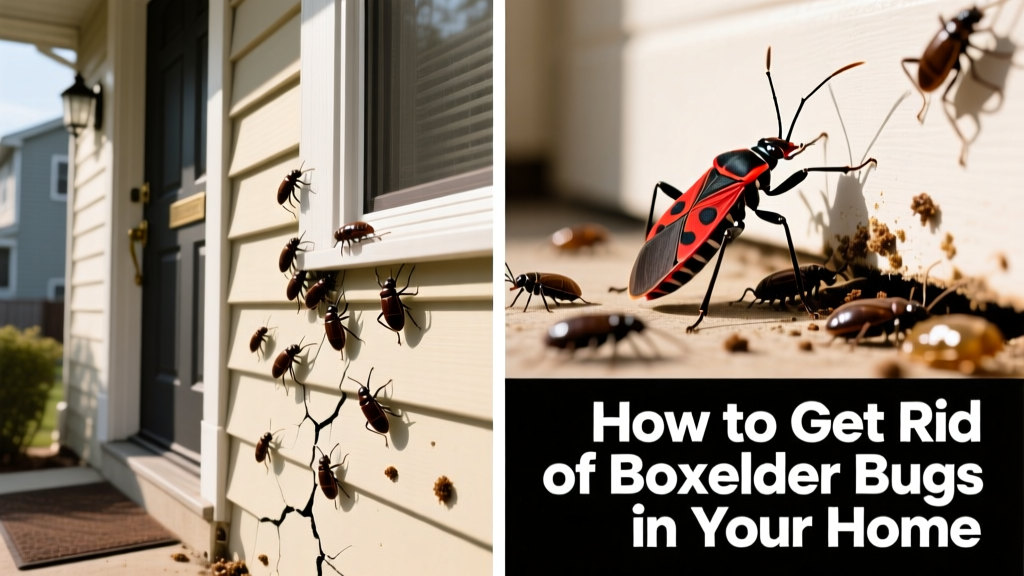
Boxelder bugs (Boisea trivittata) are harmless but persistent nuisance pests that gather in large numbers on warm, south-facing walls in late summer and fall. They don’t bite, sting, or damage structures—but when they enter homes seeking shelter for winter, they stain curtains and upholstery with excrement and emit a foul odor if crushed.
Identification
Adult boxelder bugs are about 1/2 inch long, oval-shaped, and mostly black with three distinct red-orange stripes on the thorax and red veins on their wings. Nymphs are smaller, wingless, and bright red with black legs and antennae. You’ll spot them sunning themselves on light-colored siding, clustering near windows, or crawling along baseboards indoors.
| Feature | Boxelder Bug | Western Conifer Seed Bug | Asian Lady Beetle |
|---|---|---|---|
| Size | ½ inch | ⅝ inch | ¼ inch |
| Color Pattern | Black with red thoracic stripes & wing veins | Brown with white zigzag band on wings | Orange/red with black spots (variable) |
| Odor When Crushed | Musty, foul | Strong, cedar-like | Mild, acrid |
| Primary Host Trees | Boxelder, silver maple, ash | Fir, pine, hemlock | None — generalist predator |
What Attracts Them
Boxelder bugs are drawn to warmth, light-colored surfaces, and proximity to host trees. They’re especially abundant near female boxelder maples (Acer negundo), which produce the winged seeds (samaras) they feed on. Sunny, south- or west-facing exteriors act as thermal traps—warming the bugs just enough to trigger movement toward cracks and gaps.
- Female boxelder, silver maple, or ash trees within 100 feet of your home
- South- or west-facing stucco, vinyl, or painted wood siding
- Cracks >1/8 inch wide around windows, doors, soffits, and foundation vents
- Unsealed utility penetrations (cable, pipe, wire entries)
Treatment Methods
Natural Removal
Vacuuming is the safest, most effective immediate control. Use a shop vac with a disposable bag—or line a standard vacuum bag with a nylon stocking to trap bugs without clogging filters. Empty the bag outdoors immediately; otherwise, they’ll escape or release odor. For outdoor clusters, spray a mixture of 1 part dish soap to 4 parts water directly on groups—they’ll drop and suffocate within minutes.
Chemical Options
Residual insecticides like pyrethroids (e.g., bifenthrin or deltamethrin) applied to exterior entry points provide 4–6 weeks of protection when applied in early September—before peak migration. The U.S. EPA cautions against indoor spraying unless targeting wall voids with dust formulations (e.g., silica gel or diatomaceous earth). Indoor sprays rarely reach hidden aggregations and risk unnecessary exposure.
- Apply exterior barrier treatments only to foundation walls, window/door frames, and soffits—not lawns or gardens
- Avoid carbaryl (Sevin) near flowering plants—it’s highly toxic to bees (EPA Pesticide Fact Sheet, 2022)
- Never use foggers—boxelder bugs hide deep in wall voids where aerosols can’t penetrate
Prevention
Long-term control hinges on exclusion. Seal all openings larger than 1/8 inch using caulk, copper mesh, or expandable foam. Replace damaged or missing window/door screens. Install door sweeps with rubber or vinyl gaskets—not brush-style sweeps, which leave gaps at the threshold.
Remove or prune female boxelder trees within 100 feet of your home—male trees don’t produce seeds and aren’t attractive to these bugs. If removal isn’t possible, rake and dispose of fallen samaras weekly from late spring through summer to reduce food sources.
"Boxelder bugs rarely survive more than 6 months indoors—and they won’t reproduce inside. Your goal isn’t eradication, it’s interception." — Dr. Linda Mason, Entomologist, University of Minnesota Extension (2021)
When to Call an Exterminator
Call a licensed pest management professional if you find live bugs emerging from interior walls or ceilings year after year—or if vacuuming and sealing haven’t reduced numbers after two consecutive seasons. A pro can inspect for hidden entry routes, treat wall voids with targeted dusts, and apply timed exterior barrier treatments.
Look for companies certified by the Integrated Pest Management program and ask whether they offer seasonal exclusion services—not just one-time sprays. According to the National Pest Management Association’s 2023 industry survey, 78% of successful boxelder bug reductions involved structural exclusion paired with early-fall exterior treatment.
Do boxelder bugs bite or spread disease?
No. They have piercing-sucking mouthparts designed for plant sap—not human skin. They do not transmit pathogens to people or pets. Their presence is strictly a nuisance issue.
Why do I see them in spring?
Overwintering adults emerge on warm, sunny days—often in March or April—to seek mates and lay eggs on host trees. Seeing them then means they successfully overwintered nearby, likely in your attic, walls, or garage.
Can I use essential oils to repel them?
Peppermint, clove, and rosemary oils show limited repellency in lab trials (Journal of Economic Entomology, 2020), but field effectiveness is inconsistent and short-lived—under 48 hours. Relying on oils alone delays proven exclusion work.
Are they attracted to light inside my home?
Not directly—but they move toward warmth and air currents. Interior lights often coincide with heat leaks near windows and doors, creating false associations. Fix drafts first, not lamps.
Will removing my boxelder tree solve the problem?
Yes—if it’s the only female tree within 100 feet. But boxelder bugs travel up to 2 miles to feed. If neighbors have host trees, you’ll still see some activity—though numbers typically drop by 60–80% (University of Nebraska-Lincoln Extension Bulletin G1957, 2022).
Can they damage my home’s insulation?
No. Unlike rodents, they don’t chew or nest in insulation. They simply rest in voids—often near attic vents or behind baseboards—waiting for spring.
Boxelder bugs won’t harm your family or structure, but their seasonal invasions test patience. Focus on sealing, timing, and persistence—not panic. Pair early-fall exclusion with routine checks of window seals and foundation gaps, and you’ll cut indoor sightings by 90% within two seasons. For related strategies, see our guides on ladybugs in house and stink bug control.