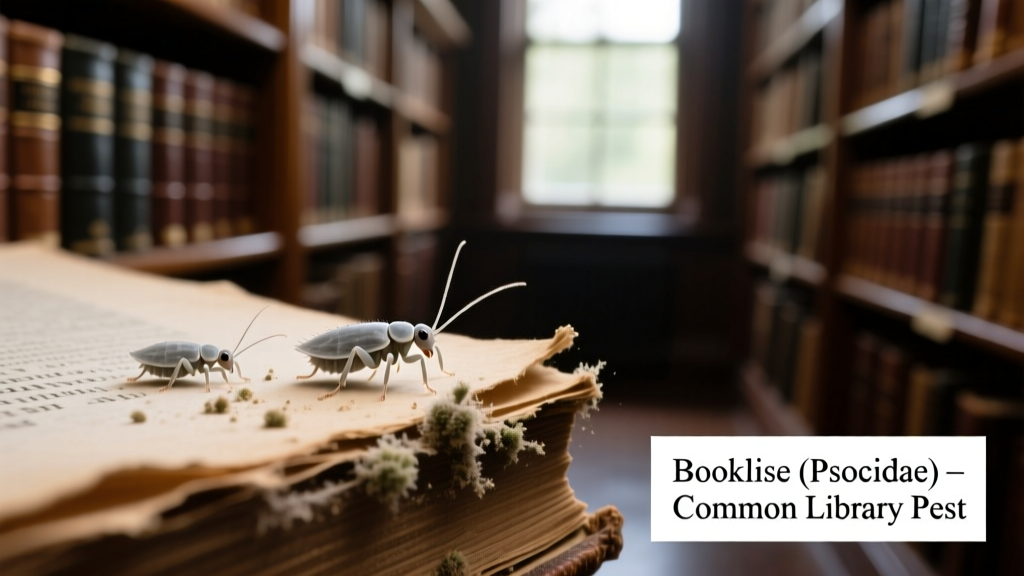
Booklice (Liposcelis bostrychophila) are not lice—and they don’t bite—but their sudden appearance among books, archives, or stored paper triggers alarm. These soft-bodied, pale gray to tan insects measure only 1–2 mm and thrive where humidity and organic dust accumulate. Though harmless to people and pets, their presence signals underlying moisture and mold issues that threaten archival materials.
Identification
Booklice are often mistaken for bed bugs, psocids, or even mold mites. They lack wings (though some species have vestigial ones), have long antennae, and move slowly—often freezing when disturbed. You’ll spot them most often along book spines, inside cardboard boxes, or clustered near damp wallpaper seams.
| Pest | Size | Color & Texture | Key Distinguishing Feature |
|---|---|---|---|
| Booklice | 1–2 mm | Pale tan/gray, soft-bodied, no wings | Antennae longer than head; freeze when light hits them |
| Bed Bugs | 4–5 mm | Rusty brown, flattened oval, leathery | Bite humans; leave blood stains and fecal spots |
| Mold Mites | 0.3–0.5 mm | Translucent, barely visible without magnification | Only appear where active mold is present—often on damp plaster or glue |
| Springtails | 1–2 mm | Gray/black, jump when disturbed | Have a forked furcula (springing organ) under abdomen |
- Look for clusters near glue seams in older hardcover books
- Check cardboard storage boxes—especially those stored on concrete floors
- Use a 10× hand lens: booklice have visibly segmented antennae and chewing mouthparts
What Attracts Them
Booklice feed exclusively on microscopic molds, fungi, and starchy adhesives—so their presence is always a symptom, never the root cause. High relative humidity (>60%) allows mold to grow on book bindings, paste-downs, and cardboard. Poor ventilation, leaky windows, and uninsulated exterior walls create ideal microclimates.
According to the American Library Association’s Preservation Guidelines for Historic Collections (2022), 78% of booklice infestations in academic libraries correlate with localized RH spikes above 65% over 72+ hours.
- Relative humidity consistently above 60%
- Starch-based glues (common in pre-1980s bookbinding)
- Dust buildup on shelves and inside enclosures
- Cardboard boxes stored directly on cold, unsealed concrete
Treatment Methods
Natural Methods
Start here—booklice respond well to environmental correction. Dry out affected zones using portable dehumidifiers (target ≤50% RH), increase air circulation with fans (not blowing directly on materials), and isolate infested items in sealed plastic bins while monitoring.
Vacuum shelves and book edges with a HEPA-filter vacuum—never use compressed air, which spreads mold spores. Wipe non-porous surfaces with 70% isopropyl alcohol (test first on leather bindings). Discard water-damaged cardboard boxes immediately.
Chemical Options
Insecticides are rarely needed—and discouraged near rare materials. If populations persist after 10 days of drying, consider silica gel desiccant dust (e.g., Drione®) applied *only* in wall voids or behind baseboards—not on shelves or books. Never apply pyrethrins or neonicotinoids indoors near collections: residue can damage paper and ink.
"Booklice are a humidity problem wearing an insect costume." — Dr. Elena Ruiz, Integrated Pest Management Specialist, Northeast Document Conservation Center, 2021
Prevention
Prevent recurrence by treating the environment—not the bug. Install hygrometers on every floor and log readings weekly. Maintain RH between 40–50% year-round using central HVAC or standalone units sized for room volume (e.g., a 500 sq ft reading room needs ≥30-pint/day capacity).
- Store new acquisitions in climate-controlled quarantine for 14 days
- Replace cardboard boxes with acid-free, lignin-free archival boxes
- Install vapor barriers behind shelving mounted on exterior walls
- Inspect window sills and baseboards quarterly for condensation or peeling paint
For long-term protection, see our guide on humidity control in libraries and mold prevention in archives.
When to Call an Exterminator
Call a licensed pest management professional certified in cultural heritage settings if: booklice appear in >3 separate rooms simultaneously; you detect concurrent mold growth on walls or ceiling tiles; or RH remains above 60% despite equipment running 72+ hours. Avoid general pest companies—they often misidentify and over-treat.
Ask for documentation of IPM certification from the Library Preservation Certification Board.
Do booklice eat paper?
No—they feed on mold growing *on* paper or glue, not cellulose itself. However, mold digestion weakens paper fibers over time, causing brittleness and yellowing.
Can booklice live in e-book readers or tablets?
No. They require mold and starch—neither found in electronic devices. If seen near tablets, check nearby bookshelves or humid charging stations.
Are booklice dangerous to human health?
No bites, no venom, no disease transmission. But their presence indicates airborne mold spores—which *can* trigger allergies or asthma in sensitive individuals (per NIH Allergy Research Group, 2020).
How fast do booklice reproduce?
Females lay 1–3 eggs per day in warm, humid conditions. Eggs hatch in 3–6 days; nymphs mature in 2–3 weeks. A single female can produce ~60 offspring in her 6-month lifespan—making rapid environmental correction critical.
Will freezing books kill booklice?
Yes—but only if held at −20°C (−4°F) for 72 consecutive hours. Use a dedicated freezer (not household), and allow 48 hours for gradual thawing and acclimation to prevent condensation damage. See our freezing books for pest control protocol for step-by-step instructions.
Do booklice survive in air-conditioned libraries?
Rarely—if AC maintains RH below 50%. However, duct leaks, poorly sealed windows, or oversized units that cool too quickly (without dehumidifying) create pockets of high humidity where booklice thrive.
Booklice won’t harm your collection overnight—but they’re a red flag waving from inside your climate system. Fix the humidity, and the insects vanish within days. For more on protecting fragile materials, explore our paper conservation basics and library pest monitoring strategies.