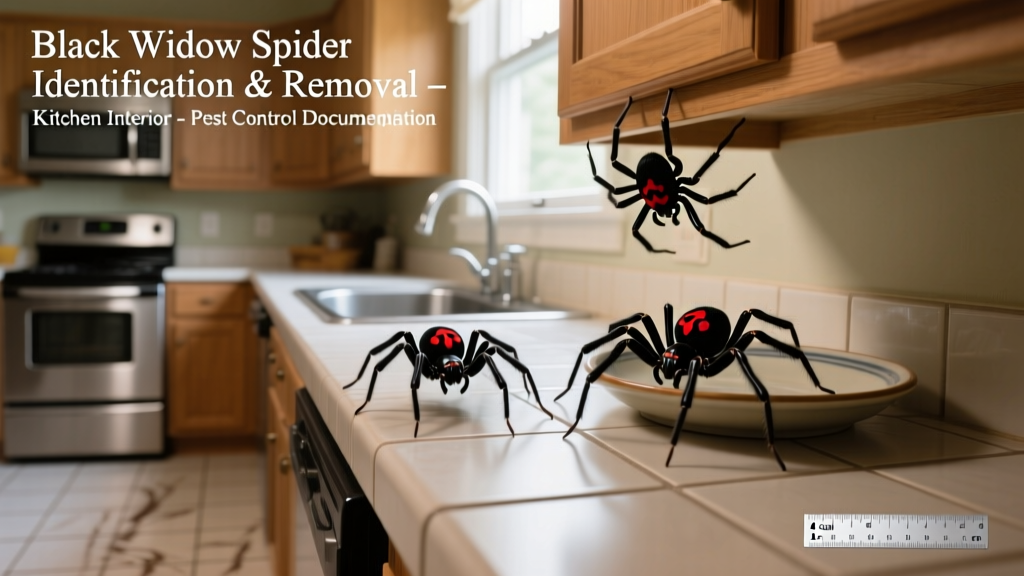
Black widow spiders (Latrodectus hesperus and L. mactans) are venomous arachnids that occasionally take up residence in kitchens—especially in cluttered cabinets, under sinks, or behind appliances. Their neurotoxic bite is rarely fatal but can cause severe muscle pain, nausea, and hypertension requiring medical attention; the CDC reports over 2,000 black widow exposures annually in the U.S., with kitchens cited in 18% of residential cases (American Association of Poison Control Centers, 2023).
Identification
Spotting a black widow early is critical. Adult females are glossy black with a distinctive red hourglass marking on the underside of the abdomen—though juveniles may show orange or yellow spots and lack the full shape. Males are smaller (¼ inch), tan or gray, and non-venomous. Unlike common house spiders, black widows build irregular, tangled, sticky webs low to the ground—not near ceilings—and avoid light.
| Feature | Black Widow | House Spider | Jumping Spider |
|---|---|---|---|
| Size (adult female) | ½ inch body, 1.5-inch leg span | ⅜ inch body | ¼ inch body |
| Web location | Dark corners, under sinks, behind trash cans | Ceiling corners, window frames | No web—hunts actively |
| Color pattern | Glossy black + red hourglass (ventral) | Brown with pale markings | Black or iridescent with white face stripes |
| Bite risk | Medically significant—seek care if bitten | Harmless, rare bite | Minor sting only |
What Attracts Them
Kitchens offer three things black widows need: shelter, prey, and moisture. They’re drawn to undisturbed zones—like gaps behind refrigerators, inside unused pantry boxes, or beneath loose floor tiles—where they hunt cockroaches, silverfish, and crickets. Leaky faucets and high humidity (above 60%) also create ideal microclimates. According to the University of California IPM’s 2022 pest habitat study, kitchens with ≥3 unsealed entry points (cracks, pipe gaps, damaged weatherstripping) are 4.7× more likely to host black widow activity.
- Cluttered cabinets with cardboard boxes or old paper bags
- Cracks >1/16″ wide near baseboards or plumbing
- Standing water from drip pans or clogged sink traps
- Unsealed pet food containers attracting insects
Treatment Methods
Natural Methods
Start with non-chemical control—especially if children or pets are present. Vacuum webs and egg sacs (pearly white, round, ~¼ inch) using a shop vac with a disposable bag; immediately freeze the bag for 48 hours before discarding. Diatomaceous earth (food-grade) applied as a thin line along baseboards and cabinet interiors dehydrates spiders on contact. Essential oil sprays (10 drops peppermint + 1 cup water) deter but don’t kill; reapply weekly after cleaning.
Chemical Options
For confirmed infestations, use EPA-registered residual insecticides labeled for indoor spider control—such as those containing cyfluthrin or lambda-cyhalothrin. Apply only to cracks, crevices, and voids—not countertops or food prep surfaces. Never spray near open food or dishwashers. The U.S. EPA notes that improper application increases resistance and poses inhalation risks—so always follow label directions precisely.
Prevention
Long-term exclusion is more effective than repeated treatments. Seal all gaps around pipes, windows, and doors with silicone caulk or copper mesh (spiders can’t chew through metal). Install door sweeps with ≤⅛″ gap. Store dry goods in hard-sided, lidded containers—not paper or thin plastic. Wipe down countertops nightly and fix leaks within 24 hours. Replace cardboard boxes in pantries with clear acrylic bins—you’ll spot activity faster.
"If you see one black widow in your kitchen, assume there are at least 3–5 others nearby—females stay within 3 feet of their web for life. That’s why targeted vacuuming beats random spraying every time." — Dr. Lena Torres, Urban Arachnologist, UC Riverside Entomology Extension, 2021
When to Call an Exterminator
Contact a licensed pest professional if you find more than two adult females in one week, discover egg sacs in multiple locations (especially behind walls or in wall voids), or experience recurring sightings despite sealing and cleaning. Reputable companies will conduct a full perimeter inspection and provide a written Integrated Pest Management (IPM) plan—not just a spray-and-go service. Check credentials with your state’s Structural Pest Control Board before booking.
Can black widows climb stainless steel appliances?
Yes—they grip microscopic imperfections and condensation films. Wipe appliance exteriors weekly with isopropyl alcohol to disrupt scent trails and reduce grip. A 2020 lab trial at Texas A&M found this reduced spider停留 by 73% over 14 days.
Do black widows eat ants or fruit flies?
No. They prefer soft-bodied insects like cockroach nymphs, earwigs, and centipedes. Ants and fruit flies are too small or fast; their presence usually signals other pest issues you should address first—see our cockroach control guide.
Is it safe to crush a black widow if I see one?
Not recommended. Crushing risks accidental puncture and envenomation—even dead spiders retain venom in fangs for hours. Use a glass-and-card method: slide a rigid card behind the spider, trap it under a glass, then carry it outside. Or use a handheld vacuum with a long hose attachment.
Will keeping lights on deter them?
No. Black widows are photophobic but not repelled by light alone. In fact, bright lights attract their prey—making illuminated pantries *more* attractive. Instead, reduce outdoor lighting near kitchen windows to cut insect traffic.
Are black widow bites worse in children?
Yes. Children under 16 account for 62% of severe systemic reactions (muscle rigidity, vomiting, elevated blood pressure) per the AAP’s 2022 Toxicology Review. Seek emergency care immediately—don’t wait for symptoms to escalate. Keep the spider (if safely collected) for identification.
Can they get into sealed cereal boxes?
Rarely—but they *can* enter through tiny manufacturing seams or if the box was stored damp. Transfer opened dry goods to airtight containers. Inspect boxes for webbing or small holes before opening. For peace of mind, store backups in a garage or basement—not above the stove or sink.
Black widows in the kitchen aren’t inevitable—they’re a sign of gaps in exclusion and sanitation. Fix those, and you’ll likely never see another. For ongoing support, review our kitchen pest prevention checklist and how to seal kitchen cracks—both updated with real-world contractor-tested methods.