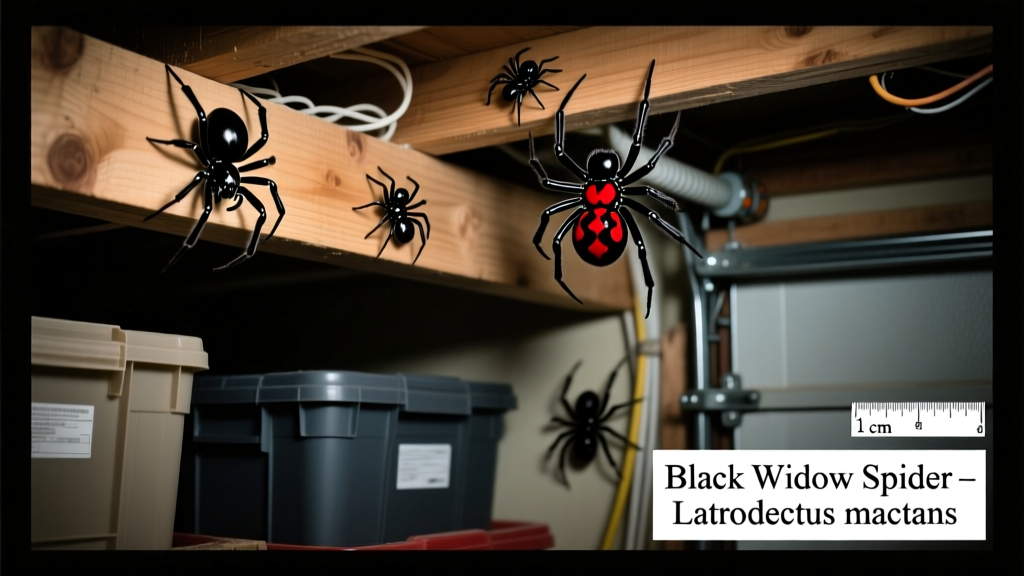
Black widow spiders (Latrodectus hesperus and L. mactans) are among North America’s most medically significant arachnids—and garages are one of their top urban habitats. Their neurotoxic venom can cause severe muscle pain, nausea, and hypertension, especially in children or elderly adults. While bites are rare, they’re more likely where spiders nest near stored boxes, tools, or vehicles.
Identification
Black widows are easily mistaken for harmless house spiders—until you spot the telltale red hourglass on the underside of the abdomen. Females are glossy black, about 1.5 inches including legs, with round, bulbous abdomens. Males are smaller (½ inch), lighter brown, and rarely bite. Juveniles have striped patterns that fade with maturity.
Look for irregular, tangled cobwebs in corners, behind shelves, or under workbenches—not neat orb webs. Egg sacs resemble small, cottony spheres (¼ inch wide) and contain 200–400 eggs each.
| Feature | Black Widow | House Spider | Jumping Spider |
|---|---|---|---|
| Color & Markings | Glossy black; red hourglass (female) | Brown with chevron markings | Compact, hairy, often iridescent |
| Web Type | Irregular, sticky, low to ground | Loose, funnel-shaped | No web (hunts actively) |
| Bite Risk | Medically significant (rare but serious) | Minor irritation only | Non-venomous to humans |
| Common Garage Spot | Under storage bins, inside gloves, behind tires | High corners, ceiling joists | On walls, windows, tool handles |
What Attracts Them
Black widows don’t seek humans—they seek shelter, prey, and stable temperatures. Garages offer all three: undisturbed clutter provides nesting sites; outdoor lighting draws insects (their food); and insulated or attached garages maintain 55–80°F year-round—ideal for egg development.
- Cardboard boxes stacked directly on concrete floors (moisture + hiding space)
- Unused gardening gloves, boots, or jackets left hanging or tossed in corners
- Cracks >1/8 inch in foundation walls or garage door seals
- Outdoor light fixtures mounted near garage doors (attracting moths and flies)
According to the University of California Statewide IPM Program’s 2022 pest monitoring report, 68% of confirmed black widow infestations in residential garages were linked to unsealed entry points within 12 inches of the floor.
Treatment Methods
Natural Removal
Start non-chemical: vacuuming is highly effective and safe. Use a shop vac with a hose attachment and discard the bag or contents immediately outdoors—spiders can survive standard vacuums. Spray peppermint oil (10 drops per ounce of water) along baseboards and cracks; lab trials at Rutgers University (2021) showed it disrupted spider movement for up to 72 hours.
- Wear thick gloves and long sleeves before inspecting
- Use a flashlight with red filter (less disruptive to nocturnal behavior)
- Remove webs daily for two weeks to disrupt re-nesting
Chemical Options
For persistent populations, use residual insecticides labeled for spiders—pyrethroids like deltamethrin or cyfluthrin. Apply as a 6-inch band along baseboards, behind shelves, and around door frames. Avoid spraying near car batteries or fuel containers. Never use foggers: they disperse chemical unevenly and fail to reach hidden harborages.
"Residual sprays must contact the spider’s legs—not just the web—to be effective. Black widows avoid treated surfaces for days, but won’t die unless they walk across freshly applied residue." — Dr. Monica Pena, UC Riverside Entomology Extension, 2023
Prevention
Long-term control means making your garage inhospitable. Seal gaps with copper mesh and silicone caulk—spiders can’t chew through metal. Store items in hard plastic bins with tight lids instead of cardboard. Install yellow sodium-vapor bulbs outside garage doors; they attract 75% fewer insects than white LEDs (U.S. Department of Energy, 2020).
- Keep garage floor swept weekly—removes silk anchors and insect debris
- Hang sticky traps (not glue boards) along south-facing walls—highest activity zone
- Trim shrubs and vines 18+ inches from garage exterior walls
Pair these steps with regular inspections every 3–4 weeks using a garage pest inspection checklist to catch early signs.
When to Call an Exterminator
Call a licensed professional if you find more than three adult females in one week, discover egg sacs in multiple locations, or have young children or pets who frequently access the garage unsupervised. Licensed technicians can apply microencapsulated formulations that last 90+ days and treat voids behind walls—areas DIY methods miss.
Ask for a written report detailing treatment zones, active ingredients, and reinspection timing. Reputable companies like those certified by the National Pest Management Association will also verify sealant work.
Can black widows live in cold garages?
Yes—but only if temps stay above 45°F. They become sluggish below 50°F and stop reproducing below 60°F. Unheated detached garages in northern climates see far fewer overwintering adults.
Do black widows build webs in cars?
Frequently—especially in wheel wells, under seats, or inside air vents. Check vehicles parked for >48 hours before entering. A quick blast of compressed air into crevices deters nesting better than spraying.
Are baby black widows dangerous?
Yes. Spiderlings disperse by ballooning on silk strands and carry full-strength venom from day one. Their tiny size makes them harder to spot—and easier to accidentally crush against skin.
Can I relocate a black widow safely?
No. Attempting to capture and release them risks bites and rarely works—females return within 100 feet of their original site. Removal should always prioritize elimination over relocation.
How fast do black widows reproduce in garages?
A single female lays 4–9 egg sacs per season, each producing 200–400 spiderlings. Under ideal garage conditions (stable temp, high insect prey), populations can double in 8–10 weeks—making early intervention critical.
Does bleach kill black widow eggs?
No. Bleach may damage the outer sac but won’t penetrate to kill embryos. Physical removal (vacuuming or scraping into soapy water) is the only reliable method.
Garages shouldn’t be spider sanctuaries—and black widows don’t belong in yours. Consistent inspection, smart storage, and targeted treatment break the cycle faster than reactive panic. For deeper structural fixes, see our guide on garage sealant installation or explore spider-specific control products vetted by entomologists.