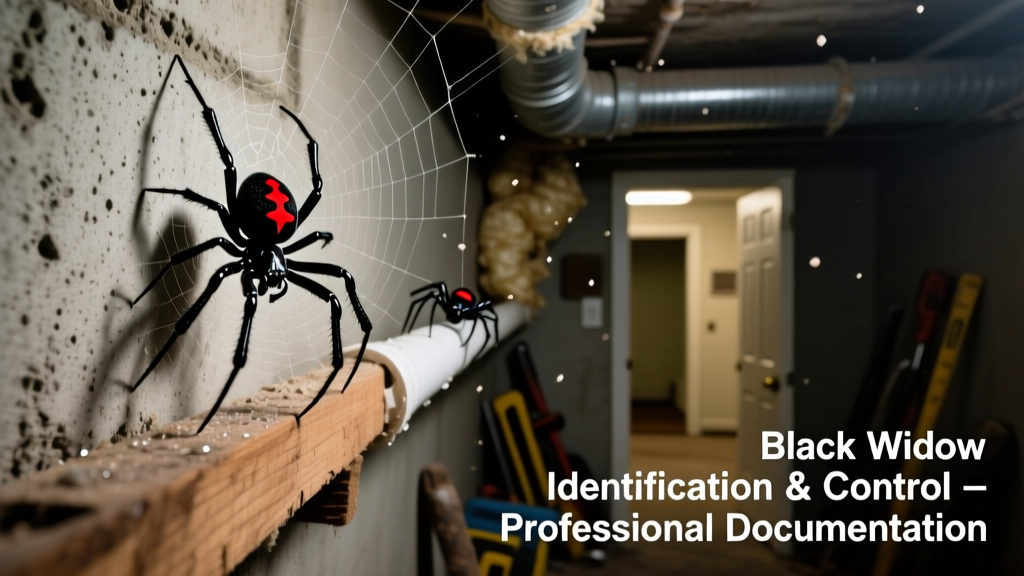
Black widow spiders (Latrodectus spp.) are among the most medically significant spiders in North America—and basements are their favorite urban habitat. Their venom contains neurotoxins that can cause severe muscle pain, nausea, and hypertension in humans, especially children and the elderly. According to the American Association of Poison Control Centers’ 2022 annual report, black widow bites accounted for 1,842 human exposures—nearly 70% of which occurred indoors, with basements and crawl spaces cited as top locations.
Identification
Black widows are easily mistaken for harmless house spiders—until you spot the telltale hourglass. Adult females are glossy black, about 1/2 inch long (not counting legs), with a rounded abdomen and the iconic red or orange hourglass marking on the underside. Males are smaller (¼ inch), lighter in color, and rarely bite. Juveniles have striped or spotted abdomens and may lack the full hourglass until maturity.
Look for irregular, tangled webs in undisturbed corners, behind stored boxes, under shelves, or near foundation cracks—not high on walls like orb weavers. You’ll often find egg sacs: smooth, pear-shaped, off-white orbs about ⅓ inch wide, each holding 200–400 eggs.
| Feature | Black Widow | House Spider | Cellar Spider |
|---|---|---|---|
| Size (body) | ½ inch (female) | ¼–⅜ inch | ¼ inch + long legs |
| Color | Glossy black, red hourglass | Brown, mottled | Pale yellow to gray |
| Web location | Low, hidden, ground-level | High corners, windows | Damp ceilings, pipes |
| Bite risk | Medically serious | Minor irritation | Non-venomous to humans |
What Attracts Them
Black widows don’t seek out humans—they seek shelter, prey, and stable microclimates. Basements offer all three: consistent cool temperatures (60–75°F), high humidity (especially near sump pumps or leaky pipes), cluttered storage (cardboard boxes, old furniture), and abundant insect prey like crickets, silverfish, and earwigs.
- Cracks in foundation walls or floor joints (as narrow as 1/16 inch)
- Unsealed utility penetrations (pipes, wires, vents)
- Cardboard boxes stacked directly on concrete floors
- Cluttered shelving units with minimal airflow
- Moisture from poor drainage or condensation on cold walls
Treatment Methods
Natural Removal
Start non-chemically—especially if children or pets frequent the basement. Vacuuming is highly effective: use a shop vac with a hose attachment and discard the bag or contents immediately outdoors. Sticky traps (placed along baseboards and behind furniture) catch wandering spiders and help monitor activity. Diatomaceous earth (food-grade) applied in thin lines along cracks and corners dehydrates spiders on contact—but reapply after any moisture exposure.
According to the University of California Statewide IPM Program’s 2023 guidelines, vacuuming followed by sealing entry points reduces black widow populations by up to 85% within two weeks when done consistently.
Chemical Options
If infestation is confirmed (≥5 spiders or egg sacs in one week), targeted chemical treatment may be necessary. Use pyrethroid-based aerosols (e.g., cyfluthrin or deltamethrin) labeled for indoor spider control—spray only into cracks, crevices, and behind objects. Avoid broadcast spraying; it’s ineffective and increases resistance risk. Never apply near sump pumps, drains, or HVAC intakes. Always wear gloves and an N95 mask during application.
- Apply at dusk—black widows are most active then
- Retreat every 3 weeks for 2 cycles if live spiders persist
- Discard used PPE and wash hands thoroughly
Prevention
Long-term control means making your basement inhospitable. Reduce humidity below 50% using a dehumidifier—black widows avoid dry air. Store items in sealed plastic bins instead of cardboard. Elevate boxes at least 6 inches off the floor using pallets or shelving. Seal all foundation cracks with hydraulic cement or expanding polyurethane foam—not caulk alone.
Install door sweeps and replace damaged window screens. Trim shrubbery and mulch at least 18 inches away from basement walls to eliminate bridge habitats. The U.S. EPA estimates that 60% of successful spider prevention hinges on structural exclusion—not pesticides.
"A single unsealed ⅛-inch gap under a basement door can allow dozens of black widows to enter over a season—sealing is non-negotiable." — Dr. Lena Cho, Entomologist, Rutgers Cooperative Extension, 2022
When to Call an Exterminator
Call a licensed pest management professional if you’ve found more than 10 adult black widows in one month, discovered egg sacs in multiple rooms, or experienced a confirmed bite. Also consult one if DIY efforts haven’t reduced sightings after 3 weeks—or if you’re uncomfortable handling venomous spiders. Reputable companies will inspect for entry points, treat only targeted zones, and provide a written exclusion plan.
Can black widows climb walls?
Yes—but they prefer horizontal surfaces and low-height hiding spots. They rarely build webs above waist level in basements, unlike common house spiders. If you see many high-up webs, it’s likely another species.
Do black widows live in groups?
No. They are solitary and cannibalistic—females may eat males after mating, and juveniles disperse quickly. Multiple sightings usually indicate several entry points, not a colony.
Are baby black widows dangerous?
Yes. Spiderlings have venom from day one, though their small fangs rarely penetrate human skin deeply. Still, handle with caution—especially around bare feet or hands.
How long do black widows live in basements?
Females survive 1–3 years indoors with stable conditions; males live only 3–4 months. A single female can produce 4–9 egg sacs per season—so early detection matters.
Will bleach kill black widow spiders?
Bleach may kill on contact but offers no residual effect and damages concrete, metal, and wiring. It’s not labeled for spider control and poses inhalation risks in enclosed basements. Skip it—use proven methods instead.
Can I relocate a black widow outside?
Technically yes—but strongly discouraged. Handling increases bite risk, and relocated spiders often return or die from stress/exposure. Vacuum-and-discard is safer and more humane.
Basements shouldn’t feel like a wildlife refuge—and they don’t have to be. With careful inspection, smart exclusion, and timely intervention, black widow activity drops sharply within days. For related concerns, see our guides on silverfish in basement and mouse-proofing basement—both pests that share the same damp, cluttered conditions black widows exploit.