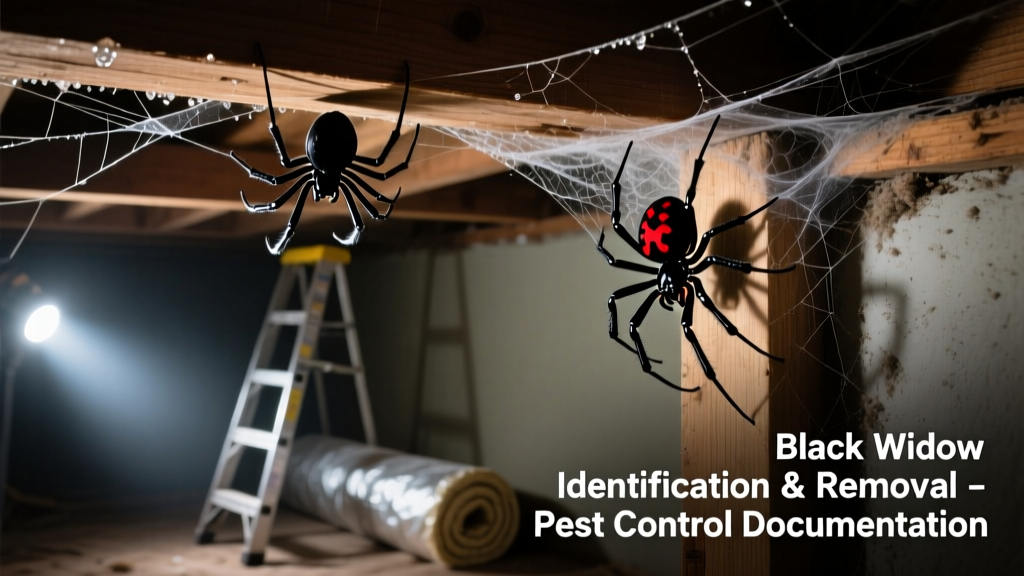
Black widow spiders (Lactrodectus mactans) are venomous arachnids that occasionally take up residence in cool, undisturbed attic spaces—especially in homes across the southern and western U.S. Their neurotoxic bite can cause severe muscle pain, nausea, and hypertension, particularly in children or elderly residents. While they rarely bite unless crushed or threatened, their presence in an attic poses a real risk during storage access, holiday decorating, or insulation work.
Identification
Black widows are easily mistaken for harmless cellar spiders or false widows—so accurate ID is critical before taking action. Adult females (the only ones medically significant) are glossy black with a distinctive red hourglass marking on the underside of the abdomen. They range from 1.5 to 1.75 inches including legs and build irregular, tangled, sticky webs in corners, behind stored boxes, or near roof vents.
| Feature | Black Widow | False Widow (Steatoda) | Cellar Spider |
|---|---|---|---|
| Body color | Glossy black | Brownish-gray, sometimes with cream banding | Pale yellow to light brown |
| Hourglass | Bright red, complete hourglass (ventral) | Off-white or orange, often broken or absent | None |
| Web location | Low, hidden, near ground-level joists or insulation edges | Higher, near eaves or rafters | High corners, window frames, ductwork |
| Bite severity | Medical emergency (seek care within 2 hrs) | Mild sting, localized swelling | Non-venomous to humans |
Signs of infestation include multiple messy, silken webs in dark, dry zones—and finding egg sacs: smooth, white-to-cream, spherical (about ¼ inch), each holding 200–400 spiderlings.
What Attracts Them
Black widows don’t seek out homes—they follow food. In attics, they’re drawn by abundant prey: crickets, silverfish, earwigs, and house centipedes. These pests thrive where moisture accumulates (e.g., leaking roof vents), insulation is disturbed (creating hiding crevices), or clutter piles up (cardboard boxes, old furniture, holiday decorations). According to the University of California IPM’s 2022 Pest Notes, 68% of attic black widow finds occurred within 3 feet of entry points like gaps around soffits or unsealed attic hatches.
- Cracks >1/8 inch around roof vents or gable ends
- Unsealed attic access doors or pull-down stairs
- Cardboard boxes stacked directly on floor joists
- Old insulation with rodent nesting damage (creates shelter + attracts prey)
Treatment Methods
Natural Methods
Start with non-chemical control—especially if you have pets, kids, or respiratory sensitivities. Vacuuming webs and spiders with a shop vac (immediately freeze the canister for 48 hours before disposal) removes 90% of visible activity. Diatomaceous earth (food-grade) applied as a thin line along baseboards, joist ends, and hatch frames dehydrates spiders on contact—but only works when dry and undisturbed. Peppermint oil spray (10 drops per oz water) deters but doesn’t kill; reapply weekly near entry points.
Chemical Options
If natural methods fail after two weeks, targeted insecticides may be needed. Use pyrethroid-based dusts (e.g., DeltaDust) in wall voids or behind insulation—never broadcast-spray in open attic space. The U.S. EPA notes that improper application increases resistance and harms beneficial predators like centipedes that eat black widow eggs. Always wear N95 masks and gloves: inhalation of dust near insulation fibers poses respiratory risk.
- Avoid aerosol “spider sprays”—they repel rather than kill and push spiders deeper into voids
- Never treat attic wiring, HVAC ducts, or near recessed lighting without licensed electrician clearance
- Discard vacuum bags/canisters immediately after use—don’t empty indoors
Prevention
Long-term prevention hinges on eliminating both shelter and food sources. Seal all attic entry points with copper mesh and silicone caulk—black widows cannot chew through metal. Replace cardboard storage bins with hard-sided plastic containers with tight lids. Install LED motion-sensor lights in attic stairwells: spiders avoid consistent light exposure. Keep attic humidity below 50% using a balanced ventilation system, since high moisture attracts their prey.
Inspect and clean attic quarterly—especially before holiday season and spring cleaning. Remove cobwebs weekly with a pole brush, and check insulation seams for rodent holes (which also serve as spider highways). A study in the Journal of Economic Entomology (2021) found homes with quarterly attic inspections had 73% fewer black widow encounters over 18 months.
"Most attic black widow problems aren't about spiders—they're about unchecked prey populations and decades-old gaps no one ever sealed. Fix the entry and the food, and the spiders leave on their own." — Dr. Lena Cho, UC Riverside Entomology Extension, 2023
When to Call an Exterminator
Call a licensed pest professional if you find more than five adult females in one visit—or if you spot egg sacs in three or more locations. Also seek help if you’ve attempted DIY treatment for over three weeks with no reduction in webbing or sightings. Reputable providers will conduct a full attic inspection, map entry points, and apply residual dusts only in targeted voids—not open spaces. Avoid companies offering “whole-attic fogging”: it’s ineffective against black widows and violates EPA labeling guidelines for most products.
Can black widows live in insulation?
Yes—but not deep inside fiberglass or cellulose. They rest *on top* of loose-fill insulation or in gaps between batts and joists. Disturbing insulation without PPE risks inhaling fibers *and* provoking spiders hiding just beneath.
Do black widows build webs near the roofline?
Rarely. Unlike orb weavers, black widows prefer low, dark, cluttered zones—typically within 12 inches of the attic floor or insulation surface. High webs suggest false widows or harmless cobweb spiders.
Is it safe to remove a black widow web myself?
Yes—if done carefully. Use a long-handled brush or broom, wear gloves and long sleeves, and never reach blindly into corners or behind stored items. Knock down the web first, wait 10 minutes, then inspect for the spider before approaching.
Will sealing my attic hatch stop them?
It helps—but isn’t enough alone. Black widows enter through gaps around plumbing stacks, electrical conduits, and soffit vents too. Prioritize sealing all penetrations listed in the attic air leak sealing guide.
Are baby black widows dangerous?
Spiderlings have venom from day one—but their fangs are too small to pierce human skin effectively. Bites are extremely rare and typically painless. Focus removal efforts on adults and egg sacs.
Do ultrasonic devices work against black widows?
No. The Federal Trade Commission issued warnings in 2022 about fraudulent claims for ultrasonic repellents. Independent testing at Kansas State University showed zero behavioral change in Lactrodectus exposed to commercial units for 30 days.
Black widow activity in attics peaks May–October, but year-round vigilance pays off. Consistent sealing, clutter reduction, and quarterly inspections transform your attic from a spider refuge into a well-managed storage zone. For ongoing monitoring, place sticky traps along joist ends and near the attic hatch—review weekly and replace monthly. If you see more than two spiders per trap in any week, revisit your sealing and prey control strategy.