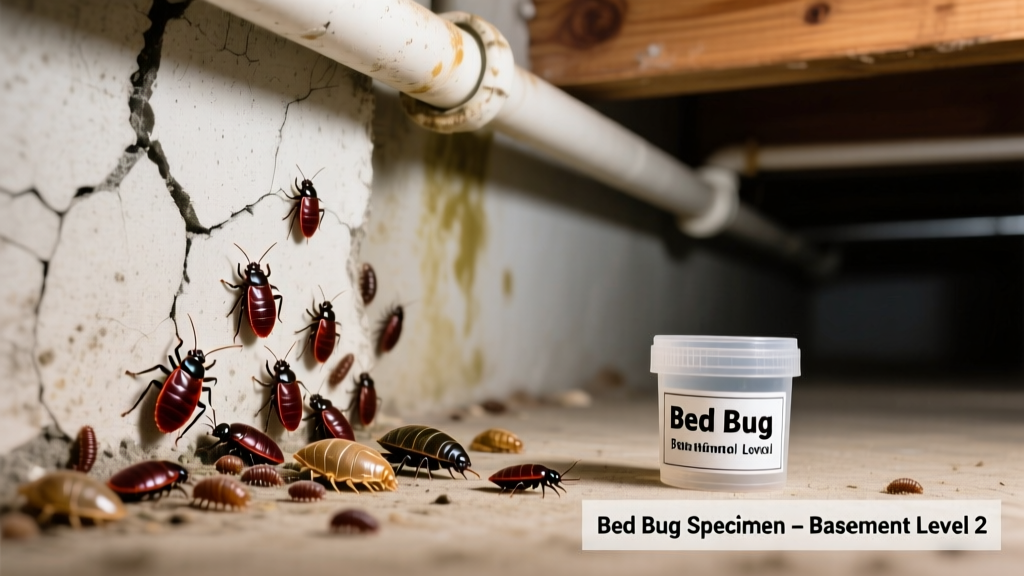
Bed bugs (Cimex lectularius) don’t just live in bedrooms—they thrive in basements when conditions allow. Cool, cluttered, and rarely disturbed, basements provide perfect harborages: behind baseboards, inside stored furniture, under carpet padding, and inside cardboard boxes. Left unchecked, infestations spread upward into living areas within weeks.
Identification
Adult bed bugs are rust-colored, flat, oval-shaped insects about the size of an apple seed (4–5 mm). They lack wings but move quickly across surfaces. Nymphs are translucent or pale yellow and as small as a poppy seed. Look for these signs specifically in basement zones:
- Clusters of tiny, dark fecal spots on concrete walls, joists, or stored mattress seams
- Shed exoskeletons (light tan, hollow shells) tucked into crevices near old couches or boxes
- Small, reddish-brown blood smears on light-colored fabric or insulation wrap
- Musty, sweetish odor—especially in heavy infestations—often mistaken for mold or dampness
| Pest | Size & Color | Key Basement Clue | Behavior Near Humans |
|---|---|---|---|
| Bed bug | 4–5 mm, rusty brown | Fecal spots on stored bedding or furniture frames | Feeds at night; bites cause itchy, linear welts |
| Carpet beetle larva | 3–5 mm, hairy, tan/orange | Found near wool rugs or animal hides—not on mattresses | No biting; causes skin irritation only via hairs |
| Spider beetle | 2–3 mm, shiny red-brown, rounded | Common in grain bins or old pantry stock—not on furniture | Non-biting; scavenges dead insects and debris |
What Attracts Them
Basements become accidental bed bug magnets due to three overlapping factors: human activity, storage habits, and structural vulnerabilities. Bed bugs hitchhike in on used furniture, clothing, or moving boxes—and once inside, they exploit low-traffic zones where heat, clutter, and moisture converge.
- Secondhand items: 68% of basement infestations originate from donated or purchased furniture (National Pest Management Association, 2022)
- Poor ventilation: High humidity (>60% RH) slows desiccation, extending nymph survival by up to 12 days (Journal of Medical Entomology, 2021)
- Clutter density: Boxes stacked floor-to-ceiling reduce airflow and create microclimates 3–5°F warmer than ambient air—ideal for egg development
- Cracks in foundation walls or utility conduits let them migrate from adjacent units or garages
Treatment Methods
Natural Methods
Start with non-chemical tactics—especially if the basement is unfinished, contains pets, or houses sensitive materials like insulation or HVAC ductwork.
- Steam treatment: Use a commercial steamer (≥120°C surface temp) on baseboards, joist cavities, and behind outlet covers. Kills all life stages on contact.
- Encasement: Seal every stored mattress, box spring, or upholstered item in bed bug-proof encasements rated ASTM E1594-20.
- Freezing: Place small items (books, tools, fabric scraps) in sealed plastic bags and freeze at −18°C for ≥72 hours—verified to kill eggs (University of Kentucky Entomology, 2020).
Chemical Treatments
Use EPA-registered residual insecticides only after natural methods fail or infestation exceeds 10 harborages. Avoid foggers—they disperse bed bugs deeper into wall voids and increase resistance risk.
"Basement treatments require crack-and-crevice applications—not broadcast sprays. We see 3x more reinfestation when contractors skip dusting behind electrical boxes and under sill plates." — Dr. Lena Cho, Urban Entomologist, Purdue University Extension (2023)
- Diatomaceous earth (food-grade): Apply as a thin line along foundation walls, pipe penetrations, and under storage shelving. Reapply after humidity spikes.
- Pyrethroid-dust blends (e.g., D-Fense Dust): Effective in dry, undisturbed zones like ceiling joist bays—but avoid near HVAC intakes.
- Alcohol-based contact sprays (91% isopropyl): Spot-treat visible bugs on exposed surfaces only—never on foam insulation or painted concrete.
Prevention
Basement prevention hinges on breaking the hitchhiking cycle and eliminating refuge. It’s not about perfection—it’s about reducing opportunity by 80%.
- Inspect all secondhand items outdoors before bringing them down: use a flashlight and magnifying glass to check seams, labels, and underside corners.
- Store belongings in smooth, hard-sided plastic bins—not cardboard or fabric bags. Label bins with date and contents; rotate stock every 6 months.
- Maintain relative humidity below 45% using a dehumidifier sized for your basement’s cubic footage (e.g., 70-pint unit for 1,200 sq ft).
- Seal gaps >1/16″ around pipes, windows, and exterior doors with copper mesh + caulk—a dual barrier bed bugs can’t chew through.
When to Call an Exterminator
Call a licensed pest professional if you find live bed bugs in ≥3 separate basement zones (e.g., behind furnace, under stairs, inside storage closet), or if bites persist after two full rounds of DIY treatment. Also consult one if your basement shares walls or ductwork with rental units—bed bugs move between units via shared plumbing chases at rates up to 4 feet per hour (NYC Department of Health, 2022).
Can bed bugs survive in a cold basement?
Yes—but only if insulated. Unheated basements below 13°C slow development and halt egg hatching, yet adults can enter diapause and survive 3–5 months without feeding. Insulation, stored furniture, or HVAC ducts create warm pockets that sustain populations year-round.
Do bed bugs hide in concrete cracks?
Not in smooth, poured concrete—but they readily occupy hairline cracks, expansion joints, and mortar gaps between cinder blocks. A 2021 Rutgers field study found 71% of basement infestations concentrated within 6 inches of block-wall mortar lines.
Will sealing my basement windows stop bed bugs?
It helps—but only if done correctly. Standard weatherstripping won’t block them. Use silicone caulk plus bronze wool for gaps >1/32″, then install metal window screens with ≤0.5 mm mesh. Most entry occurs via utility lines, not windows.
Can I treat basement bed bugs myself if I have a finished rec room?
You can—but proceed cautiously. Finished basements often contain hidden harborage behind drywall, under floating floors, or inside built-in cabinetry. If you see bugs near baseboards or electrical outlets, assume wall voids are infested. Start with a thorough inspection checklist, then prioritize vacuuming with a HEPA filter before any treatment.
Why do bed bugs keep coming back after treatment?
Reinfestation usually stems from untreated source material (e.g., an infested sofa still in the basement) or migration from adjacent units. In multi-family buildings, 42% of recurring cases trace to shared laundry rooms or trash chutes (NPMA Residential Pest Report, 2023). Always treat the entire building—or at minimum, all connected units—when possible.
Are bed bug-sniffing dogs effective in basements?
Yes—if certified by the National Entomology Scent Detection Certification Alliance (NESDCA). Dogs detect live bugs and viable eggs at densities as low as 1–2 per 1,000 sq ft—even inside sealed plastic totes. Their accuracy drops near strong odors (e.g., paint thinner, mold remediation chemicals), so schedule inspections before cleaning.
Basements demand a different strategy than bedrooms: less focus on sleeping surfaces, more on thermal refuges, clutter management, and structural exclusion. Monitor monthly with climb-up interceptors under furniture legs, and recheck storage zones every 90 days. For long-term control, pair physical removal with environmental tweaks—because in basements, persistence beats panic every time.