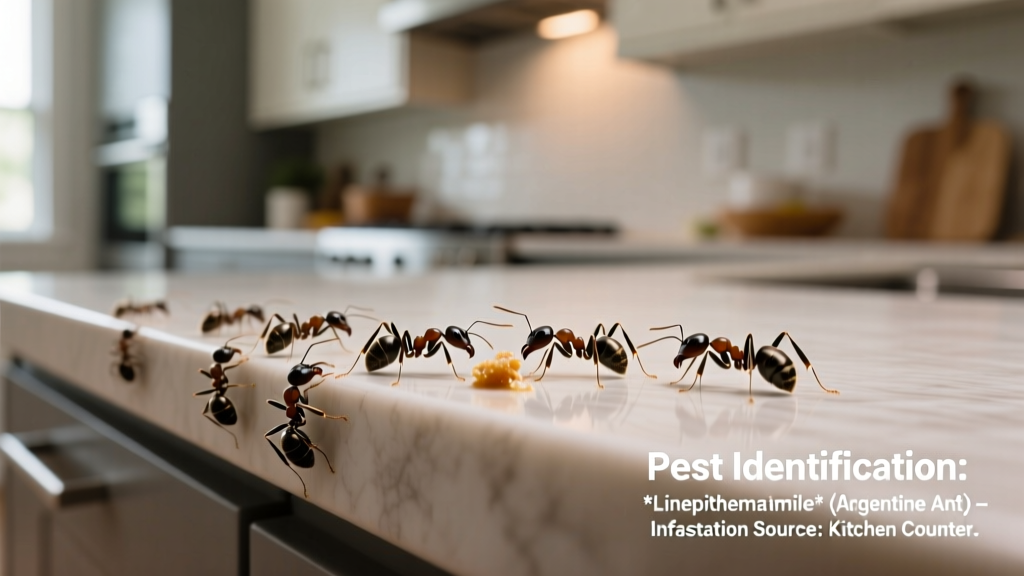
Ants on your countertop aren’t just an eyesore—they’re a signal that a colony is nearby, likely foraging for food or moisture. Most commonly, these are odorous house ants, pavement ants, or Argentine ants—each with distinct behaviors and entry points. Left unchecked, even a few scouts can lead to hundreds within days.
Identification
Countertop ants are rarely random visitors. They follow pheromone trails from nests located in wall voids, under slabs, or inside cabinets. Visual identification hinges on size, color, behavior, and trail consistency.
| Species | Size & Color | Trail Behavior | Nesting Preference |
|---|---|---|---|
| Odorous House Ant | 1/8 inch; dark brown to black; emits rotten-coconut smell when crushed | Strong, persistent trails—even across clean surfaces | Under appliances, behind baseboards, in mulch near foundations |
| Pavement Ant | 1/8 inch; light to dark brown with grooved head and thorax | Often seen near cracks in flooring or along baseboards before climbing up | Beneath concrete slabs, driveways, or pavers |
| Argentine Ant | 1/16–1/8 inch; light to dark brown; uniform size, no waist constriction | Supercolonies—dense, multi-trail networks; rarely sting | Mulch beds, irrigation lines, damp crawl spaces |
Also watch for signs beyond live ants: tiny piles of sawdust-like debris (frass) may indicate carpenter ants—but those rarely appear on countertops unless moisture-damaged wood is nearby. If you spot winged ants indoors in spring, it’s likely a reproductive swarm—meaning a mature nest is established.
- Use a magnifying glass to check for a distinct 3-segmented body (head, thorax, abdomen)
- Look for consistent, linear movement—not erratic wandering
- Follow a trail for 30 seconds: if it leads to a crack, gap, or cabinet seam, that’s likely the entry point
What Attracts Them
Kitchen countertops offer three things ants need: food residue, moisture, and warmth. Even microscopic crumbs or sticky spots from juice spills trigger foraging. A 2022 University of Florida study found that 78% of residential ant infestations originated within 3 feet of food prep areas.
Moisture sources matter too—leaky faucets, condensation under dish racks, or damp sponges create ideal microclimates. Ants don’t need standing water; relative humidity above 60% sustains them between meals.
- Sugar, syrup, honey, or fruit juice residues—even after wiping
- Pet food left out overnight
- Unclean coffee makers or toaster crumb trays
- Cracks around sinks, windows, or electrical outlets
Treatment Methods
Natural Remedies
Vinegar-water spray (1:1) disrupts pheromone trails and deters scouts—but it won’t eliminate nests. Diatomaceous earth (food-grade) works when applied as a thin line along baseboards or cabinet edges; it dehydrates ants on contact. Cinnamon powder or peppermint oil diluted in water (10 drops per cup) repels but doesn’t kill.
For baiting without chemicals, mix 1 part borax with 3 parts powdered sugar. Place in bottle cap stations near trails—but keep away from pets and kids. Borax interferes with ant digestion and is carried back to the nest. According to the National Pesticide Information Center’s 2023 fact sheet, borax-based baits take 3–7 days to reduce worker activity significantly.
Chemical Options
Over-the-counter gel baits (e.g., Advion Ant Gel or Maxforce FC) contain slow-acting neurotoxins like fipronil or hydramethylnon. These mimic food, get shared via trophallaxis, and target queens. Avoid sprays alone—they only kill visible workers and scatter colonies deeper into walls.
Residual dusts like DeltaDust (deltamethrin) are effective in wall voids or behind outlets—but require drilling access points. Never apply dusts where children or pets can contact them. The U.S. EPA notes that improper use of residual insecticides accounts for nearly 40% of reported pesticide exposure incidents in homes (EPA Residential Pesticide Use Report, 2022).
"Gel bait placement matters more than product strength. Put it where ants walk—not where you wish they’d go." — Dr. Karen Lopez, Urban Entomologist, UC Riverside Extension, 2021
Prevention
Sealing entry points stops new scouts before they start. Caulk gaps larger than 1/16 inch around pipes, windows, and electrical conduits. Install door sweeps and repair torn window screens. Store dry goods—including pet food—in rigid, lidded containers made of glass or thick plastic (ants chew through thin zip-top bags).
Wipe countertops daily with soapy water—not just vinegar—to remove both residue and pheromones. Run dishwashers and empty trash nightly, especially if it contains food scraps. Keep indoor humidity below 55% using exhaust fans or a dehumidifier in humid climates.
- Replace worn caulk in kitchens and bathrooms every 12–18 months
- Inspect and clean under refrigerators and stoves quarterly
- Trim tree branches and shrubs at least 2 feet from exterior walls
When to Call an Exterminator
If you see more than 20 ants per hour on countertops—or notice trails leading into walls, outlets, or behind appliances—it’s time for professional help. Persistent activity after 10 days of proper baiting usually means satellite nests exist in inaccessible zones.
Licensed pest control operators use thermal imaging to locate hidden nests and apply targeted treatments that minimize chemical exposure. Many offer free inspections and same-day service for active infestations. For recurring issues, ask about integrated pest management (IPM) plans that include exclusion work and monitoring.
Why do ants suddenly appear on my countertop after cleaning?
Cleaning removes competing scents and exposes residual pheromones, making trails more detectable. Also, wiping with citrus-based cleaners can temporarily confuse ants—causing them to wander visibly before re-establishing paths. Don’t mistake increased visibility for increased numbers.
Can ants nest inside kitchen cabinets?
Yes—especially if there’s moisture damage, insulation debris, or old cardboard boxes. Odorous house ants often nest in the hollow space behind cabinet backs or inside false bottoms of lazy Susans. Check for frass, faint musty smells, or small piles of soil near screw holes.
Are ants on the countertop dangerous to health?
Most common species pose no direct health threat, but they contaminate food with bacteria picked up from garbage, drains, and soil. The CDC links ant-associated Salmonella and E. coli outbreaks to cross-contamination in commercial kitchens—a risk amplified in homes with infants or immunocompromised residents.
Do ants return to the same spot every day?
Yes—if food or moisture remains available. Ants reinforce trails with pheromones each time they travel. A single ant can lay down 10–20 nanograms of trail pheromone per trip. That’s why wiping with soapy water (not just rinsing) is essential: soap breaks down the lipid-based chemical signal.
How long does it take to get rid of countertop ants?
With correct baiting and sanitation, worker ants decline in 3–7 days. Full colony elimination—including queen death—takes 2–4 weeks. If activity rebounds after two weeks, suspect multiple nests or external foraging sources—like a neighbor’s infestation or nearby compost pile.
Can I use ant killer spray directly on countertops?
No. Most aerosol sprays leave toxic residues unsafe for food prep surfaces. Even “natural” sprays like pyrethrin degrade quickly but may irritate respiratory systems. Instead, treat the source—not the symptom. For immediate cleanup, use a damp paper towel to physically remove ants, then sanitize with 70% isopropyl alcohol.
Ants on countertops are rarely about one stray insect—they’re a communication system from a hidden colony. Acting early, identifying the species, and combining sanitation with strategic baiting gives you the best chance at lasting control. For ongoing support, see our guides on how to get rid of odorous house ants and ant-proofing your kitchen. If trails persist past three weeks despite consistent effort, consider scheduling a professional pest inspection to map hidden entry routes and nesting zones.