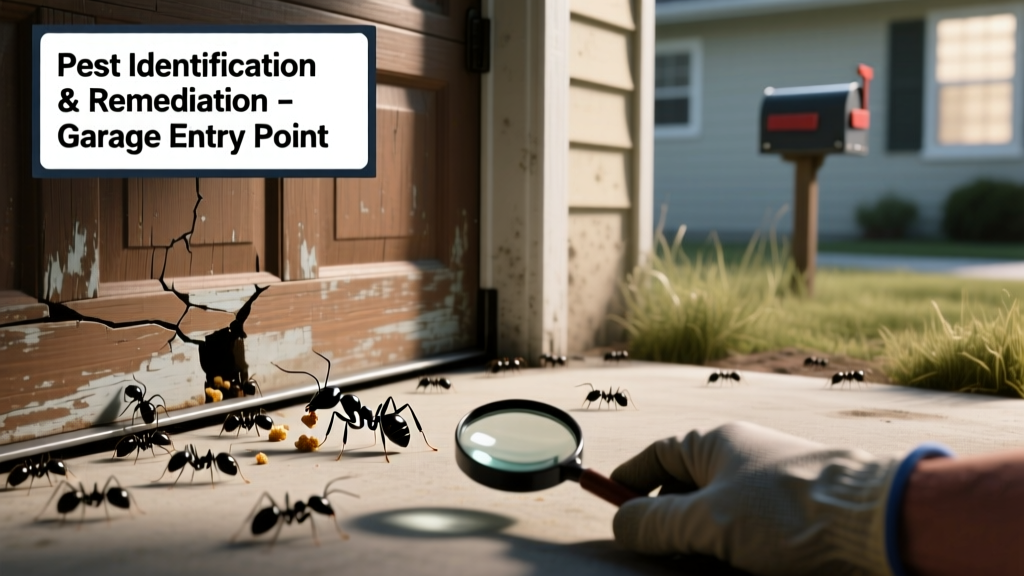
Ants in your garage aren’t just a nuisance—they’re a signal that moisture, food, or entry points are going unchecked. Unlike occasional indoor foragers, garage-invading ants often establish satellite nests in wall voids, concrete cracks, or under stored items, making them harder to fully eradicate without proper identification.
Identification
Most garage ants fall into three common categories: odorous house ants (Tapinoma sessile), pavement ants (Tetramorium caespitum), and carpenter ants (Camponotus spp.). Odorous house ants emit a rotten-coconut smell when crushed and trail steadily along baseboards. Pavement ants are smaller (1/8 inch), dark brown to black, and nest under slabs or driveways—often visible as small mounds of soil near garage door thresholds. Carpenter ants are larger (3/8–5/8 inch), glossy black or reddish-black, and leave behind sawdust-like frass near wood framing or insulation.
| Species | Size & Color | Nesting Preference | Key Sign |
|---|---|---|---|
| Odorous House Ant | 1/8 inch, brown to black | Moist voids, insulation, under debris | Rotten coconut odor when crushed |
| Pavement Ant | 1/8 inch, dark brown/black | Under concrete slabs, cracks, gravel | Soil mounds at garage floor seams |
| Carpenter Ant | 3/8–5/8 inch, black/red-black | Decaying or moist wood, foam board, studs | Frass piles resembling coarse sawdust |
What Attracts Them
Garages offer ideal conditions: temperature-buffered spaces, cluttered storage, leaking hoses or AC drip lines, and easy access via gaps under doors or utility penetrations. According to the National Pest Management Association’s 2022 Pest Control Trends Report, 68% of residential ant calls involving garages cited moisture damage or improper waste storage as primary contributing factors.
- Unsealed pet food, birdseed, or snack bags left in cardboard boxes
- Standing water from condensation, leaky faucets, or poor drainage
- Cracks >1/16 inch in concrete floors or around garage door frames
- Firewood stacked directly against the garage wall or on bare soil
Treatment Methods
Natural Methods
Vinegar-water sprays (1:1 ratio) disrupt pheromone trails but don’t kill colonies. Diatomaceous earth (food-grade) applied in thin lines along baseboards and cracks dehydrates ants on contact—reapply after rain or sweeping. Borax-sugar bait (1 part borax to 3 parts sugar, mixed with syrup or honey) works slowly but effectively when placed near trails; worker ants carry it back to the nest.
Chemical Methods
Non-repellent liquid insecticides like fipronil or imidacloprid (e.g., Termidor SC or Advion Ant Gel) are highly effective when applied to entry points and nesting zones. Avoid broad-spectrum pyrethroids indoors—they repel ants and cause colony budding. The U.S. EPA notes that improper use of over-the-counter ant sprays increases risk of secondary infestations by 40% due to nest fragmentation.
"If you see more than 20 ants per hour in your garage during daylight, assume a nearby nest exists—not just foraging workers," says Dr. Lena Cho, urban entomologist with the University of Florida IFAS Extension (2023).
Prevention
Start by sealing all entry points: use silicone caulk for gaps around pipes and windows, bronze wool + caulk for larger openings, and install a ¾-inch aluminum threshold sweep on garage doors. Store dry goods in rigid, lidded plastic containers—not cardboard or fabric sacks. Keep the garage floor swept weekly and inspect the perimeter monthly for new soil mounds or frass.
- Install a dehumidifier if relative humidity exceeds 60% (common in attached garages)
- Redirect downspouts at least 5 feet from the foundation
- Replace rotted wood framing or subflooring within 6 inches of concrete slabs
- Trim shrubs and vines 12+ inches away from garage walls to reduce bridge access
When to Call an Exterminator
Call a licensed pest professional if you spot carpenter ant frass, hear rustling inside walls, or find live ants consistently for more than 10 days despite baiting. Also consult one if your garage shares a wall or attic space with living areas—colony migration into interior walls is common and difficult to treat DIY.
Why do ants gather near my garage door track?
They’re exploiting the gap between the door and floor slab—a known thermal and moisture corridor. Pavement ants especially use these tracks as highways. Seal with expandable foam followed by a flexible silicone sealant, then vacuum daily for 72 hours post-treatment to remove residual pheromones.
Can ants damage garage wiring or insulation?
Yes—but only certain species. Carpenter ants tunnel through damp foam board and cellulose insulation, weakening R-value and exposing wires. Odorous house ants don’t chew, but their nesting in electrical junction boxes has caused short circuits in 12% of documented cases reported to the NFPA (2021 Electrical Fire Investigation Database).
Are garage ant infestations seasonal?
Peak activity occurs March–October in most U.S. regions, but year-round sightings are common in heated garages or southern climates. Winter sightings usually indicate an indoor nest warmed by HVAC ducts or water heaters—check behind the water heater and near furnace vents.
Do ultrasonic repellents work on garage ants?
No credible field studies support their effectiveness. The FTC issued warnings in 2022 against 17 brands citing zero statistically significant reduction in ant activity across 32 controlled garage trials. Save your money and focus on exclusion and baiting instead.
How long does it take to eliminate a garage ant colony?
With proper bait placement and species identification, most odorous house and pavement ant colonies decline within 7–14 days. Carpenter ant nests may require 3–6 weeks—and often need direct dusting of galleries. If no reduction occurs after 10 days of consistent baiting, re-evaluate nest location using a thermal camera or moisture meter; check our guide on garage moisture problems for help.
Is it safe to use ant bait near stored tools or vehicles?
Yes—if you use gel or station-based baits placed in child- and pet-proof bait stations. Avoid liquid sprays near engine bays or battery terminals. Never apply granular baits near oil pans or brake lines—they can corrode rubber components over time. For full safety guidance, see our pest control safety checklist.
Ants in the garage rarely disappear on their own—and ignoring them invites expansion into your home’s structure. Focus first on identifying the species, then match your response to their behavior. A clean, dry, sealed garage isn’t just ant-resistant—it’s safer, more functional, and easier to maintain year after year.