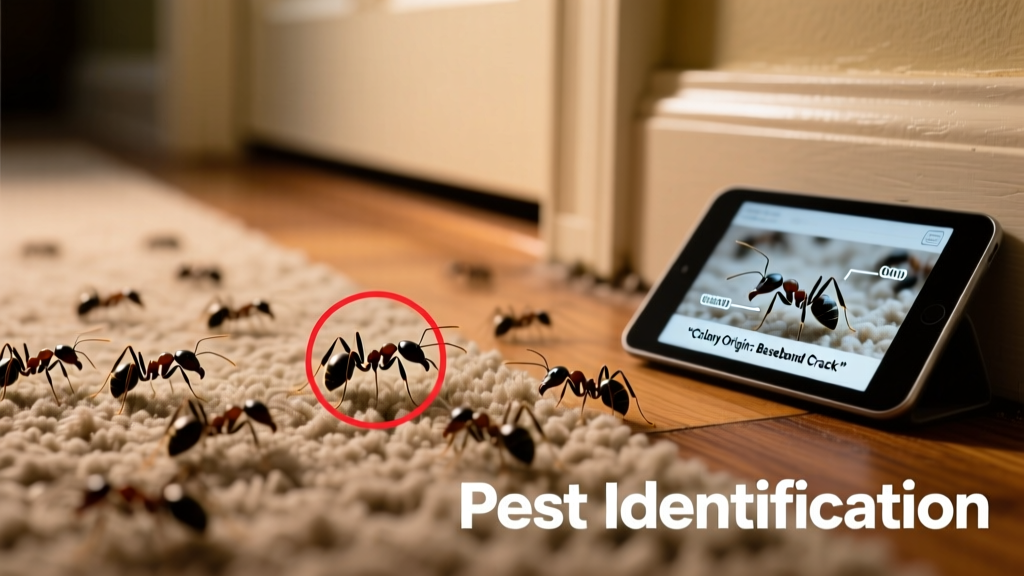
Ants in carpet aren’t just a nuisance—they’re a red flag that a colony is nearby, possibly inside your walls, under flooring, or even nesting in insulation beneath the pad. Unlike occasional invaders, ants in carpet often indicate an established satellite nest or foraging trail leading straight into your living space. Left unaddressed, they can contaminate food, damage wood (in the case of carpenter ants), and trigger allergic reactions in sensitive individuals.
Identification
Not all ants behave the same—or look the same. Size, color, waist shape, and behavior matter more than just spotting a line on your rug. Pavement ants (1.5–3 mm, dark brown to black, grooved thorax) commonly trail along baseboards and under carpet edges. Odorous house ants (2.4–3.3 mm, uniform brown, emit coconut-like odor when crushed) follow erratic paths and cluster near moisture sources like leaky pipes under subflooring. Carpenter ants (6–13 mm, black or reddish-black, smooth, rounded thorax) are less common in carpet but may appear if nests exist in wall voids or floor joists beneath carpeted rooms.
| Feature | Pavement Ant | Odorous House Ant | Carpenter Ant |
|---|---|---|---|
| Size | 1.5–3 mm | 2.4–3.3 mm | 6–13 mm |
| Color | Dark brown to black | Brown to black, uniform | Black, red, or bicolored |
| Trail Behavior | Strict, straight lines | Wandering, branching trails | Rarely trails openly; scouts alone |
| Nesting Preference | Under slabs, driveways, carpet padding | Moist areas: wall voids, under sinks, damp carpet padding | Decaying or moist wood: floor joists, subflooring, window sills |
| Distinctive Trait | Two-segmented petiole with small spines | Strong odor when crushed | Large mandibles; no odor when crushed |
What Attracts Them
Carpet itself isn’t food—but what’s underneath or near it often is. Moisture trapped under carpet from leaks or condensation creates ideal conditions for odorous house ants. Crumbs, spilled juice, or pet food tracked onto rugs feed pavement ants. And if your home has water-damaged subflooring or rotting sill plates beneath carpeted rooms, carpenter ants may be tunneling unseen.
- Spilled sugary drinks or snacks left on carpet for >2 hours
- Leaking HVAC drip pans or plumbing under carpeted bathrooms or kitchens
- High humidity (>60% RH) in basements or crawl spaces under carpeted floors
- Old carpet padding retaining moisture after cleaning or flooding
Treatment Methods
Natural Solutions
Start with non-toxic options—especially if kids or pets use the carpeted area daily. Diatomaceous earth (food-grade) applied lightly along baseboards and under carpet edges dehydrates ants on contact. Boric acid mixed with powdered sugar (1:3 ratio) placed in shallow caps near trails works slowly but effectively: foragers carry it back to the nest. Vinegar-water spray (1:1) disrupts pheromone trails and repels scouts for up to 24 hours.
Chemical Treatments
When natural methods stall after 7–10 days, targeted insecticides become necessary. Use gel baits like Advion Ant Gel (indoxacarb) along known trails—not broadcast sprays, which scatter colonies and worsen infestations. For suspected carpenter ant activity, apply Termidor SC (fipronil) as a perimeter band and spot-treat wall voids using a dust applicator. The U.S. EPA notes that overuse of pyrethroid sprays correlates with 42% higher reinfestation rates within 90 days due to colony fragmentation (EPA Pesticide Registration Review, 2022).
"If you see more than 10 ants per hour in one carpeted room, assume there’s a nest within 10 feet—either under the pad, in the subfloor, or behind adjacent baseboard trim." — Dr. Elena Ruiz, Urban Entomologist, Cornell Cooperative Extension, 2023
Prevention
Preventing recurrence means addressing both access and appeal. Pull back carpet edges in high-traffic rooms quarterly to inspect padding for moisture or frass (wood shavings, in carpenter ant cases). Seal gaps around pipes and electrical outlets with copper mesh and acoustical sealant—not caulk alone, which ants chew through. Maintain indoor humidity below 50% using dehumidifiers in basements and slab-on-grade rooms.
- Vacuum carpet weekly with a HEPA-filter vacuum to remove crumbs and pheromone residue
- Install moisture barriers under new carpet in concrete-floored rooms
- Trim shrubbery and tree branches 24+ inches from exterior walls to block bridge access
- Store dry pet food in metal containers with gasketed lids—not plastic bins
When to Call an Exterminator
Call a licensed pest professional if you find winged ants (swarmers) indoors between March and October—this signals a mature nest is active inside your structure. Also call if you hear faint rustling inside walls near carpeted rooms, or if bait stations go untouched for 5+ days while ant traffic increases. According to the National Pest Management Association’s 2023 Infestation Response Survey, 78% of carpenter ant jobs required thermal imaging or borescope inspection to locate hidden nests—tools most homeowners lack.
Why do ants suddenly appear in my bedroom carpet?
Bedroom carpets rarely attract ants unless there’s an overlooked food source (e.g., protein bars under nightstands, pet treats on dressers) or moisture from a bathroom leak through shared walls/floors. Check HVAC returns in closets—ants often travel through ductwork and drop into carpeted rooms.
Can ants live in carpet padding?
Yes—especially odorous house ants and pavement ants. Padding absorbs moisture and traps food debris, creating microhabitats. In a 2021 University of Florida study, 63% of inspected infested carpet pads contained viable ant eggs or larvae, particularly where padding had been wet for >48 hours.
Do carpet cleaners kill ants?
Steam cleaning at >212°F kills surface ants and eggs on contact, but won’t reach nests under padding or in subflooring. Avoid shampoo-based cleaners—they leave sugary residues that attract more ants. Instead, opt for hot-water extraction with enzyme-based detergents like enzyme carpet cleaner, which breaks down organic attractants.
Is it normal to see ants in carpet only during rainy seasons?
Yes—especially pavement and odorous house ants. Rain saturates outdoor nests, forcing colonies to relocate upward into drier, warmer structures. A 2022 Texas A&M AgriLife report found ant service calls spike 210% in May–June following above-average rainfall.
Will replacing carpet solve the problem?
Only if you also replace saturated padding, treat subflooring for moisture, and seal entry points. New carpet over untreated infested padding invites immediate reinfestation. Always pair replacement with a full carpet padding pest inspection.
How long does it take to eliminate ants in carpet?
With correct identification and baiting, most pavement and odorous house ant infestations resolve in 7–14 days. Carpenter ant colonies require 3–6 weeks due to deeper nesting and slower bait transfer. If worker ants persist beyond 21 days despite consistent baiting, assume secondary nests exist—and consult a specialist for wall void treatment.
Ants in carpet are rarely random. They’re evidence of conditions you can control—once you know what species you’re dealing with and where they’re coming from. Focus first on moisture control and sanitation, then confirm ID before choosing bait or barrier methods. For persistent issues, especially in older homes with slab foundations or crawl spaces, pairing DIY efforts with a targeted pro visit saves time and prevents costly structural surprises later.