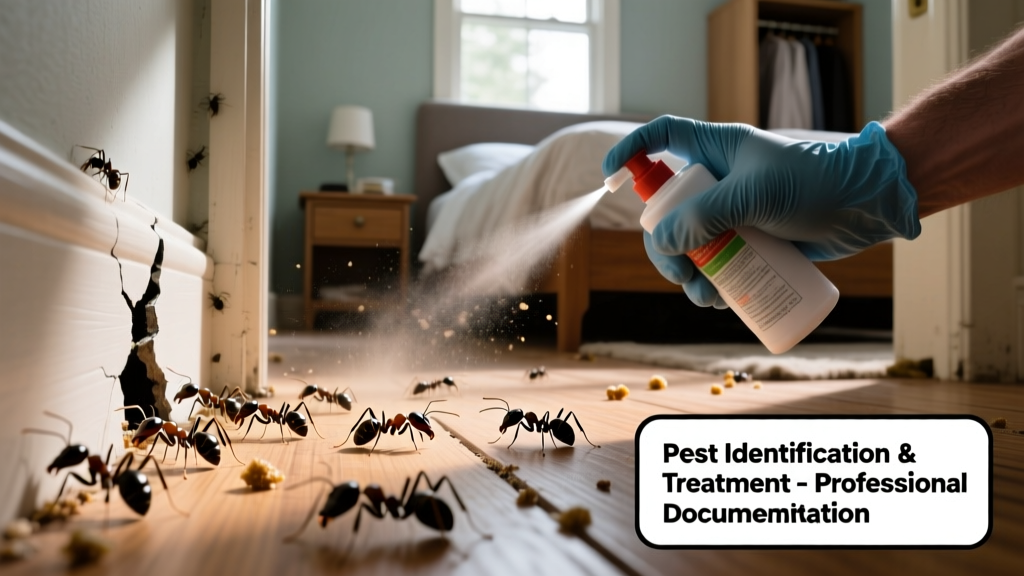
Ants in your bedroom aren’t just a nuisance—they’re a red flag that something’s off in your home’s moisture, food access, or structural integrity. Unlike ants that stay outdoors, those appearing in sleeping areas often signal nesting activity inside walls, under floors, or behind baseboards.
Identification
Most bedroom-invading ants fall into three common categories: odorous house ants (Tapinoma sessile), carpenter ants (Camponotus spp.), and pavement ants (Tetramorium caespitum). Odorous house ants are tiny (1/8 inch), dark brown to black, and emit a rotten-coconut smell when crushed. Carpenter ants are larger (¼–½ inch), often black or reddish-black, with smooth, rounded thoraxes—and they don’t eat wood but excavate it for nesting. Pavement ants are smaller (1/8 inch), brownish-black, with grooved heads and parallel ridges on their thorax.
| Species | Size & Color | Key Clue | Nesting Preference |
|---|---|---|---|
| Odorous House Ant | 1/8″, dark brown/black | Rotten coconut odor when crushed | Wall voids, under flooring, near pipes |
| Carpenter Ant | ¼–½″, black/red-black | Sawdust-like frass near baseboards | Moist, decayed wood in walls/floors |
| Pavement Ant | 1/8″, brownish-black | Small mounds of soil near cracks | Under slabs, in insulation, behind outlets |
Look for trails along baseboards, window sills, or electrical outlets—especially at dawn or dusk. Check behind nightstands, under mattresses, and around HVAC vents. If you spot winged ants indoors between March and June, that’s likely a reproductive swarm—a sign of an established colony nearby.
What Attracts Them
Bedrooms aren’t typical ant destinations unless conditions mimic their ideal habitat: consistent warmth, hidden moisture, and accidental food sources. A single dropped crumb from snack delivery, spilled lotion residue, or even sweat-soaked pillowcases can draw scouts. But the bigger driver is moisture: leaky AC drip lines, condensation behind headboards, or high humidity (>60%) encourages nesting. According to the National Pest Management Association’s 2022 Residential Pest Survey, 68% of indoor ant infestations begin within 10 feet of plumbing or HVAC units.
- Cracks in baseboards, window frames, or electrical outlets
- Unsealed gaps around HVAC ducts or door thresholds
- Cluttered nightstands or dressers hiding food debris
- Overwatered indoor plants sitting on bedroom floors
Treatment Methods
Natural Solutions
Start with non-toxic interventions—especially if kids or pets share the space. Diatomaceous earth (food-grade) applied in thin lines along baseboards disrupts ant exoskeletons; reapply after vacuuming or humidity spikes. A 50/50 vinegar-water spray deters scouts by erasing pheromone trails—spray daily for 5 days. Boric acid mixed with powdered sugar (1:3 ratio) works as a slow-acting bait: ants carry it back to the nest, killing queens and larvae over 3–7 days.
Chemical Options
When natural methods stall, targeted insecticides become necessary. Gel baits like Advion Ant Gel (indoxacarb) are low-risk and highly effective against odorous house and pavement ants—place pea-sized dabs near trails, not broad sprays. For suspected carpenter ants, dust formulations like Drione (silica gel + pyrethrins) injected into wall voids via small drill holes offer deep penetration. Never use perimeter sprays indoors—the U.S. EPA warns that overuse increases resistance and exposes residents to unnecessary neurotoxicants.
Prevention
Long-term control means removing what draws them in—and sealing what lets them in. Maintain indoor humidity below 55% using dehumidifiers or exhaust fans. Wipe down nightstands weekly with soapy water to remove scent residues. Seal entry points with silicone caulk—not painter’s caulk, which ants chew through. Replace water-damaged baseboards or subflooring near exterior walls; carpenter ants prefer wood with >15% moisture content.
"If you’re seeing more than 5 ants per day in the bedroom for over 3 days straight, assume there’s a satellite nest within 10 feet—check behind outlet covers and under carpet edges." — Dr. Lena Cho, Urban Entomologist, Purdue University Extension, 2023
- Install door sweeps on all bedroom entryways
- Store seasonal clothing in sealed plastic bins—not cardboard
- Inspect HVAC return grilles monthly for frass or live ants
- Trim tree branches 3+ feet from bedroom windows
When to Call an Exterminator
Call a licensed professional if you find sawdust piles near walls, hear rustling inside walls at night, or see winged ants indoors outside of spring swarming season. Also act immediately if ants appear in multiple bedrooms simultaneously—that suggests a main nest in shared framing or attic space. Reputable providers will conduct a full inspection—including thermal imaging for moisture pockets—and provide a written treatment plan with follow-up visits. Avoid same-day ‘spray-and-pray’ services; effective ant control requires colony elimination, not surface killing.
Why do ants suddenly appear in my bedroom overnight?
Ants rarely show up without warning. What seems sudden is usually the final phase of trail establishment—scouts discovered a reliable resource (moisture, food, warmth) and recruited dozens more. Check recent changes: new humidifier use, a leaking window seal, or even a forgotten energy drink can under the bed.
Can ants build nests inside mattress seams?
Not typically—but they’ll crawl through zipper gaps or fabric tears to reach crumbs or skin flakes. More commonly, they nest in the box spring or bed frame, especially if it’s made of particleboard with moisture damage. Inspect the underside with a flashlight before assuming the mattress itself is infested.
Are bedroom ants dangerous to humans?
Odorous house and pavement ants pose no direct health threat, though they can contaminate surfaces. Carpenter ants don’t bite unless provoked, but their presence indicates underlying structural moisture issues that could lead to mold or rot. None transmit disease like cockroaches or rodents—but their trails increase allergen load in sensitive individuals.
Will cleaning alone get rid of bedroom ants?
Cleaning helps break pheromone trails and removes attractants—but it won’t eliminate a nest. In fact, aggressive vacuuming without sealing entry points may scatter colonies deeper into walls. Pair sanitation with baiting and exclusion for lasting results. For more on eliminating attractants, see our kitchen ant prevention guide.
How long does it take to get rid of ants in the bedroom?
With proper baiting and exclusion, visible activity drops in 3–5 days. Complete colony elimination takes 1–3 weeks for odorous house ants, up to 6 weeks for carpenter ants due to slower brood development. Monitor with sticky traps placed near suspected entry points—if no ants are caught after 14 days, the nest is likely gone. Learn more about timeline expectations in our ant treatment timelines breakdown.
Do ultrasonic pest repellers work against bedroom ants?
No. Independent testing by the University of Nebraska-Lincoln’s Entomology Department (2021) found zero statistically significant reduction in ant activity using ultrasonic devices—even at maximum decibel output. Save your money and focus on proven methods: baiting, moisture control, and physical exclusion.
Ants in the bedroom are rarely about the room itself—and almost always about conditions elsewhere in your home. The fix isn’t just about killing bugs—it’s about reading the signals they’re sending. Once you identify the species and its motivation, you shift from reaction to precision control. And remember: consistent monitoring beats emergency treatment every time. For help identifying ant frass or moisture damage, check out our carpenter ant frass guide.