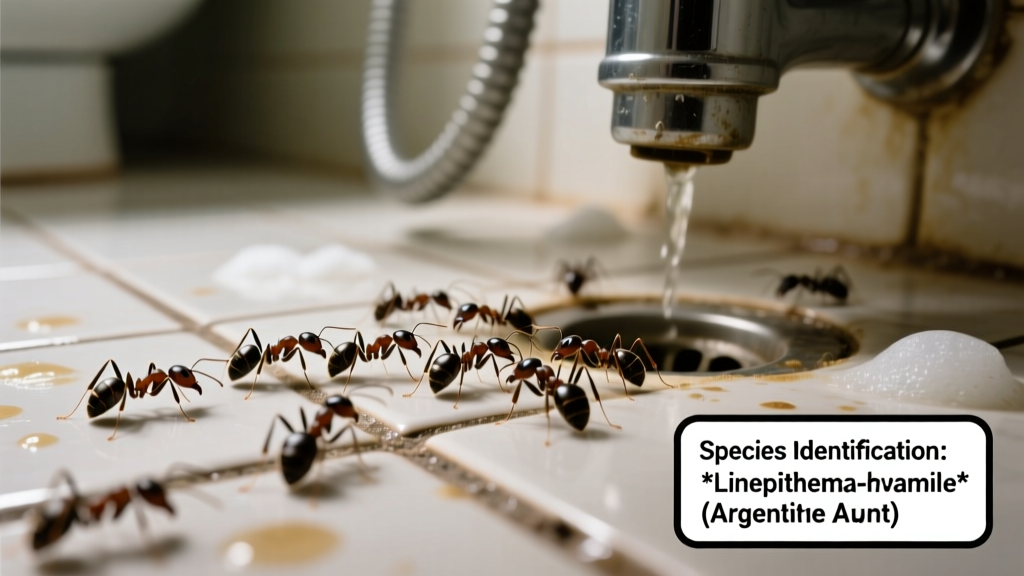
Ants in the bathroom aren’t just a nuisance—they’re a red flag that moisture, food residue, or entry points are going unaddressed. Most commonly, these are odorous house ants (Tapinoma sessile) or pavement ants (Tetramorium caespitum), both drawn to humidity and tiny organic spills near sinks, tubs, or baseboards. Left unchecked, even a few scouts can signal a satellite nest behind tile grout or under vanity cabinets.
Identification
Odorous house ants are 1/8-inch long, dark brown to black, with a single-node petiole and uneven thorax profile. When crushed, they emit a rotten-coconut smell—a key field ID trait. Pavement ants are slightly larger (up to 1/8 inch), have parallel grooves on their head and thorax, and build small soil mounds near foundations. Both trail persistently along baseboards, pipes, and caulking lines.
| Species | Size & Color | Key ID Feature | Typical Nest Location |
|---|---|---|---|
| Odorous house ant | 1/8"; brown-black | Rotten coconut odor when crushed | Under flooring, inside wall voids near plumbing |
| Pavement ant | 1/8"; dark brown | Parallel grooves on head/thorax | Cracks in slab, under bathroom subfloor |
| Carpenter ant | 1/4"–5/8"; black/red-black | Smooth, shiny thorax; no node groove | Rotting wood around leaky windows or shower frames |
Look for live trails at dawn or dusk—especially near damp corners, behind toilets, or where tile meets drywall. Check for frass (fine sawdust) near baseboards: that’s a carpenter ant warning sign.
What Attracts Them
Bathrooms offer three irresistible resources: moisture, warmth, and accidental food sources. Even microscopic toothpaste residue, shampoo drips, or skin flakes provide enough sugar and protein to sustain small colonies. Leaky faucets raise ambient humidity above 60%, creating ideal microclimates—especially in older homes with compromised vapor barriers.
- Standing water from clogged floor drains or cracked caulk
- Sweat, lotion, or hair product residue on countertops or shower doors
- Moisture-warmed pipes acting as thermal corridors into walls
- Unsealed gaps around toilet flanges or sink supply lines
According to the National Pest Management Association’s 2022 Residential Pest Report, 68% of bathroom ant infestations begin within 3 feet of a plumbing fixture—and 41% originate from nests inside wall voids adjacent to water heaters or HVAC ducts.
Treatment Methods
Natural Options
Vinegar-water spray (1:1) disrupts pheromone trails on surfaces—reapply daily for 5 days. Diatomaceous earth (food-grade) applied in thin lines along baseboards dehydrates ants on contact but loses efficacy if dampened. Boric acid mixed with powdered sugar (1:3 ratio) works as a slow-kill bait; place in bottle caps away from kids and pets.
- Wipe all surfaces with 5% white vinegar before bed for 7 nights
- Apply silica gel dust (not DE) in wall voids using a bulb duster through outlet plate gaps
- Use cotton swabs dipped in diluted peppermint oil along pipe chases—ants avoid the scent
Chemical Solutions
For confirmed colony activity, non-repellent liquid insecticides like fipronil (Termidor SC) or imidacloprid (Advion Ant Gel) are most effective. These compounds transfer via trophallaxis—worker ants share bait with the queen and brood. Avoid pyrethroids alone; they cause colony budding, worsening the problem.
"Baiting is only effective when you match the ant’s current food preference—sugary in spring, protein/fat-heavy in summer. Test with peanut butter vs. jelly on separate cards for 24 hours," says Dr. Elena Ruiz, urban entomologist at Purdue University’s Center for Urban & Industrial Pest Management (2023).
Prevention
Fix moisture first—repair leaks, install exhaust fans rated for ≥50 CFM, and replace cracked caulk with silicone sealant containing mildewcide. Seal entry points with copper mesh and acoustical sealant (not caulk alone) around pipes and vents. Keep toiletries capped and wipe down surfaces after each use—especially near electric outlets, where condensation collects.
- Inspect grout lines quarterly for hairline cracks; reseal with epoxy-based grout sealer
- Install door sweeps with aluminum bristles on bathroom entry doors
- Run dehumidifier during humid months—maintain RH below 55% to deter nesting
For long-term control, pair physical exclusion with leak detection and mold prevention strategies—since both attract the same pests.
When to Call an Exterminator
Contact a licensed pest professional if you see more than 20 ants per hour indoors, find frass or hollow-sounding wood near fixtures, or notice trails leading into walls or ceilings. Also call if DIY baiting fails after 10 days—this often means multiple satellite nests or a parent colony outside the structure.
Why do ants appear only in my bathroom and nowhere else?
They’re likely exploiting a localized moisture source—like a slow drip behind the vanity or condensation buildup inside a poorly insulated exterior wall. Unlike kitchens, bathrooms rarely get deep-cleaned weekly, letting biofilm accumulate in drain traps and grout. That persistent moisture + organic film = prime real estate.
Can ants come up through the drain?
Yes—but rarely as a primary entry. More often, they follow moisture gradients upward from slab leaks or sewer line cracks. A properly installed P-trap blocks access, but dried-out traps (common in guest bathrooms) let them enter. Pour 1/4 cup of water down unused drains monthly to maintain the seal.
Are bathroom ants dangerous to health?
Not directly. Odorous house and pavement ants don’t sting or transmit disease, but they track bacteria—including E. coli and Staphylococcus—from garbage or soil into clean areas. The bigger risk is misidentification: carpenter ants indicate structural decay, and pharaoh ants may carry pathogens in healthcare-adjacent homes.
Do ultrasonic repellents work on bathroom ants?
No. Independent testing by the University of Kentucky Entomology Department (2021) found zero reduction in ant activity across 12 brands over 30 days. These devices don’t affect ant navigation, which relies on chemical trails—not sound frequencies.
How long until ants disappear after treatment?
With proper baiting, worker ants decline in 3–5 days; full colony elimination takes 2–4 weeks. If you see new ants after 12 days, reevaluate bait placement—ants ignore baits placed too far from active trails or near competing food sources.
Can I use bleach to kill ants in the bathroom?
Bleach kills on contact but doesn’t eliminate nests and damages grout and metal fixtures. It also masks pheromone trails temporarily, causing ants to scatter and form new paths. Use it only for surface disinfection *after* removing ants—not as a control method.
Ants in the bathroom are less about invasion and more about invitation. Fix the moisture, block the routes, and starve the trail—and you’ll break the cycle faster than any spray ever could. For persistent cases, pair pest control with ventilation upgrades to make the space inhospitable year-round.