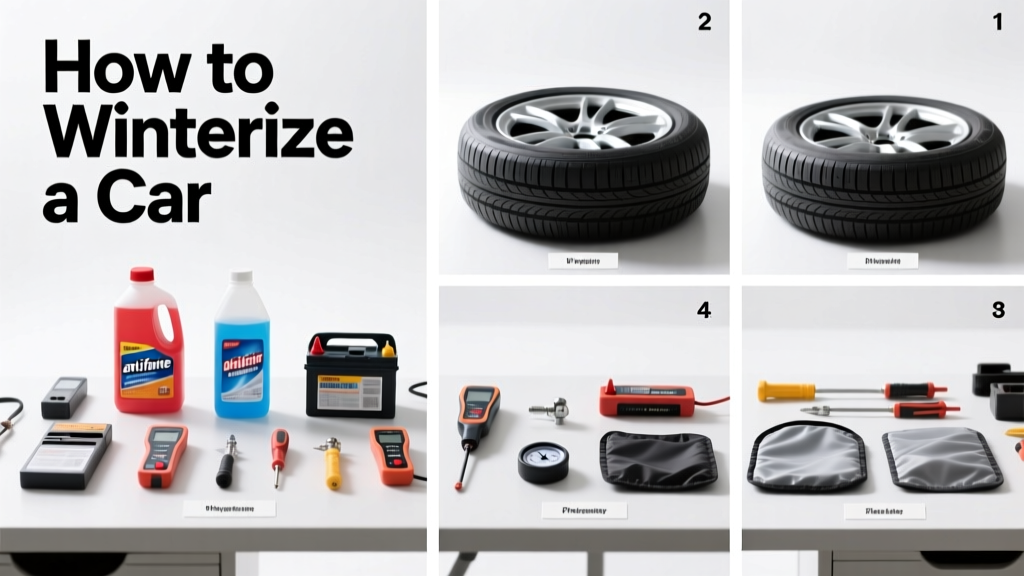
Winterizing your car is a preventive maintenance skill that takes 2–3 hours and requires no mechanical certification—just careful attention and basic tools. It’s rated beginner-friendly if you’re comfortable checking fluid levels and swapping wiper blades; intermediate if tackling battery testing or undercarriage inspection.
Overview
| Skill Level | Time Required | Tools Needed | Estimated Cost |
|---|---|---|---|
| Beginner to Intermediate | 2–3 hours (first time); ~45 minutes after year one | Basic hand tools, tire pressure gauge, funnel, flashlight, gloves | $45–$180 (varies by coolant, tires, and battery age) |
Tools & Materials
| Item | Quantity | Notes |
|---|---|---|
| Antifreeze/coolant (50/50 ethylene glycol mix) | 1–2 gallons | Check owner’s manual for OEM-recommended type (e.g., GM Dex-Cool, Toyota SLLC) |
| Winter-grade windshield washer fluid (-20°F or lower) | 1–2 bottles | Never dilute with water—ice formation can crack reservoir or lines |
| Ice scraper with brush | 1 | Look for reinforced plastic blade; metal scrapers damage modern coatings |
| Battery load tester or multimeter | 1 | Required if battery is 3+ years old—cold cranking amps (CCA) drop 30–40% below 0°F (AAA, 2022) |
| Tire pressure gauge (digital preferred) | 1 | Analog gauges lose accuracy below 20°F; digital holds calibration |
| Full-size spare tire + jack + lug wrench | 1 set | Verify spare is inflated to 60 PSI and tread depth ≥4/32" |
Step-by-Step Instructions
1. Test and clean the battery
Turn off the engine and all accessories. Use a multimeter: red probe on positive terminal, black on negative. A fully charged battery reads 12.6V at rest. Below 12.2V? Charge it. Below 12.0V? Replace it—especially if it’s over 42 months old. Clean terminals with baking soda/water paste and a wire brush. Reconnect positive first, then negative. Warning: Never jump-start a frozen battery—it can explode.
2. Check and top off all fluids
Engine oil: Confirm viscosity grade matches winter specs (e.g., 0W-20 or 5W-30—not 10W-40). Coolant: Use a refractometer or hydrometer to verify freeze point is ≤−34°F. Brake fluid: Should be amber, not brown or cloudy—moisture absorption lowers boiling point and increases ice risk in ABS modules. Power steering and transmission fluids: Check levels cold, before starting engine.
3. Inspect and replace wiper blades and fluid
Swap blades if rubber is cracked, stiff, or leaves streaks—even if they “still work.” Install winter blades with reinforced rubber boots to resist ice buildup. Fill reservoir with washer fluid rated to −20°F or colder. Pro tip: Add fluid only when ambient temperature is above freezing to prevent immediate line clogs.
4. Evaluate tires and adjust pressure
Measure tread depth with a quarter: Insert head-first—if Washington’s head is fully visible, tread is ≤4/32″ and unsafe for snow. Check sidewalls for cracks or bulges. Inflate tires to the door-jamb sticker pressure—not the max on the tire wall. Cold air drops pressure ~1 PSI per 10°F drop; recheck weekly. If you live where snow is frequent, consider dedicated winter tires—they outperform all-seasons below 45°F, even on dry pavement (Rubber Manufacturers Association, 2023).
Pro Tips
Many drivers skip undercarriage inspection—but road salt accelerates rust on control arms, sway bar links, and exhaust hangers. Spray a light coat of fluid film (not WD-40) on exposed metal every 6 weeks if driving on treated roads. Also, avoid using your parking brake overnight when temps dip below 15°F—cables can freeze.
"A battery tested at room temperature may show full charge, but fail instantly at −10°F. Always test under real-world cold conditions—or simulate with a freezer test: chill battery for 2 hours at 15°F, then load-test." — ASE Master Technician Maria Chen, Motor Age Magazine, 2021
Why does my heater blow cold air even when the engine is warm?
Most often, it’s low coolant level or an air pocket trapped in the heater core. Top off coolant slowly with the heater on high and radiator cap off (engine cool!). Let it run 10 minutes to purge air. If still cold, check for a stuck blend door actuator—a common failure in vehicles 2012–2020.
Can I use summer oil in winter?
You can—but shouldn’t. Thicker oils like 10W-40 take longer to circulate at startup, increasing wear during the first 30 seconds. Modern engines designed for 0W-20 see up to 27% less cold-start wear than with 5W-30 (SAE International, J2902, 2020). Check your manual: many newer models require specific low-viscosity synthetics.
Do I need snow tires if I have AWD?
Yes. AWD helps with acceleration, not stopping or cornering. In a 2022 Tire Rack braking test, AWD SUVs with all-season tires needed 52 feet more to stop from 60 mph on packed snow than identical models with winter tires. Traction starts at the tire contact patch—not the drivetrain.
How often should I change my cabin air filter in winter?
Every 12,000 miles or once per season—whichever comes first. A clogged filter reduces defroster output by up to 40%, fogging windows faster and straining the blower motor. Most are located behind the glovebox; replacement takes under 5 minutes. See our cabin air filter replacement guide for model-specific locations.
Is it safe to warm up my car for 10 minutes before driving?
No—and it wastes fuel and increases emissions. Modern fuel-injected engines need only 30 seconds to circulate oil. Idling longer just burns fuel and coats cylinders with unburned hydrocarbons. Drive gently for the first 5–10 minutes instead. For remote start users: limit pre-heating to 3–5 minutes maximum.
What’s the best way to de-ice frozen door locks?
Use a lock de-icer spray (alcohol-based), not hot water—it refreezes instantly and can crack the lock cylinder. Keep a small bottle in your glovebox. If frozen solid, heat your key gently with a lighter for 5 seconds, insert, and wiggle—don’t force it. For persistent issues, here’s how to service the lock mechanism.
Winterizing isn’t about perfection—it’s about reducing failure points when temperatures drop and roads get slick. Do these steps before the first hard freeze, and revisit fluid levels and tire pressure monthly. You’ll gain confidence, avoid roadside calls, and keep your family safer. Need help identifying fluid reservoirs? We’ve mapped them by make and model.