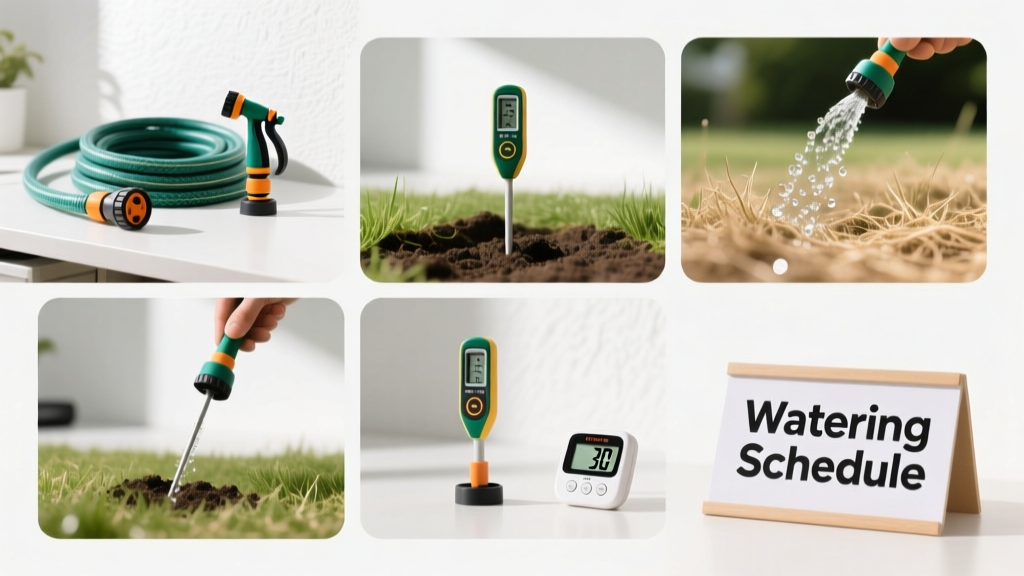
Watering a lawn properly isn’t about frequency—it’s about delivering the right amount, at the right time, to the right depth. This skill is beginner-friendly but requires observation and consistency; expect to spend 10–15 minutes per session, plus 5 minutes weekly to check soil moisture and adjust.
Overview
| Skill Level | Time Required | Tools Needed | Estimated Cost |
|---|---|---|---|
| Beginner | 10–15 min/session, 2–3x/week in summer | Timer, sprinkler or hose, screwdriver (for rotor heads), rain gauge | $0–$45 (most homeowners already own basics; smart timer starts at $25) |
Tools & Materials
| Item | Why It’s Essential | Notes |
|---|---|---|
| Rain gauge or tuna can | Measures actual water delivery—not just run time | Place near sprinkler; 1 inch = ~0.62 gallons per sq ft (U.S. EPA, 2022) |
| Soil probe or screwdriver | Tests moisture depth without digging | If it slides 6+ inches easily, top 6″ is moist; if it stops at 2″, roots are dry |
| Smart irrigation controller (optional) | Adjusts for weather, soil type, and evapotranspiration | Reduces overwatering by up to 30% (California Water Resources Control Board, 2023) |
| Rotating sprinkler (not oscillating) | Delivers water slowly enough for absorption—no runoff | Oscillating types apply water too fast on clay or sloped lawns |
Step-by-Step Instructions
1. Determine your lawn’s weekly water need
Most cool-season grasses (Kentucky bluegrass, fescue) need 1–1.5 inches of water per week—including rainfall. Warm-season grasses (Bermuda, zoysia) need 0.75–1 inch. Use a rain gauge or empty tuna can placed in the spray zone to measure output. Run your system until it fills to the 1-inch mark—then note how long that took. That’s your baseline runtime.
- Tip: Check local weather reports or use how to read a rain gauge to subtract natural precipitation.
- Warning: Don’t assume 30 minutes = 1 inch. Output varies wildly—low-pressure rotors may take 90 minutes; high-output impact heads may hit 1 inch in 22.
2. Water early—between 4 a.m. and 10 a.m.
Morning watering minimizes evaporation (up to 30% less loss than midday, per USDA Agricultural Research Service, 2021) and gives grass blades time to dry before evening, reducing fungal risk. Avoid watering after 6 p.m., especially in humid climates.
- Tip: Set a phone reminder or use a mechanical timer with AM-only settings.
- Warning: Night watering encourages dollar spot and brown patch—especially on St. Augustine or bentgrass.
3. Water deeply and infrequently
Apply the full weekly amount in 2–3 sessions—not daily sprinkles. This trains roots to grow deeper (6–8 inches), making your lawn drought-resilient. Shallow, daily watering keeps roots in the top 1–2 inches, where heat and dryness hit first.
- Tip: If your soil is compacted or slopes >5%, split one session into two back-to-back cycles (e.g., 15 min on, 30 min off, 15 min on) to prevent runoff.
- Warning: Overwatering causes shallow roots, thatch buildup, and leaching of nitrogen—visible as yellowing tips and weak spring regrowth.
4. Adjust for soil type and season
Clay holds water longer—water every 4–5 days in summer. Sandy soil drains fast—water every 2–3 days, but reduce volume per session (½ inch instead of 1). In fall, cut frequency by half; in winter dormancy (below 50°F for 2 weeks), stop unless rainfall is below 0.5 inch/month.
- Tip: Test your soil texture using the soil texture test—it takes 10 minutes and needs only a jar and water.
- Warning: Never water frozen ground—it creates ice lenses that heave turf and kill crowns.
Pro Tips
Seasoned turf managers stress one principle above all: “Water the soil—not the grass.” That means prioritizing infiltration over leaf coverage. The U.S. EPA estimates that 14% of household water usage is from leaks and inefficient irrigation—many caused by misaligned heads or forgotten seasonal adjustments.
“If you can’t see your footprints disappear within 10 minutes after walking on the lawn, the surface is too dry—and you’ve waited too long to water.” — Dr. Nick Christians, Iowa State University Turf Extension, 2020
Common mistakes include running sprinklers during peak sun (wasting 25–40% to evaporation), ignoring clogged nozzles (causing dry patches), and skipping seasonal head adjustments (leading to sidewalk watering and uneven coverage). Also avoid “set-and-forget” timers—most need manual tweaks every 2–3 weeks as temperatures shift.
How do I know if I’m overwatering?
Look for persistent sponginess, algae or moss in shaded spots, fungal rings (fairy rings), or runoff pooling along driveways. A simple test: push a 6-inch screwdriver into the soil—if it goes in easily beyond 6 inches *without* recent rain, you’re likely applying too much.
Do new sod or seedlings need different watering?
Yes. New sod needs light, frequent watering: 10–15 minutes, 2–3x/day for the first 7–10 days, then taper to deeper, less-frequent cycles. Seeded lawns require misting 2x/day until germination (5–21 days depending on species), then switch to 1 inch/week—but only after seedlings reach 1 inch tall.
Can I use greywater to water my lawn?
Only if it’s from laundry or showers (not kitchen sinks or dishwashers) and free of sodium-based soaps, boron, or chlorine bleach. Soap residue builds up in soil over time, damaging microbial life and structure. The University of Arizona Cooperative Extension recommends diluting greywater 1:1 with fresh water and rotating application zones monthly.
Why does my lawn have brown patches even when I water regularly?
Brown patches often signal disease (like Pythium blight), insect damage (grubs), or compacted soil—not lack of water. Perform a 1-foot square shovel test: lift turf and examine roots. Healthy roots are white and firm; grub-damaged turf lifts like carpet; compacted soil shows no earthworms and hard, layered strata.
Should I water before or after mowing?
Water before mowing—ideally the day before. Wet grass clippings clog mowers and form mats that smother turf. Mowing dry grass also reduces disease spread and gives cleaner cuts. Never water immediately after mowing: wet blades + open wounds = higher infection risk.
What’s the best way to water a sloped lawn?
Use low-angle, rotating sprinklers—not fan-pattern heads—to reduce runoff. Program your timer for shorter, repeated cycles (e.g., 8 minutes on, 30 minutes off, 8 minutes on). For steep grades (>15%), consider drip tubing along contour lines or installing check-valve rotors that shut off flow when pressure drops.
Consistent, thoughtful watering transforms a thin, stressed lawn into a dense, resilient one—not overnight, but within 4–6 weeks of adjusting your routine. You’ll notice fewer weeds, deeper green color, and grass that springs back after foot traffic. Keep a small notebook or app log for the first month: date, minutes run, observed soil depth, and weather. That record becomes your best tool for next season’s plan.