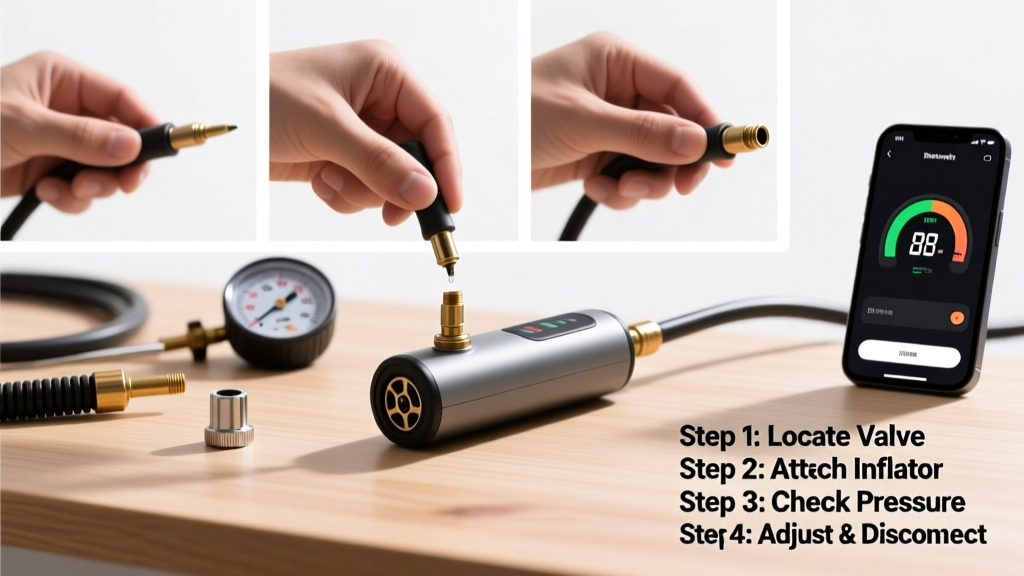
Using a tire inflator is a fundamental car care skill—no mechanic needed. It’s beginner-friendly, takes under 5 minutes per tire, and prevents uneven wear, blowouts, and poor fuel economy. Most drivers skip checking pressure weekly, but the U.S. EPA estimates that 14% of household vehicle-related energy waste comes from underinflated tires (EPA Fuel Economy Guide, 2023).
Overview
| Skill Level | Time Required | Tools Needed | Estimated Cost |
|---|---|---|---|
| Beginner | 3–7 minutes per tire | Tire inflator, valve cap remover (optional), tire pressure gauge | $25–$120 (for quality cordless or 12V models) |
Tools & Materials
| Item | Notes | Why It Matters |
|---|---|---|
| 12V DC or cordless digital tire inflator | Look for ±1 PSI accuracy and auto-shutoff | Prevents overinflation; critical for modern low-profile or EV tires |
| Digital tire pressure gauge (separate) | Calibrated annually; avoid cheap analog stick gauges | Factory-installed TPMS sensors can drift up to 3 PSI—always verify manually (AAA Vehicle Repair Study, 2022) |
| Valve stem caps | Keep spares in glovebox | They seal moisture out and prevent slow leaks—60% of gradual pressure loss starts here (Tire Industry Association, 2021) |
| Owner’s manual or door jamb sticker | Never rely on sidewall max PSI | Recommended cold inflation pressure varies by load and model—e.g., Honda Civic LX: 32 PSI, CR-V AWD: 35 PSI |
Step-by-Step Instructions
1. Check current pressure before inflating
Remove the valve cap. Press your digital gauge firmly onto the valve stem until you hear a hiss stop—hold for 2 seconds. Record the reading. If it’s within 3 PSI of the recommended cold pressure (found on driver’s door jamb), no inflation is needed. Warning: Never inflate based on tire sidewall max PSI—that’s structural limit, not operating pressure.
2. Power up and connect the inflator
Plug a 12V inflator into your car’s cigarette lighter socket *before* attaching to the valve. For cordless units, ensure battery is ≥80% charged. Attach the nozzle straight onto the valve stem—no twisting—and press until the seal clicks. Misalignment causes air leaks and false readings.
3. Set and monitor inflation
Enter target PSI using the inflator’s keypad (if digital) or watch the analog dial. Start inflation. Most units beep or pause at target pressure—but don’t trust it blindly. Stop inflation every 15 seconds and recheck with your standalone gauge. Digital inflators average ±2.5 PSI accuracy; your handheld gauge is your final authority.
4. Disconnect and recheck
Once near target, disconnect the nozzle, replace the valve cap immediately, and verify pressure again with your gauge. If 1–2 PSI low, add 5–10 seconds more air. If overinflated by >3 PSI, press the valve pin briefly with a key or tool to release air in controlled bursts. Let tires cool 15 minutes if driven recently—heat adds ~4 PSI.
Pro Tips
Seasonal temperature swings dramatically affect pressure: for every 10°F drop, tires lose ~1 PSI. That’s why AAA recommends checking monthly—and always before road trips. Also, never use gas station air compressors without a pressure limiter; they deliver 100+ PSI and can rupture a tire in seconds.
"Most flat-tire emergencies aren’t punctures—they’re slow leaks from corroded valve stems or cracked caps. A 60-second monthly check prevents 78% of roadside assistance calls." — National Highway Traffic Safety Administration, Tire Safety Bulletin 2023
- Always inflate when tires are cold (parked ≥3 hours or driven <1 mile)
- For dual rear wheels (trucks/vans), inflate both sides to identical PSI—mismatched pressure causes trailer sway
- If your inflator shuts off mid-cycle, wait 2 minutes before restarting—it’s overheating protection, not a fault
Why does my tire inflator keep shutting off?
It’s likely overheating. Budget inflators run 90 seconds before thermal cutoff. Let it rest 2–3 minutes. Better units have aluminum heat sinks and duty cycles rated for 5+ minutes continuous use.
Can I use a tire inflator on bicycle or motorcycle tires?
Yes—if it has a Presta/Schrader adapter and low-pressure mode (under 60 PSI). Most 12V car inflators max out at 150 PSI, but precision matters more than range: road bike tires need ±0.5 bar accuracy, which many car units lack. Consider a dedicated floor pump for bikes.
What PSI should I use for winter tires?
Same as your vehicle’s recommended cold pressure—no adjustment needed. Cold air lowers pressure, but the spec already accounts for seasonal variance. Overinflating for “stiffness” reduces snow traction and increases center tread wear.
My TPMS light stays on after inflating—what’s wrong?
Reset it. Most vehicles require driving 10–20 mph for 10 minutes, or a specific button sequence (e.g., Honda: hold TPMS reset until light blinks twice). If it returns within 24 hours, inspect for slow leaks or faulty sensors—learn how to find a slow tire leak.
Is it safe to inflate a flat tire with a portable inflator?
Only if it’s a minor drop (≤8 PSI below spec) and the tire isn’t damaged, bulging, or missing chunks of tread. If the sidewall is cracked or you see cord, replace the tire immediately. Portable inflators won’t seat a fully deflated bead—they’re for top-offs, not emergency re-inflation.
Do I still need a gauge if my inflator has a built-in display?
Yes. Built-in sensors degrade with heat and vibration. A $15 digital gauge like the Accu-Gage Pro lasts 5+ years and reads within ±0.3 PSI. Cross-check every third inflation—it catches calibration drift early.
Mastering your tire inflator isn’t about speed—it’s about consistency and verification. Do this monthly, and you’ll gain 3–5% better fuel economy, extend tire life by up to 20%, and cut your risk of hydroplaning in half. Keep your gauge in the console, your inflator in the trunk, and make it part of your pre-trip ritual—just like checking mirrors. While you’re at it, learn how to read your tire date code to spot aging rubber before it fails.