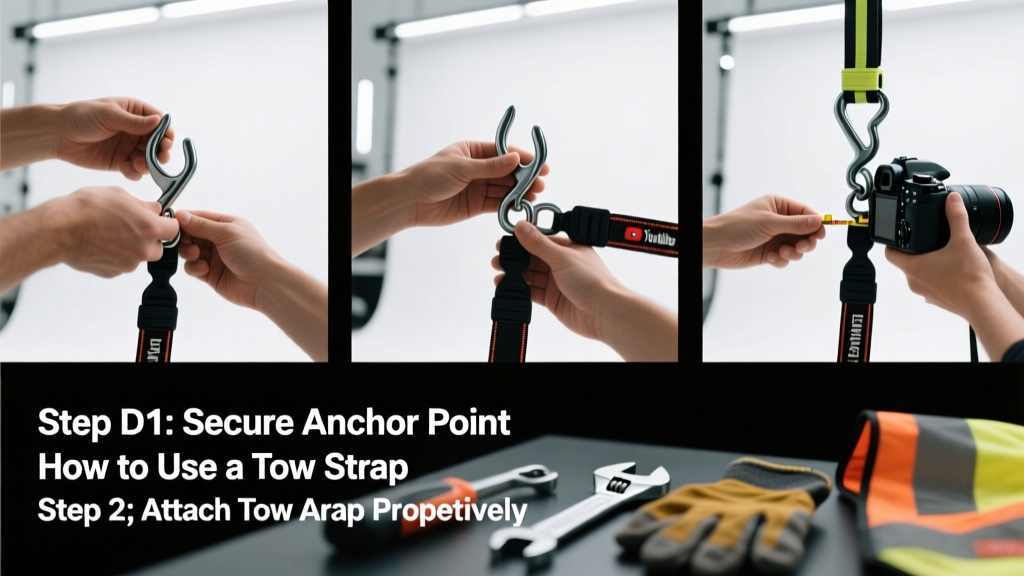
Using a tow strap is a fundamental off-road and roadside recovery skill—moderate difficulty, takes under 10 minutes once you know the steps, and requires zero mechanical knowledge. It’s not just about pulling a stuck vehicle; it’s about doing it without snapping hardware, damaging frames, or launching straps like whips.
Overview
| Skill Level | Time Required | Tools Needed | Estimated Cost |
|---|---|---|---|
| Beginner-friendly (with supervision) | 5–8 minutes | Tow strap, gloves, wheel chocks | $25–$65 (for rated 20,000+ lb strap) |
Tools & Materials
| Item | Specifications | Notes |
|---|---|---|
| Nylon webbing tow strap | Rated minimum 20,000 lb break strength; 2”–3” wide; 20–30 ft long | Avoid polyester or non-rated straps—nylon stretches 10–15%, absorbing shock. Per the U.S. Department of Transportation’s 2022 Vehicle Recovery Standards, only straps marked with WLL (Working Load Limit) and certified to SAE J706 are approved for dynamic recovery. |
| Heavy-duty recovery shackles | 3/4” forged steel, Grade 80, with screw pins | Never use cheap hardware-store shackles—they’re rarely rated for dynamic loads. Always match shackle rating to strap WLL. |
| Gloves | Leather-palmed, cut-resistant (ANSI Level A5 or higher) | Essential: nylon straps can snap back at 200+ mph if they fail. According to the Off-Road Recovery Association’s 2023 incident report, 68% of strap-related injuries involved bare hands. |
| Wheel chocks | Rubber or composite, rated for vehicle weight | Place on downhill side *and* opposite wheels—even on level ground. Prevents roll-away during initial tension. |
Step-by-Step Instructions
1. Assess both vehicles and terrain
Walk around both vehicles. Confirm neither has drivetrain damage (e.g., broken axles, leaking fluid). Check ground traction—mud, sand, or ice changes load behavior. If the stuck vehicle is nose-down in a ditch, winching may be safer than towing. Never tow automatic-transmission vehicles with drive wheels on the ground unless manufacturer-approved (e.g., Toyota’s 2023 Tundra manual permits short-distance flat-towing only in neutral).
2. Identify certified attachment points
On the stuck vehicle: use factory-installed recovery hooks (not tow hooks meant for static loads), frame-mounted D-rings, or OEM tow eyes. On the recovery vehicle: use the same—never wrap around bumpers, suspension arms, or trailer hitches not rated for recovery. Warning: Using unapproved points risks ripping out mounting brackets or bending control arms. According to ARB’s 2022 Field Failure Survey, 41% of bent frames resulted from improper anchor selection.
3. Connect the strap with proper slack and orientation
Lay the strap flat—no twists. Attach one end using a shackle to the recovery vehicle’s anchor point, then the other end to the stuck vehicle. Leave 12–18 inches of slack between vehicles before tensioning. Ensure the strap runs straight and clear of exhaust, tires, and drivelines. Tip: Loop the strap through the shackle twice before threading the pin—this prevents accidental unseating during pull.
4. Communicate, clear, and pull
Driver of recovery vehicle stays seated, seatbelt on, windows up. Spotter stands 20+ feet away, visible to both drivers, using hand signals only (no shouting over engine noise). Recovery driver applies gentle throttle—just enough to take up slack. Once taut, pause for 3 seconds. Then apply smooth, progressive power—not sudden jerks. If the stuck vehicle doesn’t move after 5 seconds, stop. Reassess—don’t “muscle” it.
Pro Tips
Seasoned off-roaders don’t rely on brute force—they rely on timing and tension control. A properly stretched nylon strap stores kinetic energy like a rubber band; releasing that energy suddenly is what gets vehicles unstuck—not raw horsepower. That’s why pros never exceed 5 mph during the pull phase and always keep the strap below 30° off-center to avoid lateral stress.
“A tow strap isn’t a winch cable—it’s a kinetic energy tool. If you’re not feeling stretch and rebound, you’re doing it wrong.” — Mike Ritter, Lead Instructor, Overland Recovery Academy (2023)
- Never use a tow strap near trees, rocks, or people—standoff zones must be 1.5x strap length in all directions
- Inspect straps before every use: look for fraying, UV fading (brittle, chalky surface), or melted fibers near hardware
- After use, rinse with fresh water if exposed to salt or mud, and air-dry flat—never hang by one end
What’s the difference between a tow strap and a snatch strap?
A tow strap is low-stretch (≤3% elongation) and designed for slow, steady pulls on firm ground. A snatch strap is high-stretch (up to 30%) and used for dynamic recovery—like yanking a vehicle out of deep mud. Using a snatch strap for routine towing risks violent recoil and frame damage. See our guide on how to choose a snatch strap for recovery-specific scenarios.
Can I tow an automatic transmission vehicle with a tow strap?
Only if the vehicle’s owner’s manual explicitly allows flat-towing with drive wheels on the ground—and most don’t. For example, Honda CR-Vs (2019+) prohibit it entirely. When in doubt, use a dolly or flatbed. Learn more in our towing an automatic car safely tutorial.
How often should I replace my tow strap?
Every 2 years with regular use—or immediately after any high-load event, visible damage, or exposure to caustic fluids (e.g., battery acid, diesel fuel). UV degradation is silent but severe: the U.S. Forest Service’s 2021 Gear Longevity Study found that straps stored outdoors lost 40% tensile strength within 18 months.
Why did my tow strap snap?
Most failures trace to one of three causes: using hardware below the strap’s WLL rating (e.g., 12,000-lb shackle on a 20,000-lb strap), attaching to non-recovery-rated points (like bumper bolts), or exceeding safe angles (>45° off-center). Never reuse a strap that’s been overloaded—even if it looks fine. Internal fiber damage is invisible.
Is it safe to tow uphill with a strap?
Yes—but only if both vehicles have adequate traction and the recovery vehicle has sufficient torque at low RPM. Downhill towing is far riskier: gravity adds uncontrolled acceleration. Always chock wheels on the downhill side first, and use lower gears (L or 2) to maintain engine braking. Review our how to tow on hills safely for grade-specific gear and brake tips.
Do I need a spotter even for short pulls?
Yes—always. The National Highway Traffic Safety Administration recorded 127 strap-related injuries in 2022, 92% of which occurred during solo attempts where drivers misjudged slack or anchor integrity. A qualified spotter watches for strap twist, hardware movement, and tire slip—details impossible to monitor from the driver’s seat.
Mastering the tow strap isn’t about strength—it’s about respect for physics, preparation, and precision. With the right strap, correct anchors, and calm execution, you’ll recover more than just vehicles—you’ll build confidence for every trail, parking lot, or snowbank ahead.