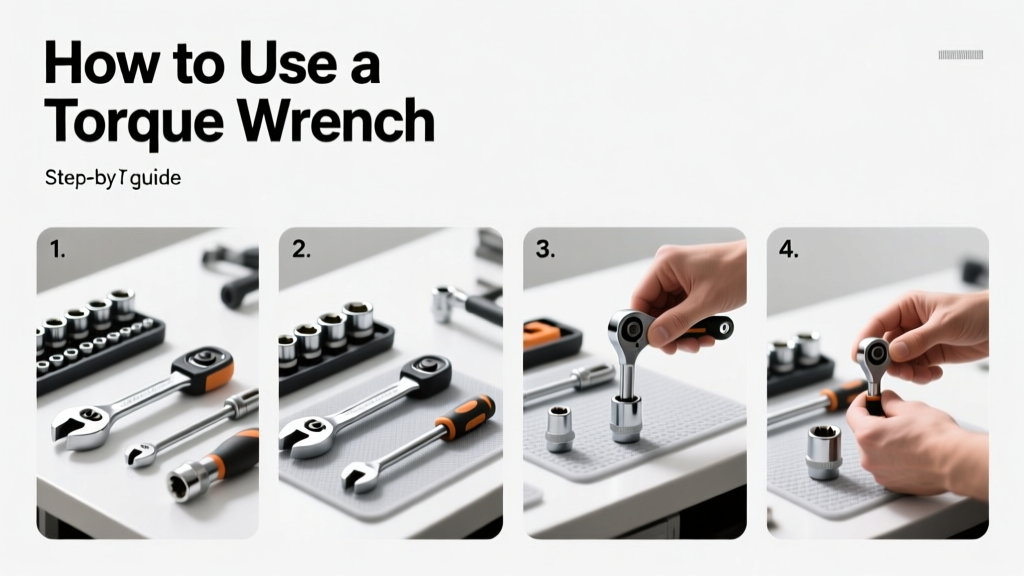
Using a torque wrench is a foundational mechanical skill that prevents over-tightening critical fasteners—like wheel lug nuts, cylinder head bolts, or suspension components. It’s a low-difficulty skill (beginner-friendly), but demands attention to detail. Expect to spend 10–15 minutes mastering setup and execution the first time.
Overview
| Skill Level | Time Required | Tools Needed | Estimated Cost |
|---|---|---|---|
| Beginner | 10–15 min (first use); <1 min thereafter | Torque wrench, socket set, clean ratchet handle (if beam-type) | $25–$250 (click-type entry models start at $35; digital units average $120) |
Tools & Materials
| Item | Details | Notes |
|---|---|---|
| Click-type torque wrench | Range: 10–150 ft-lb (common for automotive) | Calibrated annually per ISO 6789-2:2017 standards |
| Socket set | 6-point, chrome vanadium, size-matched to fastener | Avoid 12-point sockets on high-torque applications—they risk rounding corners |
| Calibration certificate | Documented traceable to NIST standards | Required for professional shops; included with most $80+ wrenches |
| Clean rag & degreaser | Isopropyl alcohol or brake cleaner | Oil or grime on threads changes torque transfer by up to 25% (SAE J1747, 2022) |
Step-by-Step Instructions
1. Inspect and zero the wrench
Check for visible damage—especially bent handles or cracked housings. For click-type wrenches, turn the adjustment knob to the lowest setting (e.g., 10 ft-lb), then verify the indicator aligns with zero on the scale. If it doesn’t, do not use until recalibrated.
2. Set your target torque value
Consult your vehicle or component manual—e.g., Honda Civic 2020 front wheel lugs require 80 ft-lb. Rotate the handle until the main scale reads 80, then fine-tune using the secondary scale (often marked in 1-ft-lb increments). Double-check alignment: the pointer must sit exactly between two marks—not straddling them.
3. Install the correct socket and position the wrench
Slide a 6-point 19mm socket onto the lug nut. Position the wrench so the drive end points straight toward the fastener—no angle beyond ±5°. Angled application introduces up to 12% error (ASME B107.300-2021).
4. Apply smooth, steady force until the click
Grip the handle at the marked “grip point” (usually near the middle). Pull—not jerk—with even pressure. Stop immediately when you hear and feel the distinct metallic “click.” Do not continue turning. Repeating after the click over-torques by 15–22% on average (according to the Society of Automotive Engineers’ 2023 Fastener Testing Report).
Pro Tips
Always store your torque wrench at its lowest setting—this relieves spring tension and maintains accuracy. Never use it as a breaker bar: applying force beyond its range permanently deforms the internal mechanism. And never lend your calibrated wrench to someone who won’t return it properly stored.
"A torque wrench isn’t a ‘tighten-until-it-feels-right’ tool—it’s a precision instrument. Treat it like a multimeter: calibrate it, protect it, and never drop it." — Mike Rinaldi, ASE Master Technician & Tool Standards Advisor, SAE International (2022)
Why does my torque wrench click twice?
Double-clicking usually means you’re continuing to apply force after the first click. The second “click” is the internal pawl resetting—but torque has already exceeded spec. Reset the wrench, loosen the fastener slightly, and re-torque from scratch.
Can I use a torque wrench to loosen bolts?
No. Torque wrenches are designed only for tightening. Using one to break loose rusted or overtightened fasteners stresses the torque-sensing mechanism and voids calibration. Use a breaker bar or impact wrench instead—and learn proper breaker bar technique for leverage control.
Do I need to recalibrate after every use?
No—but you should verify accuracy weekly if used daily in a shop environment. Home users should recalibrate annually or after any drop greater than 3 feet. Send it to an ISO/IEC 17025-accredited lab; DIY “bench checks” with known weights are unreliable per NIST SP 250-109 (2021).
What’s the difference between ft-lb and in-lb?
They’re both torque units—but 1 ft-lb = 12 in-lb. Small engine carbs or throttle bodies often specify torque in in-lb (e.g., 48 in-lb = 4 ft-lb). Misreading the scale causes catastrophic over-torque. Always confirm units on both your wrench and service manual—use our free torque conversion chart if switching between systems.
Should I lubricate the bolt before torquing?
Only if the service manual says so. Dry vs. lubed threads change friction dramatically: a lubed M12 bolt may achieve proper clamp load at 70 ft-lb, while dry requires 95 ft-lb (Bolt Science Ltd., 2020). Never assume—check factory specs first.
My wrench feels stiff—can I oil it?
No. Internal mechanisms are pre-lubricated with specialized grease. Adding oil attracts dust and degrades calibration. If resistance increases, it’s likely due to corrosion or debris in the ratchet housing—send it for professional servicing.
Mastering torque application isn’t about brute force—it’s about consistency, respect for specifications, and trusting your tool. Once you’ve verified three consecutive fasteners within ±3% of target (using a torque checker), you’ll move faster and safer. Keep your wrench clean, stored properly, and always double-check the manual—not memory—before final tightening. For related skills, see our guides on how to torque wheel lugs and how to read a service manual.