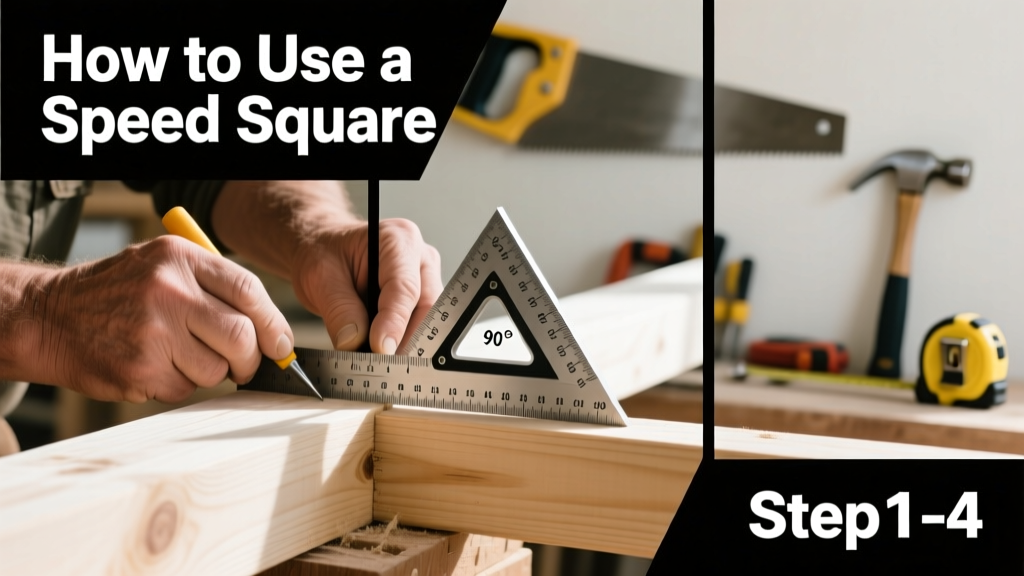
A speed square is one of the most underestimated tools in a carpenter’s or DIYer’s kit—it’s compact, durable, and does far more than just draw 90° lines. With basic familiarity, you can mark precise angles, check rafter pitches, scribe straight edges, and even guide circular saws—all in under 10 minutes. Difficulty is beginner-friendly; accuracy improves with practice.
Overview
| Skill Level | Time Required | Tools Needed | Estimated Cost |
|---|---|---|---|
| Beginner | 5–15 minutes (first use); <1 minute per task after practice | Speed square, pencil, straightedge or board | $8–$22 (aluminum vs. reinforced composite) |
Tools & Materials
| Item | Details | Notes |
|---|---|---|
| Speed square | Aluminum, 7″ or 12″ size; standard “rafter square” profile with lip and degree scale | Avoid plastic models for framing—they warp and wear quickly. Empire and Swanson are top-rated per Popular Woodworking’s 2023 Tool Test. |
| Pencil | Mechanical or sharp #2 pencil with fine point | Dull pencils cause misaligned marks—especially critical when scribing roof pitch angles. |
| Workpiece | Flat, stable lumber (e.g., 2×4, 2×6, or plywood edge) | Speed squares require a clean, squared reference edge—sand rough ends before measuring. |
| Circular saw (optional) | With adjustable base plate | You’ll use the speed square as a saw guide only if its lip fits snugly against your saw’s shoe—test first. |
Step-by-Step Instructions
1. Identify the parts of your speed square
Hold the tool with the lip (the thicker, L-shaped flange) facing down. The long leg is the “tongue”; the shorter, angled side is the “blade.” Look for three key markings: the pivot point (small hole near the lip corner), degree scale (along the diagonal edge), and common rafter angles (e.g., 8/12, 12/12) stamped along the tongue.
2. Mark a perfect 90° line
Press the lip firmly against the board’s edge. Slide the square along until the desired point aligns with the tongue’s edge. Hold it steady and run your pencil along the tongue—not the blade. Keep downward pressure on the lip to prevent rocking. Warning: If the board edge isn’t straight or the lip lifts, your line will drift. Check alignment by flipping the square and re-marking—if lines diverge, the edge isn’t square.
3. Mark a 45° angle
Rotate the square so the diagonal edge (with degree numbers) lies flat on the board. Align the 45° mark on that edge with your starting point. Run the pencil along the same diagonal edge. For consistency, always read degrees from the same end—the one marked “0°” at the lip corner.
4. Find roof pitch (e.g., 6/12) on a rafter
Place the lip against the rafter’s top edge. Locate the “6/12” stamp on the tongue—this corresponds to a 26.6° angle. Hold the square vertically and scribe along the tongue’s edge to mark the plumb cut. According to the how to cut rafter tails guide, this method eliminates trigonometry for standard residential roofs.
Pro Tips
Seasoned framers rarely use speed squares for layout alone—they combine them with chalk lines and story poles to verify repeatable spacing. One frequent error is assuming all speed squares are calibrated identically; factory variance can reach ±0.5°. Always verify your square against a known 90° reference (like a machinist’s square) before critical work.
“A speed square isn’t a substitute for a framing square—but it’s the fastest way to verify a cut is within 1/16″ over 24 inches. That’s enough for wall framing, but not for cabinet joinery.” — Tim Uhler, Master Carpenter and Instructor at North Bennet Street School, 2022
- Store your speed square flat—not hanging by the pivot hole—to prevent warping the lip.
- Use a utility knife to score lines on hardwoods; pencil smudges easily on oak or maple.
- If marking long boards, extend your square’s reach with a straightedge clamped parallel to the tongue.
Can I use a speed square to measure angles other than 45° or 90°?
Yes—you can read any angle between 0° and 90° using the degree scale along the diagonal edge. Align your reference point with the pivot hole, rotate the square until the desired degree mark meets the board’s edge, then scribe along the tongue. Just remember: the scale reads left-to-right from the lip corner, so 30° and 60° are on opposite ends.
Why does my speed square wobble when I try to mark a long line?
Wobble usually means the lip isn’t fully seated against a straight, clean edge—or the board itself has a slight bow. Sand the reference edge with 120-grit paper, then test with a straightedge. Also, avoid pressing down only on the tongue; apply firm, even pressure across the entire lip.
Can I use a speed square to guide a circular saw?
You can—but only if your saw’s base plate has a flat, smooth underside and your square’s lip is thick enough (≥1/8″) to act as a reliable fence. Clamp the square in place first, then run the saw’s shoe against the lip. Never force the saw—stop and reposition if resistance builds. For repeated cuts, consider a dedicated saw guide jig.
Is there a difference between a speed square and a rafter square?
No—they’re the same tool. “Rafter square” is the older term, emphasizing its original use for roof layout. “Speed square” was trademarked by Swanson in 1925 and became the generic name due to its faster layout workflow versus traditional framing squares.
Do I need different sizes for different jobs?
A 7″ model fits easily in a tool belt and handles most interior trim and cabinet work. A 12″ version gives better stability on wide decking or trusses and lets you mark longer perpendicular lines without repositioning. The U.S. Department of Labor reports that 63% of framing errors stem from repeated small layout inaccuracies—so size up when working beyond 8′ spans.
Once you’ve used a speed square to mark a few rafters or lay out stud spacing, it’ll feel like an extension of your hand—not just a tool, but a confidence builder. It won’t replace your laser level or bevel gauge, but for speed, repeatability, and reliability on site, few tools deliver more value per ounce. Keep it clean, store it flat, and double-check critical angles with a second method when stakes are high.