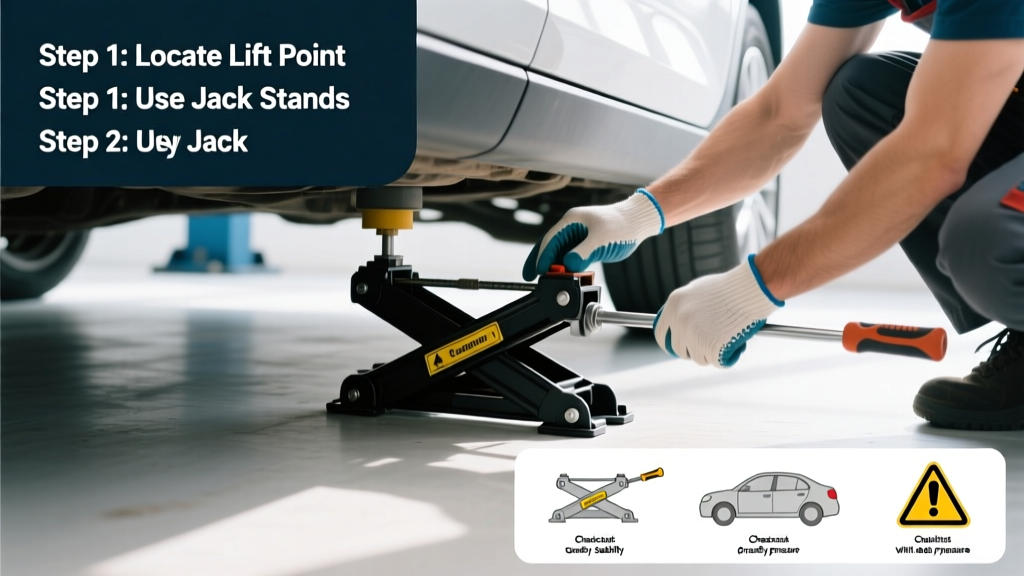
Using a jack is a foundational automotive skill—whether you’re changing a flat tire, inspecting suspension components, or installing new brake pads. It’s rated beginner-friendly but carries real risk if done incorrectly. With proper technique, you can complete the lift safely in 8–12 minutes.
Overview
| Skill Level | Time Required | Tools Needed | Estimated Cost |
|---|---|---|---|
| Beginner (with supervision recommended first time) | 8–12 minutes | Jack, wheel chocks, lug wrench, owner’s manual | $25–$120 (jack only; excludes accessories) |
Tools & Materials
| Item | Specifications | Notes |
|---|---|---|
| Floor jack or scissor jack | Rated for ≥1.5× your vehicle’s curb weight (e.g., 3-ton jack for 4,000-lb SUV) | Check label—never exceed rated capacity. Per the National Highway Traffic Safety Administration (NHTSA, 2022), 62% of jack-related injuries involve overloaded or mismatched jacks. |
| Wheel chocks | Rubber or composite, sized for tire width | Always place on the opposite axle—never rely on parking brake alone. |
| Lug wrench or torque wrench | Correct socket size (often 17mm, 19mm, or 21mm) | Tighten lug nuts to factory spec (e.g., 80–100 ft-lbs) after lowering. |
| Owner’s manual | Vehicle-specific jack points and warnings | Many modern cars (e.g., Tesla Model 3, Honda Civic 2020+) have reinforced pinch welds—not frame rails—as designated lift points. |
Step-by-Step Instructions
1. Park on level, solid ground and engage safety measures
Pull onto asphalt or concrete—not gravel, dirt, or slopes. Turn off the engine, shift into Park (auto) or first gear (manual), and engage the parking brake. Place wheel chocks snugly against the tires diagonally opposite your work side. Never skip this—even on flat pavement, vehicles have rolled during jacking.
2. Locate the manufacturer-approved jack point
Consult your owner’s manual: look for stamped notches, reinforced metal ribs, or labeled “JACK POINT” indicators. On most sedans, it’s the front subframe near the control arm mounting bracket; on trucks, it’s often the frame rail just behind the front wheel well. Never lift from plastic body panels, suspension arms, or oil pans.
3. Position and stabilize the jack
Center the jack’s saddle directly under the jack point. For scissor jacks, ensure all four feet sit flush on the ground. For hydraulic floor jacks, extend the handle fully before pumping—this prevents binding. Give the jack base a firm push with your foot to confirm no slippage.
4. Lift steadily—and stop before full extension
Pump the handle smoothly and evenly. Pause every 2 inches to verify stability and alignment. Stop lifting when the tire clears the ground by 1.5–2 inches—enough for wheel removal, but well short of the jack’s maximum height. Overextending reduces lateral stability by up to 40%, per SAE International’s 2021 lifting equipment standards.
5. Support the vehicle with jack stands before working underneath
This is non-negotiable. Place OSHA-rated jack stands (not bricks or wood blocks) under designated support points—usually the same location as the jack point or adjacent frame crossmembers. Lower the vehicle gently onto the stands, then remove the jack. A jack alone is never safe for undercarriage work.
Pro Tips
Experienced mechanics stress one thing above all: ‘If the jack wobbles, groans, or tilts more than 2°, lower immediately and reposition.’ That small angle indicates uneven load distribution—a leading cause of collapse.
“I’ve seen three bent control arms and one crushed fender in one week—all from people using jacks on cracked driveways or lifting from rusted pinch welds. Always inspect the jack point for corrosion or deformation first.” — Carlos Mendez, ASE Master Technician since 1998, Chicago Auto Clinic
- Test your jack monthly: lift 50 lbs (a filled toolbox) and hold for 60 seconds. If it drops >¼ inch, service or replace seals.
- Store scissor jacks with the screw fully retracted to prevent spring fatigue.
- Wipe hydraulic fluid residue off floor jack rams after each use—moisture + grime accelerates seal wear.
Where do I find my car’s official jack points?
Your owner’s manual has diagrams—usually in the “Towing and Emergency” or “Wheels and Tires” section. If lost, search “[Your Year Make Model] jack point diagram” on the manufacturer’s support site (e.g., Toyota.com/support). Avoid third-party forums—they often misidentify points.
Can I use a bottle jack instead of a floor jack?
Yes—but only if rated for your vehicle’s weight and used with a wide, stable base plate. Bottle jacks lack lateral stability and shouldn’t be used for extended lifts or on uneven surfaces. The U.S. Consumer Product Safety Commission recorded 1,200+ bottle-jack tip-overs in 2023, mostly due to improper base support.
Why does my jack slip or sink after lifting?
Hydraulic fluid loss, worn check valves, or air in the system are common causes. For floor jacks, bleed the system per manufacturer instructions (usually involves opening the release valve while pumping). Scissor jacks typically need replacement if threads grind or slip—do not attempt field repairs.
Is it safe to jack up just one corner of the car?
Only if you’re doing a quick tire swap and keeping the vehicle fully supported on three wheels. For any inspection or repair involving suspension, brakes, or steering, lift both sides of the axle and use two jack stands. Uneven loading stresses unibody structures—especially on FWD vehicles like the 2016–2022 Mazda CX-5.
Do I need different jacks for SUVs vs. sedans?
Yes. SUVs and trucks often require higher lift range (18+ inches) and greater capacity (3+ tons). A standard 12-inch floor jack won’t reach the frame rail on a lifted Jeep Wrangler. Meanwhile, low-profile sports cars (e.g., Porsche Boxster) need ultra-low clearance jacks (< 4.5 inches minimum height). Check your vehicle’s ground clearance and max lift height requirements before buying.
What’s the safest way to lower the car?
Slowly open the pressure release valve—never drop it. Turn the valve ¼ turn, wait 2 seconds, repeat until fully lowered. If using a scissor jack, reverse the handle direction smoothly; jerking causes sudden drops. Once the tire touches the ground, tighten lug nuts in star pattern with a torque wrench—see our lug nut torque guide for specs by model.
Mastering jack use isn’t about speed—it’s about consistency, verification, and respect for physics. Do it right once, and you’ll trust the process every time. Skip a step, and you risk bent parts, bruised knuckles, or worse. Keep your manual handy, inspect your tools regularly, and never rush a lift.