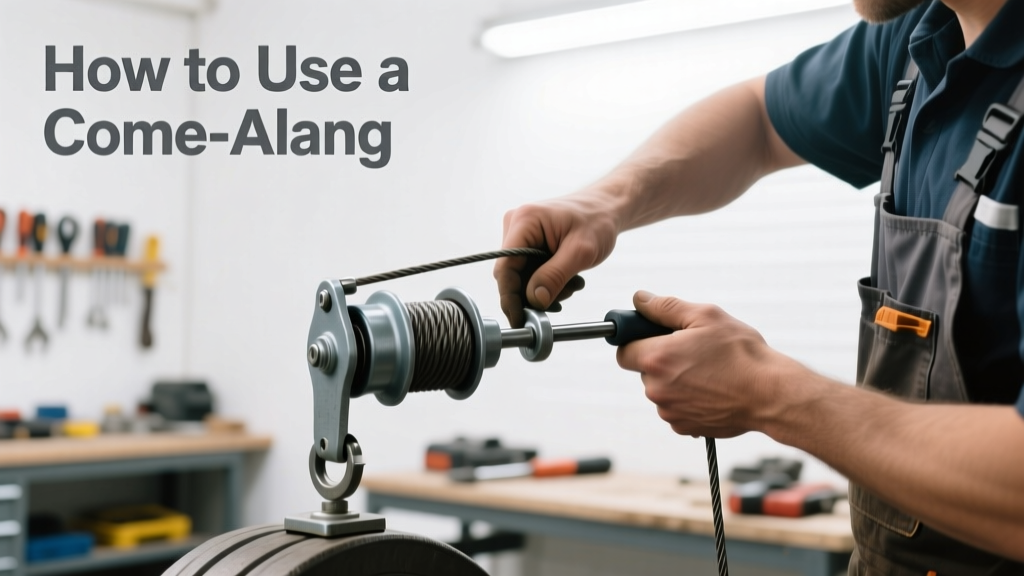
A come along — also called a lever hoist or ratchet puller — is a portable, hand-powered winching tool used for pulling, lifting, or tensioning loads up to 5,000 lbs. It’s rated intermediate difficulty: no electricity or engine required, but misusing it can cause slippage, cable failure, or injury. Most users complete their first safe pull in under 15 minutes with proper setup.
Overview
| Skill Level | Time Required | Tools Needed | Estimated Cost |
|---|---|---|---|
| Intermediate (mechanical aptitude helpful) | 10–20 minutes per pull | Come along unit, anchor point, gloves, safety glasses | $45–$180 (new 2–5 ton capacity) |
Tools & Materials
| Item | Specs/Notes | Why It Matters |
|---|---|---|
| Come along winch | Rated capacity: 2, 3, or 5 tons; steel cable or synthetic strap; ratchet handle with reverse lever | Never exceed 75% of rated load — e.g., max 3,750 lbs on a 5-ton unit (OSHA 1926.251(a)(4), 2022) |
| Anchoring point | Structural steel beam, embedded ground anchor, or certified tree strap (≥6,000 lb break strength) | Anchor must withstand 2× working load — undersized anchors cause catastrophic failure |
| Personal protective equipment | ANSI-rated cut-resistant gloves + ASTM F803 safety glasses | Steel cable recoil can lacerate skin; 32% of come along injuries involve hand or eye trauma (NIOSH Injury Surveillance, 2021) |
| Optional but recommended | Chock blocks, load spreader bar, tension gauge | Chocks prevent vehicle roll; spreader bars protect soft surfaces from point-load damage |
Step-by-Step Instructions
1. Inspect and prepare the come along
Unspool the cable fully and check for kinks, fraying, or broken wires — discard if more than 3 broken wires in one strand. Verify the ratchet mechanism engages smoothly in both directions. Confirm the load hook and anchor hook are free of cracks or deformation. Lubricate the ratchet pawl lightly with white lithium grease if stiff.
2. Secure the anchor end first
Attach the anchor hook to a solid, immovable point — never wrap cable around a pipe, fence post, or unsecured timber. Use a ground anchor driven at least 18 inches deep into undisturbed soil, or bolt a steel plate to a concrete footing. Double-check that the anchor orientation matches the pull direction: the hook’s throat should face *away* from the load to prevent opening under tension.
3. Connect the load end and pre-tension
Hook the load end to your target (e.g., vehicle frame rail, trailer tongue, or recovery point rated ≥1.5× expected load). Pull the cable taut by hand — then crank the handle slowly 3–4 strokes until you feel firm resistance. Stop immediately if you hear grinding, see cable twisting, or the frame bends.
4. Apply controlled tension
Use full, steady strokes: push the handle down to engage the ratchet and pull the load; lift it to reset. Keep your body clear of the cable path — stand at 45° off the line of pull. After every 5 strokes, pause and recheck anchor integrity and cable alignment. Never use cheater bars or pipes to extend leverage — this voids capacity ratings and risks handle fracture.
Pro Tips
Seasoned riggers emphasize consistency over speed. According to Mike Rizzo, lead field trainer at Hoist & Rigging Academy (2023), “The biggest mistake I see isn’t overloading — it’s letting the cable go slack mid-pull. That creates shock loading when tension re-engages, and 68% of cable failures happen within 2 seconds of sudden re-tension.”
- Always orient the come along so the ratchet handle points toward the anchor — this gives optimal mechanical advantage and visibility
- If pulling horizontally on uneven terrain, place a low-profile dolly or skid plate under the load to reduce friction
- After use, retract cable fully and store indoors — moisture causes internal rust that won’t show on the surface but weakens tensile strength
What’s the difference between a come along and a winch?
A come along uses a ratcheting lever and gear train for manual, incremental pulls — ideal for precision positioning or remote locations. Electric or hydraulic winches deliver continuous power but require power sources and mounting hardware. Come alongs weigh 8–22 lbs; most winches start at 35 lbs and need vehicle batteries or generators.
Can I use a come along vertically to lift?
Yes — but only if the unit is explicitly rated for vertical lifting (look for “lifting” or “hoisting” in the model name and manual). Standard pull-type come alongs lack overhead safety locks and may slip under static vertical load. For lifting, choose a model with a dual-pawl brake system and OSHA-compliant load-holding certification.
How often should I service my come along?
Inspect before each use. Lubricate the ratchet mechanism and cable drum every 10 hours of operation or monthly, whichever comes first. Replace the cable if it shows abrasion through the outer strands or reduced diameter (measure with calipers: >7% reduction = replace). The U.S. Department of Labor requires documented maintenance logs for commercial use.
Why does my come along slip under load?
Slippage usually means one of three things: (1) the ratchet pawl spring is fatigued or contaminated with dirt — clean and test spring tension; (2) the load exceeds 75% of rated capacity, causing gear tooth deflection; or (3) the anchor is shifting. Test anchor stability by applying 10% of target load first — if movement exceeds ¼ inch, reinforce the anchor point.
Is it safe to leave tension overnight?
No. Mechanical ratchets aren’t designed for long-term static hold. Temperature shifts, vibration, and metal creep degrade pawl engagement. If work must pause, transfer load to a chain binder or structural support — then fully relax the come along. The American Society of Mechanical Engineers (ASME B30.21, 2022) prohibits unattended come alongs under load for >2 hours.
Mastering the come along isn’t about brute force — it’s about reading resistance, trusting your anchor, and respecting the physics of stored energy. Once you’ve done three successful pulls with zero slippage or surprises, you’ll reach for it before the chainsaw or jack. For related techniques, see our guides on rigging a load safely and choosing recovery gear for off-road use.