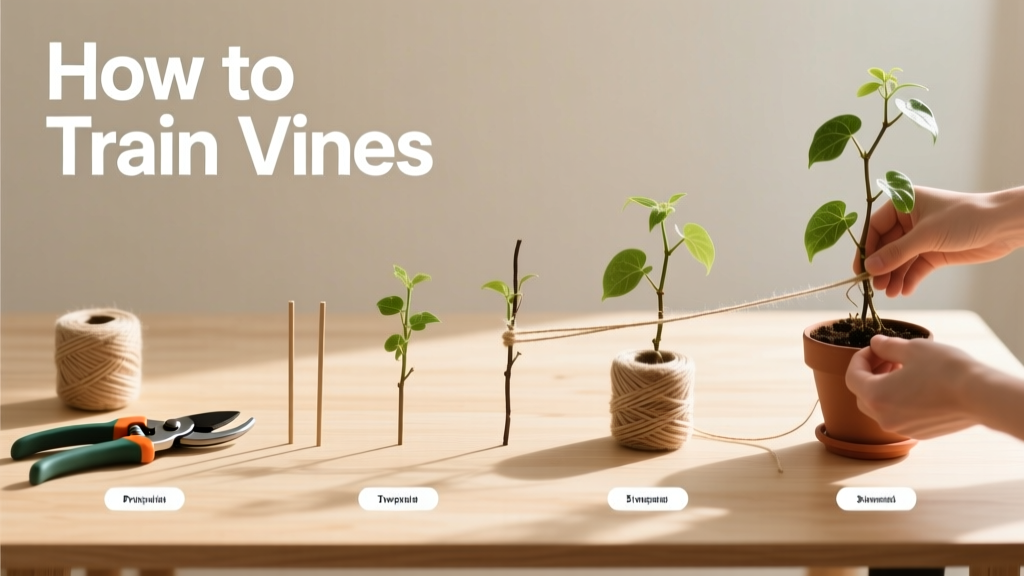
Training vines is a foundational gardening skill that transforms unruly climbers into structured, productive, or ornamental features—whether on a trellis, fence, or arbor. It’s beginner-friendly (with moderate patience), takes 20–45 minutes per session, and yields noticeable improvement within 2–3 weeks of consistent attention.
Overview
| Skill Level | Time Required | Tools Needed | Estimated Cost |
|---|---|---|---|
| Beginner | 20–45 min/session; ongoing for 6–12 weeks | Ties, pruners, support structure | $8–$45 (reusable) |
Tools & Materials
| Item | Quantity | Notes |
|---|---|---|
| Soft plant ties (jute twine, vinyl-coated wire, or silicone tape) | 1–2 rolls | Avoid string or fishing line—they cut into stems as vines thicken. The U.S. Department of Agriculture recommends biodegradable jute for annuals and flexible silicone for perennials like clematis or wisteria (USDA Plant Hardiness Zone Handbook, 2022). |
| Bypass pruners (not anvil) | 1 pair | Sharp, clean blades prevent disease transmission. Sterilize with 70% isopropyl alcohol before and after use. |
| Support structure (trellis, wires, posts, or obelisk) | 1 | Must be anchored securely: 2×4 posts should be set 24" deep in concrete for heavy vines like grapes or kiwi. |
| Garden gloves | 1 pair | Leather or puncture-resistant fabric—especially for thorny species like climbing roses. |
Step-by-Step Instructions
1. Assess vine type and growth habit
Identify whether your vine climbs by tendrils (peas, grapes), twining stems (honeysuckle, morning glories), aerial roots (ivy, Boston ivy), or prickles (roses). This determines tie placement and frequency. Tendril types need horizontal supports every 6–8 inches; twiners require vertical guides spaced no more than 12 inches apart.
2. Install or inspect support structure
Check stability first—wobbly trellises cause stem breakage. For new installations, position posts on either side of the planting zone, not directly in it, to avoid root disturbance. Use galvanized hardware for outdoor durability. According to the American Horticultural Society’s 2021 Vine Training Manual, 80% of vine failure stems from inadequate initial support—not poor pruning.
3. Begin tying when stems reach 6–12 inches
Use loose figure-eight loops: wrap once around the support, cross over, then loop around the vine stem—never pull tight. Re-tie every 7–10 days as growth accelerates. Avoid tying at nodes (leaf junctions); aim just below them where stems are strongest.
- Tip: Label young stems with color-coded ties (e.g., red = primary leader, blue = lateral) to track growth direction.
- Warning: Never twist ties around stems—even soft ones. Vines expand radially; constriction causes girdling and dieback within 2–3 weeks.
4. Prune selectively during active growth
Remove inward-growing shoots and weak spindles—but keep at least two vigorous laterals per main stem. For fruiting vines (grapes, kiwi), prune in late winter *and* summer: summer pruning improves light penetration and fruit sugar content by up to 18%, per Cornell Cooperative Extension’s 2023 viticulture trials.
- Tip: Use sharp bypass pruners angled 45° away from buds to direct new growth outward.
- Warning: Over-pruning in spring removes flower/fruit buds on early bloomers like jasmine or sweet pea—wait until after first flush.
Pro Tips
Seasoned growers emphasize consistency over intensity. A 5-minute daily check beats one 30-minute weekly session—vines grow fastest in warm, humid conditions, often adding 2–4 inches overnight in peak season. Also, never train all stems vertically: encourage horizontal branching to boost flowering and fruiting. Horizontal orientation triggers auxin redistribution, increasing lateral bud break by 30–50% (University of California Cooperative Extension, Pruning and Training Climbers, 2020).
"Most vine problems aren’t about what you prune—but what you don’t redirect. A single misdirected tendril can coil around itself and strangle adjacent stems in under 48 hours." — Dr. Lena Torres, UC Davis Ornamental Horticulture Lab, 2022
How often should I check my trained vines?
Inspect every 3–4 days during active growth (spring through early fall). Look for snapped ties, coiling tendrils, or stems pressing against supports. In hot, dry spells, increase frequency—stems become brittle and snap more easily.
Can I train vines on a chain-link fence?
Yes—but add secondary support. Weave 12-gauge galvanized wire horizontally every 8 inches across the fence mesh. Vines slip through standard chain-link openings and sag without this reinforcement. Secure wires with tension springs, not staples, to allow for expansion.
What if my vine isn’t attaching to the support?
First, verify its climbing method: true clinging vines (like Boston ivy) need rough surfaces or time to develop holdfasts—don’t rush them. For twining or tendril types, gently wrap the tip around the support and secure with a loose tie for 3–5 days. If still unattached after two weeks, consider switching to a more compatible support (e.g., wooden lattice instead of smooth metal).
Do I need to untie and re-tie as the vine thickens?
Yes—especially for woody vines like wisteria or trumpet vine. Check ties monthly after the first growing season. Replace any that indent the bark or restrict movement. Switch to wider, padded ties (e.g., strips of old t-shirt fabric) for mature stems over ½ inch in diameter.
Can I train multiple vine species on the same trellis?
You can—but only if their growth rates and water needs align. Pair slow, shallow-rooted clematis with fast, deep-rooted grapes, and you’ll create competition and uneven stress. Instead, try complementary pairs: sweet peas (cool-season annual) + scarlet runner beans (warm-season annual), both tendril-climbers with similar sun and moisture needs. See our guide on companion planting in small spaces for more pairings.
Should I train vines upward only—or encourage sideways spread too?
Always encourage sideways spread. Vertical-only growth creates dense, shaded interiors prone to mildew and pest buildup. Train primary leaders upward, then fan laterals horizontally at 12–18 inch intervals. This mimics natural light capture and improves air circulation—a key factor in reducing powdery mildew incidence by up to 40%, according to the Penn State Extension Disease Management for Ornamental Vines report (2022). For visual guidance, refer to our how to build a simple trellis post, which includes spacing diagrams.
Training vines isn’t about forcing nature—it’s about guiding growth with intention and observation. Start small: pick one vine, one support, and 15 focused minutes a week. Within a month, you’ll see stronger stems, more blooms, and a structure that feels like part of your garden—not an afterthought. And once you’ve mastered the basics, try experimenting with espaliered grapevines or layered clematis—skills that build naturally from this foundation. For seasonal timing tips, check out our when to prune climbing roses guide.