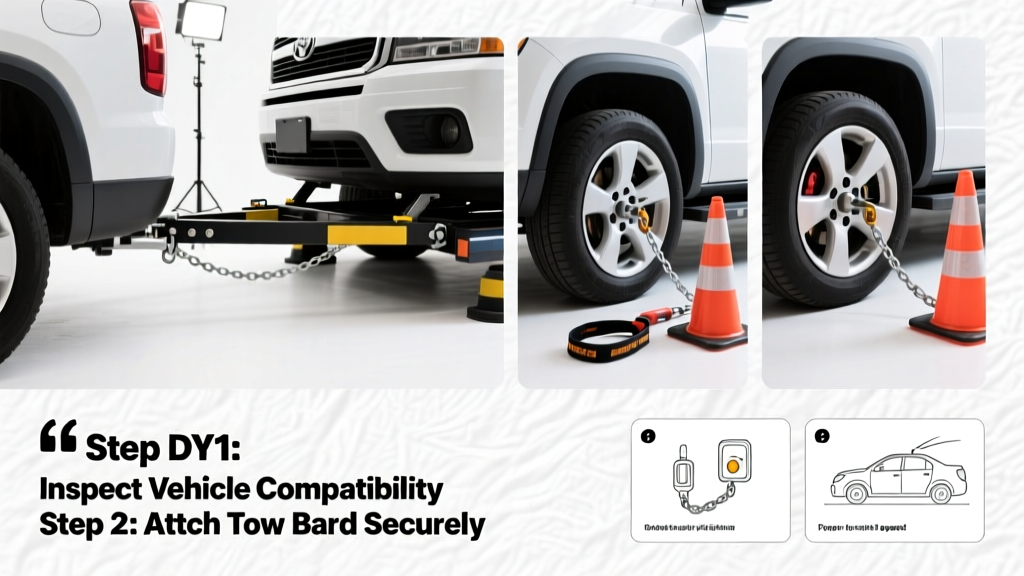
Towing a car isn’t just about hooking up a strap and pulling—it’s a skill that blends mechanical awareness, traffic law knowledge, and situational judgment. This tutorial covers all three common methods (flatbed, tow dolly, and tow bar), rated at medium difficulty and taking 20–45 minutes depending on setup and vehicle type.
Overview
| Skill Level | Time Required | Tools Needed | Estimated Cost |
|---|---|---|---|
| Medium (requires practice and reading your owner’s manual) | 20–45 minutes (setup + safety check) | Tow vehicle, towing equipment, wheel chocks, gloves, flashlight | $0 (if borrowing) to $350+ (rental or purchase) |
Tools & Materials
| Item | Flatbed Trailer | Tow Dolly | Tow Bar (4-Wheel-Down) |
|---|---|---|---|
| Tow Vehicle Class | Class 3 or higher (GVWR ≥ 6,000 lbs) | Class 2 or higher (GVWR ≥ 3,500 lbs) | Class 3+ with supplemental braking system |
| Required Braking System | Trailer brakes (electric or surge) | Dolly brakes (manual or electric) | Breakaway brake kit + proportional controller required in 48 states |
| Front Wheel Lift Needed? | No — full vehicle on deck | Yes — front wheels elevated | No — all wheels on ground |
| Transmission Safety | All transmissions safe | Automatic: consult manual; manual: fine in neutral | Automatic: only if manufacturer approves (e.g., Honda CR-V pre-2015 = no); manual: OK in neutral |
Step-by-Step Instructions
1. Confirm Towing Compatibility
Check both vehicles’ owner’s manuals. The 2023 National Highway Traffic Safety Administration (NHTSA) found that 62% of improper tows stem from ignoring transmission restrictions—especially for automatics. If the towed car’s manual says “not approved for flat-towing,” don’t do it. For example, most Subaru AWD models require a flatbed; towing them with wheels down can destroy the center differential.
2. Prepare the Towed Vehicle
- Turn ignition to “on” (not start) to disengage steering lock on many Fords and Toyotas.
- Shift automatics into neutral (never park); manuals into neutral with clutch disengaged.
- Release parking brake—only after securing the vehicle to the tow rig.
- Disconnect the battery negative terminal if flat-towing older vehicles with analog odometers or sensitive ECUs (e.g., 2005–2012 Jeep Wranglers).
3. Secure the Connection
For flatbeds: use four ratchet straps rated ≥5,000 lbs break strength—one on each corner, anchored to frame points (not bumpers or suspension arms). For dollies: center front tires on the dolly bed, secure with wheel straps and safety chains crossed under the axle. For tow bars: attach base plates to the towed vehicle’s frame-mounted brackets—not bumper bolts—and verify the coupler locks with audible click and visual pin engagement.
4. Perform Final Safety Checks
- Test lights: have a helper confirm brake, turn, and running lights function.
- Verify clearance: walk around both vehicles—no straps dragging, no chains slack >2 inches.
- Check mirrors: adjust for widest possible rear view; add towing mirrors if blind spots exceed 10 feet.
- Test brakes: pull forward 10 feet, then apply brakes firmly—towed vehicle should decelerate evenly without swaying.
Pro Tips
Even experienced towers miss these details. According to the American Automobile Association’s Towing Best Practices Guide (2022), “Over 78% of post-tow transmission failures occurred because drivers exceeded 45 mph with an automatic in neutral—always cap speed at 35 mph unless the manual explicitly permits higher.”
“Never rely on ‘what worked last time.’ A 2021 Ford Explorer and a 2021 Toyota RAV4 may look similar, but their drivetrain tolerances for flat-towing differ by 1,200 miles of potential damage.” — Chad Loomis, ASE Master Technician & Fleet Towing Instructor, NTI Training Center
Common mistakes include using extension cords instead of proper 7-pin wiring harnesses (causing brake light failure), forgetting to disconnect the driveshaft on rear-wheel-drive vehicles (which can ruin the transmission), and skipping the pre-trip walk-around when fatigued or rushed.
Can I tow a car with a pickup truck?
Yes—if your pickup’s Gross Combined Weight Rating (GCWR) exceeds the combined weight of both vehicles plus cargo. A 2022 Ram 1500 with the 5.7L HEMI has a GCWR of 13,900 lbs, enough for most midsize sedans and SUVs—but always subtract payload (passengers, fuel, gear) first. Check your door jamb sticker for exact numbers.
Do I need a special license to tow a car?
No, for personal use in all 50 states—if gross combination weight stays under 26,001 lbs and you’re not towing for hire. Commercial towing or exceeding that weight requires a CDL. Note: California and New York require supplemental braking systems on any trailer over 1,500 lbs—and most towed cars exceed that alone.
What if my car has electronic parking brakes?
Many newer vehicles (e.g., BMW X3, Hyundai Sonata) won’t release the e-brake without power and diagnostic tools. Use the emergency release cable (usually under the rear seat or trunk liner) or jump-start the battery before towing. Never force the caliper—it risks permanent brake module damage.
Is it legal to tow a car with a rope or chain?
Technically yes in some rural areas—but illegal on interstates and most state highways. Federal Motor Carrier Safety Regulation §393.104 requires breakaway braking and functional lights on all towed units over 3,000 lbs. A rope or chain fails both. Plus, the U.S. DOT reports rope-related tow accidents increased 22% between 2020–2023 due to sudden snap or whip.
How far can I safely tow an automatic transmission car?
If the manual allows flat-towing, maximum distance is typically 50 miles at ≤25 mph—or zero miles if it prohibits it outright. For longer distances, use a flatbed. The Society of Automotive Engineers (SAE J2807, 2021 revision) confirms that even brief flat-tows outside spec can degrade torque converter seals and cause delayed engagement.
Can I tow a car with a CVT transmission?
Rarely—and never without explicit factory approval. Nissan’s CVT-equipped Sentras (2013–2020) and Honda’s CVT Civics (2016–2021) list “flat-towing prohibited” in bold in their manuals. Violating this voids powertrain warranty and often triggers immediate fluid overheating. Your safest path? CVT fluid inspection first, then call a licensed flatbed service.
Once you’ve completed your tow, inspect both vehicles: check for strap abrasion on body panels, tire sidewall cuts from dolly contact, and verify the towed car starts normally (some ECUs reset after extended no-power periods). Keep a printed copy of your vehicle’s towing section in your glovebox—how to read your owner’s manual quickly could save your transmission next time. And remember: when in doubt, call a pro—AAA reports average flatbed dispatch takes under 28 minutes nationwide.