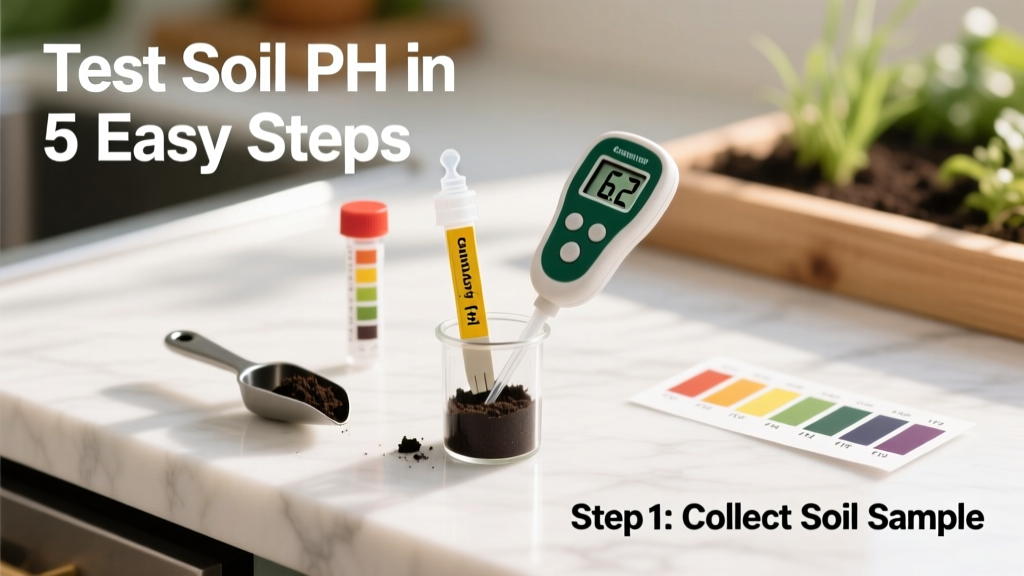
Testing soil pH tells you whether your garden soil is acidic, neutral, or alkaline — a critical factor for nutrient availability and plant health. This skill is beginner-friendly, takes under 20 minutes per sample, and requires no special training.
Overview
| Skill Level | Time Required | Tools Needed | Estimated Cost |
|---|---|---|---|
| Beginner | 15–20 minutes per sample | Soil sample, water, testing tool | $5–$45 (varies by method) |
Tools & Materials
| Item | Purpose | Notes |
|---|---|---|
| Soil test kit (litmus-based or colorimetric) | Chemical reaction shows pH via color chart | Most common; $5–$15; includes vials, reagents, and chart |
| Digital pH meter | Electronic probe gives instant numeric reading | Requires calibration; $20–$45; lasts years with care |
| Distilled water | Prevents interference from tap minerals | Do not use tap water — it skews results (U.S. EPA, 2022) |
| Clean trowel or soil auger | Collects representative sample | Avoid rusty or galvanized tools that may leach metals |
| Small plastic container or zip-top bag | Holds sample before testing | Label with location and date |
Step-by-Step Instructions
1. Collect a representative soil sample
Dig five 6-inch-deep cores from different spots in your bed or lawn — avoid compost piles, fertilizer spills, or areas near foundations. Mix them in a clean bucket, then air-dry for 24 hours (no oven or heater). Sift out roots and stones. Use only the fine, crumbly fraction.
- Tip: For lawns, sample at root-zone depth (2–4 inches); for vegetable beds, go to 6–8 inches.
- Warning: Wet soil gives false high pH readings — never test damp or recently watered soil.
2. Prepare the soil-water slurry (for chemical kits)
Measure 1 part dry soil to 1 part distilled water (e.g., 1 tablespoon soil + 1 tablespoon water) in a clean cup. Stir gently for 30 seconds. Let sit 10 minutes until water clears slightly.
3. Run the test
For colorimetric kits: Insert test strip or add reagent drop, swirl, wait 30 seconds, then match color to chart under natural light. For digital meters: Calibrate first (using pH 4.0 and 7.0 buffer solutions), then insert probe into slurry — hold steady for 60 seconds until reading stabilizes.
- Tip: Rinse probe with distilled water between samples to prevent cross-contamination.
- Warning: Don’t press digital probes into dry soil — they’ll break or give erratic readings.
4. Record and interpret results
Note the pH value and location. Most vegetables thrive at pH 6.0–7.0; blueberries prefer 4.5–5.5; lilacs and clematis do best above 7.0. If your reading falls outside your crop’s ideal range, consult our guide on how to amend soil pH.
Pro Tips
Seasonal timing matters: Test in early spring before planting or in fall after harvest — not during drought or heavy rain. Soil pH shifts slowly, so retest every 1–2 years unless amending heavily.
"A single pH unit represents a tenfold difference in hydrogen ion concentration — so 6.0 isn’t just 'a little more acidic' than 7.0. It’s ten times more acidic." — Dr. Sarah Lin, Soil Science Extension Specialist, Cornell Cooperative Extension, 2021
Common mistakes include using dirty tools, skipping calibration on digital meters, and testing only one spot in a large area. Always composite samples from at least five locations — University of Vermont Extension found single-spot tests misrepresent actual field pH 68% of the time (2020).
Why does soil pH affect plant growth?
pH controls solubility of essential nutrients like iron, manganese, phosphorus, and calcium. At pH below 5.5, aluminum becomes toxic to roots; above 7.5, phosphorus binds tightly to calcium and becomes unavailable. That’s why broccoli may yellow in alkaline soil and potatoes scab in overly acidic conditions.
Can I trust cheap $5 test kits?
Yes — for relative accuracy (±0.5 pH units) and trend tracking. They won’t match lab-grade precision, but they reliably tell you whether your soil is acidic, neutral, or alkaline. For commercial growers or problem soils, send samples to a certified lab like your state’s extension service.
What if my pH reading is inconsistent across samples?
Variability signals patchy soil conditions — common near old foundations (lime leaching), compost piles (temporary acidity), or where mulch has broken down unevenly. Map each reading and treat zones separately. Never average widely divergent values.
Does rain or watering change soil pH quickly?
No — natural rainfall rarely shifts pH more than 0.1–0.2 units per year. Major changes require decades or human intervention (e.g., repeated sulfur applications or wood ash). What *does* change fast is surface pH after fertilizer application — wait 2 weeks after amending before retesting.
How deep should I sample for trees and shrubs?
Go deeper: 12–18 inches for established woody plants. Their roots explore farther down, and subsoil pH often differs from topsoil — especially in layered soils or those with clay pans. Use a soil auger, not a trowel, for this depth.
Can I test potted plant soil the same way?
Yes, but adjust the ratio: Use 2 parts soil to 1 part distilled water (potting mixes drain faster and hold less buffer). Also test multiple pots — container soils acidify faster due to frequent watering and fertilizer salts. Check our indoor plant soil care guide for more.
Once you’ve confirmed your soil’s pH, you’ll know exactly which plants will thrive — and whether lime, sulfur, or organic matter adjustments are needed. With practice, you’ll run reliable tests in under 15 minutes, turning guesswork into grounded, science-backed gardening decisions.