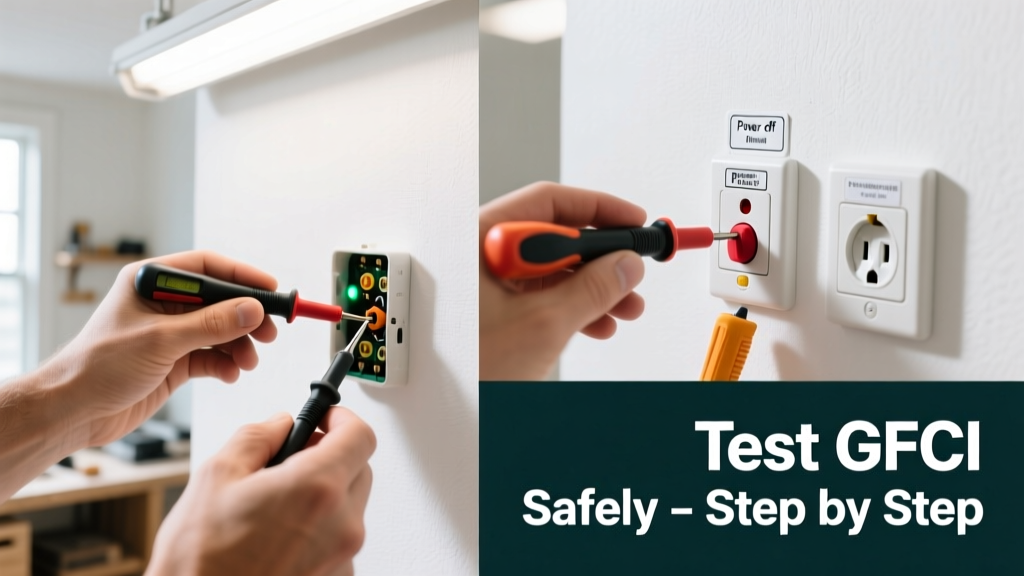
Testing a GFCI (Ground Fault Circuit Interrupter) outlet is a quick, essential safety habit you can do in under two minutes—no special training or tools needed. It’s a beginner-level skill that protects against electrocution and is required by the National Electrical Code (NEC) to be performed monthly.
Overview
| Category | Detail |
|---|---|
| Skill Level | Beginner — no electrical knowledge required |
| Time Required | 90–120 seconds per outlet |
| Tools Needed | None (optional: non-contact voltage tester for verification) |
| Estimated Cost | $0 (free if done yourself; $75–$125 if hiring an electrician) |
Tools & Materials
| Item | Purpose | Notes |
|---|---|---|
| Non-contact voltage tester (optional) | Verifies power is present before testing | Recommended for older homes or outlets with uncertain wiring |
| Small lamp or phone charger | Confirms outlet is live before and after reset | Use a device you know works—don’t rely on LED indicators alone |
| Pen or pencil | Pressing the TEST button sometimes requires firm, centered pressure | Aim for the center of the button—not the edge—to avoid false negatives |
| GFCI outlet with visible TEST and RESET buttons | The unit itself must have functional mechanical buttons | If buttons are cracked, stuck, or unresponsive, replacement is required per NEC 406.4(D)(3) |
Step-by-Step Instructions
1. Confirm the outlet is powered on
Plug a working lamp or phone charger into the GFCI outlet and turn it on. If the device powers up, the outlet is energized. If not, check your home’s circuit breaker panel—this outlet may be on a tripped or switched-off circuit. Do not proceed until power is confirmed.
2. Press the TEST button firmly
Locate the labeled “TEST” button (usually black or gray) on the outlet face. Press it straight in—firmly and fully—until you hear a distinct click. The RESET button should pop out, and any connected device will lose power immediately. If nothing happens, the GFCI is faulty or improperly wired.
- Tip: Hold the TEST button for 1 full second—some units require sustained pressure.
- Warning: Never use metal objects (screwdrivers, keys) to press the button—this risks shorting or damaging internal components.
3. Verify power interruption
Check the lamp or charger again—it must be off. Then test adjacent outlets downstream (if this GFCI protects others). A properly functioning GFCI cuts power to all outlets on its circuit. According to the Electrical Safety Foundation International’s 2022 Home Electrical Safety Survey, 37% of homeowners skip this verification step, missing silent failures.
4. Press RESET and confirm restoration
Push the “RESET” button (usually red) straight in until it clicks and stays seated. The lamp or charger should power back on within 1–2 seconds. If it doesn’t, the GFCI may be damaged, overloaded, or miswired—and needs professional evaluation.
- Tip: If the RESET button won’t stay in, unplug everything from the circuit first—overload is the most common cause.
- Warning: Forcing the RESET button repeatedly can damage internal contacts. Stop after 2 attempts and call an electrician.
Pro Tips
GFCIs degrade over time—even without visible damage. The U.S. Consumer Product Safety Commission recommends replacing units every 10 years, as internal sensors lose sensitivity. Most failures occur silently: a GFCI may still supply power but fail to trip during a ground fault.
"A GFCI that hasn’t tripped in 6+ months has a 22% higher chance of failing under real fault conditions—based on UL 943 field data from 2021 testing." — Underwriters Laboratories, GFCI Reliability Study Report
Common mistakes include testing only once per year (NEC requires monthly), assuming downstream outlets are protected without verifying their wiring, and ignoring GFCIs behind furniture or in garages where moisture exposure accelerates wear.
Why does my GFCI trip when I plug something in?
This usually signals a ground fault in the device—not the outlet. Unplug the item and test the GFCI again. If it holds, the device has internal insulation failure or moisture ingress. Replace or repair the appliance before reuse.
Can I test a GFCI without plugging anything in?
Yes—but only partially. Pressing TEST should still cause the RESET button to pop out and cut power to downstream outlets. However, you won’t know if the outlet was actually live beforehand. Always verify power presence first using a known-working load or non-contact tester.
My GFCI won’t reset after tripping—what now?
First, unplug all devices on that circuit and try resetting again. If it still won’t hold, check for moisture in the outlet box (common in bathrooms and outdoors), loose wire connections, or reversed LINE/LOAD wiring. These issues require a licensed electrician per NEC Article 406.4(D).
Do GFCIs in older homes need special attention?
Absolutely. Units installed before 2006 may lack self-test features and have higher failure rates. The National Fire Protection Association found that 48% of GFCIs installed between 1990–2005 failed functional testing during home inspections (NFPA 70B Maintenance Standard, 2023 edition). Consider upgrading to models with status-indicating LEDs.
Is there a difference between testing indoor vs. outdoor GFCIs?
Yes—outdoor and garage GFCIs face greater thermal cycling and moisture exposure. Test them before each season change, not just monthly. Also, wipe away visible condensation or debris from the faceplate before testing—dirt or corrosion can interfere with button actuation.
What if my GFCI trips but the RESET button doesn’t pop out?
This indicates a mechanical failure inside the device. Even if power cuts off, the unit cannot be manually reset and poses a safety risk. Replace it immediately—do not attempt field repair. See our how to replace a GFCI outlet guide for safe installation steps.
Testing your GFCI isn’t just routine—it’s a critical layer of protection for everyone in your home. Make it part of your monthly safety checklist, right alongside smoke detector testing. If you discover a nonfunctional unit, don’t delay: download our free home electrical safety checklist, and consider scheduling a licensed inspection—especially if you live in a home built before 2011, when GFCI requirements expanded to include kitchens and laundry rooms.