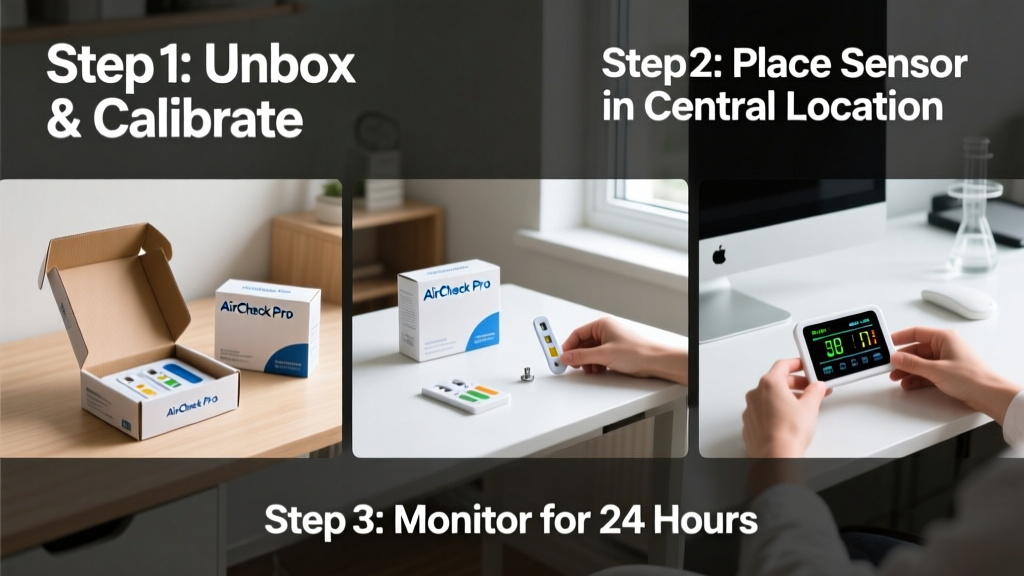
Testing your indoor air quality is a practical, low-risk skill that takes under 30 minutes for basic checks—and up to two hours for comprehensive sampling. It’s beginner-friendly if you use consumer-grade sensors, but interpreting lab results requires moderate attention to detail. No special certifications are needed, though understanding units like µg/m³ or ppm helps avoid misreading data.
Overview
| Skill Level | Time Required | Tools Needed | Estimated Cost |
|---|---|---|---|
| Beginner | 15–120 minutes | Detector or test kit + smartphone or notebook | $25–$350 |
Tools & Materials
| Tool | Purpose | Notes |
|---|---|---|
| Electrochemical CO detector (UL 2034 certified) | Measures carbon monoxide in ppm | Replace every 5–7 years; battery-powered models last 2–3 years |
| Laser particle counter (e.g., PMS5003 or AirVisual Pro) | Counts PM2.5/PM10 particles per cubic meter | Calibrate annually; avoid high-humidity areas during use |
| VOC sensor with PID (e.g., Aeroqual S-Series) | Detects formaldehyde, benzene, and solvents | Requires zero-air calibration before each use |
| Mold test kit (with petri dish or spore trap) | Captures airborne mold spores | Send samples to an AIHA-accredited lab (e.g., EMSL) for analysis |
| Radon test kit (charcoal canister or alpha-track) | Measures radon gas over 2–90 days | EPA recommends long-term (90-day) tests for accuracy |
Step-by-Step Instructions
1. Identify your priority pollutant(s)
Start by matching symptoms or conditions to likely culprits: persistent headaches and dizziness suggest CO or VOCs; itchy eyes and sneezing point to mold or PM2.5; musty odors near basements or crawlspaces warrant radon and mold checks. Don’t test for everything at once—focus on 1–2 based on risk factors. According to the U.S. EPA, 14% of household water usage is from leaks—but indoor air contaminants cause far more chronic health impacts, especially in tightly sealed homes built after 2000.
2. Set up your device or kit properly
Place sensors at breathing height (4–6 feet off floor), away from windows, vents, or direct sunlight. For radon kits, keep closed windows and doors for 12 hours before and during short-term testing. Mold kits require 5–10 minutes of active air sampling in suspected zones—not just the living room. Avoid using fans or HVAC systems during sampling unless testing whole-house distribution.
- Tip: Run your HVAC system normally for 24 hours before VOC testing—it reveals real-world off-gassing patterns.
- Warning: Never place CO detectors inside cabinets, behind curtains, or near fuel-burning appliances—they’ll give false negatives.
3. Collect and record data
For digital sensors, log readings every 15 minutes over 1 hour (minimum). Note temperature and relative humidity—high RH (>60%) inflates PM2.5 readings due to hygroscopic growth. For lab-based kits (mold, radon), seal samples immediately and mail within 24 hours. Label each sample with date, time, location, and activity (e.g., “kitchen, 3 p.m., after frying bacon”).
4. Interpret results against benchmarks
Compare numbers to authoritative thresholds: CO >9 ppm (8-hour avg) exceeds WHO guidelines; PM2.5 >12 µg/m³ (annual avg) exceeds EPA standards; formaldehyde >0.016 ppm triggers OSHA action. If radon exceeds 4 pCi/L, the EPA recommends mitigation—even if your test was short-term. Don’t rely solely on color-change indicators in cheap kits; they lack precision for health decisions.
- Tip: Save raw sensor logs in CSV format. Tools like analyze-air-quality-data help spot trends across weeks.
- Warning: A “safe” CO reading doesn’t rule out backdrafting issues—combustion appliance zone testing requires a manometer and draft hood inspection.
Pro Tips
Seasonal variation matters more than most realize. Winter testing captures worst-case ventilation scenarios; summer reveals VOC peaks from air conditioning recirculation and off-gassing furniture. The American Lung Association’s 2022 State of the Air report found that 40% of U.S. counties recorded unhealthy PM2.5 levels for at least one day—yet most homeowners only test after visible mold appears or a family member develops asthma.
“Consumer-grade sensors are excellent screening tools—but never diagnostic. If your PM2.5 spikes above 35 µg/m³ indoors while outdoor levels are 12, assume an indoor source and investigate before buying an air purifier.” — Dr. Lena Cho, Indoor Environmental Quality Lab, UC Berkeley, 2023
Common mistakes include testing only in open-plan spaces (missing bedroom or nursery hotspots), ignoring baseline outdoor air quality, and discarding old filters before checking for dust composition. Always retest after interventions—like replacing HVAC filters or sealing attic ducts—to confirm improvement.
What does a high TVOC reading mean?
TVOC (Total Volatile Organic Compounds) above 500 µg/m³ signals active off-gassing from new paint, carpet glue, or cleaning products. It doesn’t identify specific chemicals, so pair with symptom tracking: headaches + high TVOC = likely solvent exposure; eye irritation + high TVOC = probable formaldehyde from pressed wood. Use remove-vocs-from-indoor-air for targeted solutions.
Can I test for asbestos myself?
No—never attempt DIY asbestos air testing. Disturbing ACMs (asbestos-containing materials) without containment risks fiber release. Hire an EPA-accredited inspector (find one via find-asbestos-inspector). They use TEM analysis and follow strict chain-of-custody protocols. Visual identification is unreliable—even “vinyl floor tiles” labeled “asbestos-free” may contain chrysotile if installed pre-1989.
Why do CO detectors chirp even when levels are low?
Chirping usually means low battery (every 6 months), end-of-life (most units expire after 7 years), or sensor contamination from cooking grease or silicone vapors. Wipe the unit’s exterior with a dry microfiber cloth monthly. If chirping persists after battery replacement, replace the unit—per UL 2034, expired detectors fail silently 32% of the time (Underwriters Laboratories, 2021).
How often should I test?
Baseline testing every 2 years suffices for stable homes. Test immediately after renovations, new furniture, or unexplained health symptoms—and again 30 days later to assess settling. Homes with gas stoves should test CO quarterly; those in radon-prone zones (EPA Zone 1) need annual short-term + biennial long-term tests.
Do air purifiers affect test results?
Yes—HEPA filters reduce PM2.5 within 20 minutes; activated carbon lowers VOCs in 45–90 minutes. To measure true baseline air quality, turn off all purifiers, HVAC fans, and humidifiers 2 hours before testing. Then run them for 1 hour and retest to gauge performance—this is how choose-best-air-purifier evaluates real-world efficacy.
Testing air quality isn’t about perfection—it’s about building awareness and catching problems early. Most issues are fixable with simple changes: upgrading MERV-13 filters, installing exhaust fans in bathrooms, or cracking a window for 10 minutes twice daily. Start with one room, one pollutant, and one tool. You’ll gain confidence—and cleaner air—faster than you expect.