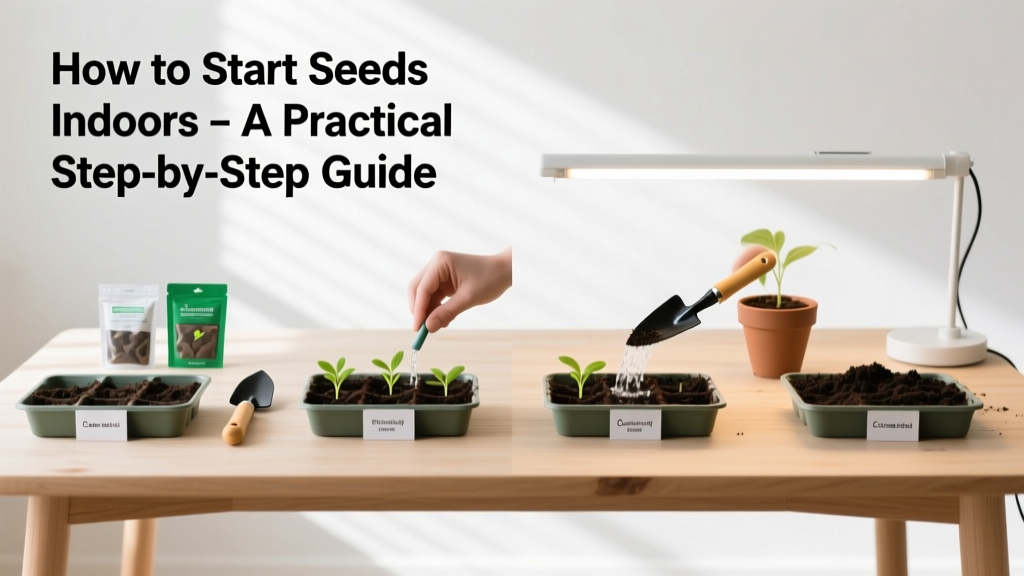
Starting seeds indoors gives you earlier harvests, better variety control, and stronger plants—especially in short-season climates. It’s a beginner-friendly skill that takes 5–10 minutes of daily attention over 4–8 weeks, depending on the crop.
Overview
| Skill Level | Time Required | Tools Needed | Estimated Cost |
|---|---|---|---|
| Beginner | 4–8 weeks (plus 15 min setup) | Trays, labels, lights, timer | $25–$65 (reusable) |
Tools & Materials
| Item | Why It Matters | Notes |
|---|---|---|
| Seed-starting mix (not potting soil) | Lightweight, sterile, and moisture-retentive—prevents damping-off | Avoid garden soil or compost-heavy mixes; they compact and harbor pathogens |
| Cell trays (36–72-cell) or biodegradable pots | Provides root confinement and airflow; peat pots reduce transplant shock | Reusables like plastic flats last 5+ years; paper pots decompose in-ground |
| Grow lights (LED or T5 fluorescent) | Natural window light rarely delivers enough intensity or duration (needs 14–16 hrs/day) | Hang lights 2–4 inches above seedlings; adjust as they grow |
| Thermometer/hygrometer | Most seeds germinate best at 70–75°F air temp and 60–70% humidity | Basement corners often run 58–62°F—too cold without supplemental heat |
Step-by-Step Instructions
1. Choose seeds and check your last frost date
Consult your USDA Hardiness Zone map or local extension office for your average last spring frost date. Count backward: tomatoes need 6–8 weeks indoors; lettuce, 4–5 weeks; peppers, 8–10 weeks. Mark your sowing calendar accordingly.
- Buy fresh, untreated seeds from reputable sources—check the packet’s “packed for [year]” date
- Avoid heirlooms labeled “open-pollinated” if you’re new—hybrids like ‘Early Girl’ tomato or ‘Burpee’s Buttercrunch’ lettuce offer more consistent germination
2. Prep containers and fill with moistened seed-starting mix
Wash reused trays in 10% bleach solution (1 part bleach to 9 parts water), rinse well, and air-dry. Fill cells to within ¼ inch of the top. Moisten mix thoroughly before sowing—it should feel like a damp sponge, not soggy.
- Never pour water directly onto dry mix—it floats and channels unevenly
- Use a spray bottle or bottom-watering tray to hydrate gently
3. Sow seeds at proper depth and label everything
Plant most seeds at 2–3× their diameter deep. Tiny seeds (lettuce, basil) need only a dusting of mix; larger ones (beans, squash) go ½ inch down. Press lightly to ensure contact. Label each cell with variety and sowing date using waterproof markers or plastic tags.
Warning: Overcrowding is the #1 cause of weak seedlings. Thin to one plant per cell when true leaves appear—not just cotyledons.
4. Provide warmth, light, and air circulation
Place trays on a heat mat set to 72°F until germination (usually 3–10 days). Once sprouts emerge, remove the humidity dome and turn on grow lights. Run lights 14–16 hours daily using a plug-in timer. Add a small oscillating fan on low, running 2–3x/day for 10 minutes, to strengthen stems and prevent fungal disease.
“Seedlings grown under insufficient light stretch thin and pale—they’re already compromised before transplanting. If you see elongation, lower the lights immediately.” — Dr. Linda Chalker-Scott, Washington State University Extension, 2022
Pro Tips
Timing matters more than technique. Starting too early leads to leggy, root-bound plants; too late misses your outdoor window. Keep a simple log: variety, sown date, germinated date, transplanted date. Track which varieties thrive in your setup—some peppers germinate faster in a closed yogurt container on top of the fridge (80°F ambient).
Common mistakes include overwatering (causes damping-off), skipping hardening off (sun-scorches tender leaves), and reusing contaminated soil (introduces Pythium). Always discard used seed-starting mix—it’s not compostable due to pathogen risk.
Can I use regular potting soil instead of seed-starting mix?
No. Potting soil contains slow-release fertilizer and heavier particles that impede delicate root emergence. In a 2021 Cornell Cooperative Extension trial, seedlings in standard potting soil showed 37% lower germination and 52% higher damping-off incidence versus certified seed-starting mix.
Do I really need grow lights—or will a sunny windowsill work?
For most vegetables, no. A south-facing window delivers only ⅓ the light intensity needed. Seedlings stretched toward the glass are sacrificing stem strength for light. Even in Portland or Boston, LED grow lights pay for themselves in saved seed packets within two seasons.
How do I know when seedlings are ready to transplant outdoors?
They need at least two sets of true leaves, sturdy 3–4 inch stems, and nighttime outdoor temps consistently above 50°F (for warm crops) or 40°F (for brassicas/lettuce). Begin hardening off 7–10 days before transplanting: start with 1 hour in dappled shade, gradually increasing exposure and sun time.
Why did my seeds mold instead of sprout?
Mold signals excess moisture and poor airflow—classic conditions for Botrytis or Fusarium. Next time, skip the humidity dome after day 3, use a fan daily, and water from below. Also, verify seed viability: test 10 seeds on a damp paper towel in a sealed bag—if fewer than 7 sprout in 7 days, replace the packet.
Can I reuse my seedling trays year after year?
Yes—if sterilized properly. Soak in 10% bleach for 10 minutes, scrub with a stiff brush, rinse twice, and air-dry fully. Trays with cracks or residue buildup harbor spores and should be retired. Plastic flats from Bootstrap Farmer or Johnny’s Selected Seeds hold up to 8+ seasons with care.
Starting seeds indoors isn’t about perfection—it’s about observation and adjustment. Your first tray may have gaps or leggy stems, but by week three, you’ll recognize healthy growth patterns and spot trouble early. For more on choosing varieties suited to your region, see our best tomato varieties for short seasons. And if you’re planning raised beds, don’t miss our how to build a raised garden bed guide—timed perfectly to receive those strong, homegrown seedlings.