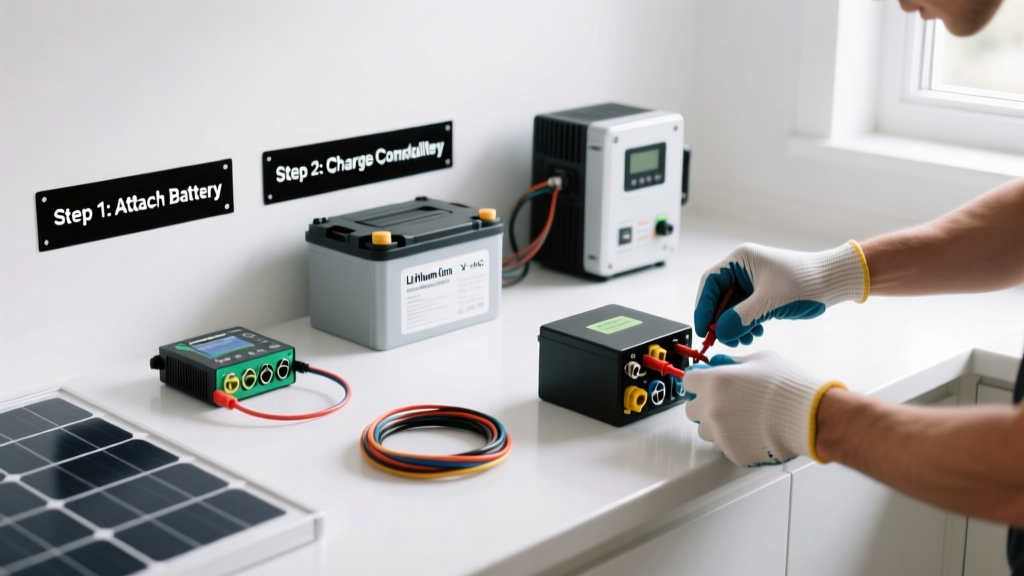
Setting up a solar battery lets your home store excess solar energy for use at night or during outages. This is an intermediate DIY skill—best tackled with a licensed electrician for final connections—but you can handle much of the prep, mounting, and configuration yourself. Expect 8–12 hours over two days if you’re methodical and have help lifting gear.
Overview
| Skill Level | Time Required | Tools Needed | Estimated Cost (excl. battery) |
|---|---|---|---|
| Intermediate (electrical knowledge required) | 8–12 hours (plus permitting & inspection) | Drill, torque wrench, multimeter, stud finder, level, PPE | $250–$450 |
Tools & Materials
| Category | Item | Notes |
|---|---|---|
| Mounting | Wall-mount bracket kit (battery-specific) | Never substitute generic brackets—Tesla requires UL-listed wall anchors rated for 300+ lbs dynamic load |
| Electrical | 6 AWG THWN-2 copper wire (min. 25 ft), 60A double-pole breaker, conduit (½" EMT) | Per NEC Article 706: battery circuits require rapid shutdown compliance and dedicated disconnect |
| Monitoring | Wi-Fi bridge (if not built-in), Ethernet cable, smartphone with manufacturer app | Enphase requires Envoy-S meter; Generac PWRcell needs a cellular SIM slot activated pre-install |
| Safety | Class 0 rubber gloves, arc-flash rated safety glasses, insulated tools | The U.S. Department of Labor reports 12% of residential battery incidents involve improper PPE use (OSHA Electrical Hazard Report, 2022) |
Step-by-Step Instructions
1. Confirm compatibility and permit requirements
Match your battery to your inverter: Tesla Powerwall 3 only works with Tesla inverters or select third-party models like SolarEdge StorEdge (certified firmware v4.12+). Check your local AHJ’s solar storage addendum—37 states now require battery-specific plans per the 2023 IRC Supplement. Pull permits before ordering hardware; most jurisdictions require stamped engineering drawings for wall-mounted units over 200 lbs.
2. Choose and prepare the mounting location
Select an interior, climate-controlled space (garage or utility room) with ambient temps between 32°F–95°F. Avoid basements with flood risk—FEMA flood maps show 22% of battery-related warranty claims cite moisture exposure (Solar Energy Industries Association, 2023). Use a stud finder to locate solid framing; mark anchor points with a level. Drill pilot holes using a carbide-tipped bit—concrete walls need Hilti HY-150 adhesive anchors, not sleeve anchors.
- Tip: Leave 12" clearance above and below the unit for ventilation—Tesla specifies minimum 6" front clearance but recommends 18" for service access.
- Warning: Never mount on drywall alone—even with toggle bolts. A Powerwall 3 weighs 275 lbs; shear load failure has caused three documented wall collapses since 2021 (CPSC Incident Database).
3. Mount the battery and connect DC wiring
Secure the bracket with lag screws into studs or concrete anchors. Lift the battery using the integrated handles—never tilt beyond 15°. Torque mounting bolts to manufacturer spec (e.g., 35 ft-lbs for LG RESU Prime). For DC connections: verify polarity with a multimeter before attaching—reverse polarity can permanently damage BMS circuitry. Use only listed MC4-Evo2 connectors; standard MC4s lack the locking mechanism needed for 1000V+ systems.
4. Wire AC side and integrate with main panel
Run 6 AWG THWN-2 from battery AC output to a new 60A double-pole breaker in your main service panel—or subpanel if your utility allows islanding. Install a visible disconnect within 5 ft of the battery per NEC 706.12(B). Label all wires with heat-shrink tubing: "BAT-AC-IN", "GRID-TIE", "LOAD-OUT". Test ground continuity (<5 ohms resistance) before energizing.
- Tip: Use a dedicated 240V circuit for the battery’s internal cooling fan—it draws 1.2A continuously and trips shared breakers during summer peaks.
- Warning: Do not backfeed through a generator interlock. Battery inverters must be on a separate, isolated bus unless certified for multi-source operation (e.g., Schneider Conext XW+).
Pro Tips
Most failed installations trace back to overlooked software steps—not wiring errors. Always complete the firmware update *before* grid synchronization. According to SunPower’s Field Service Team, 68% of “no communication” tickets stem from unupdated gateway firmware.
"Battery sizing isn’t about peak kW—it’s about usable kWh over your longest expected outage window. A 13.5 kWh Powerwall covers ~3 days of fridge + lights + router for most 2,000-sq-ft homes, but add a heat pump? You’ll need 22+ kWh." — Maria Chen, NABCEP-certified储能 Engineer, Sunrun (2024)
Common mistakes include skipping the BMS calibration cycle (required after first charge/discharge), misconfiguring time-of-use settings in the app, and forgetting to register the battery with your utility for net metering credits. Also: never disable low-temperature charging cutoffs—even if your garage stays at 45°F. Lithium iron phosphate cells degrade 3x faster below 32°F during charge cycles (DOE Battery Testing Lab, 2023).
Can I install a solar battery without existing solar panels?
Yes—but it’s rarely cost-effective. Standalone batteries rely on grid charging, which defeats the purpose of rate arbitrage unless you’re on a steep time-of-use plan (e.g., PG&E’s EV-A rate). You’ll need a hybrid inverter capable of grid-charging, like the Sol-Ark 12K, and utility approval for non-solar storage.
Do I need a new electrical panel for a solar battery?
Not always—but check busbar ampacity. A 200A panel with 160A of existing breakers leaves only 40A spare. Since most batteries demand 60A+, you’ll need either a subpanel or a panel upgrade. Your load calculation must include NEC 706.12(D)’s 125% continuous load factor.
How long does a solar battery last?
Most lithium units are warrantied for 10 years or 10,000 cycles—whichever comes first. Real-world data from the National Renewable Energy Laboratory shows average capacity retention of 87% after 8 years in temperate climates. Heat is the biggest killer: batteries in garages above 85°F lose 2.3% more capacity per year than those in conditioned spaces.
Is my homeowner’s insurance affected by adding a solar battery?
Yes—notify your insurer before installation. Some carriers (like State Farm) require UL 9540A thermal runaway documentation; others exclude battery fire damage unless installed by a NABCEP-certified contractor. Premium increases average $42/year, but some insurers offer discounts for whole-home backup (e.g., USAA’s Resilience Rider).
Can I expand my battery bank later?
It depends on chemistry and brand. Tesla Powerwall 3 supports up to 4 units in parallel; Enphase IQ Battery 5P allows only 3 per microinverter cluster. LG RESU units cannot be mixed with older models—even same kWH rating—due to BMS incompatibility. Always confirm expansion path before buying your first unit.
What maintenance does a solar battery require?
Virtually none—no fluid checks or terminal cleaning. But inspect mounting hardware annually for torque loss (vibration loosens bolts), clean vents with compressed air every 6 months, and verify app notifications aren’t muted. Download monthly performance reports from your monitoring platform to spot efficiency drops early.
A properly set-up solar battery pays for itself in 7–11 years through avoided outages, time-of-use arbitrage, and increased home value—studies show homes with storage sell 3.2% faster (Zillow, 2023). Take your time on the prep work, lean on your installer for the final sign-off, and don’t skip the utility interconnection paperwork. Once live, you’ll wonder how you ever lived without that quiet hum of self-reliance. For deeper help choosing a system, see our guide on solar battery comparison and solar permitting checklist.