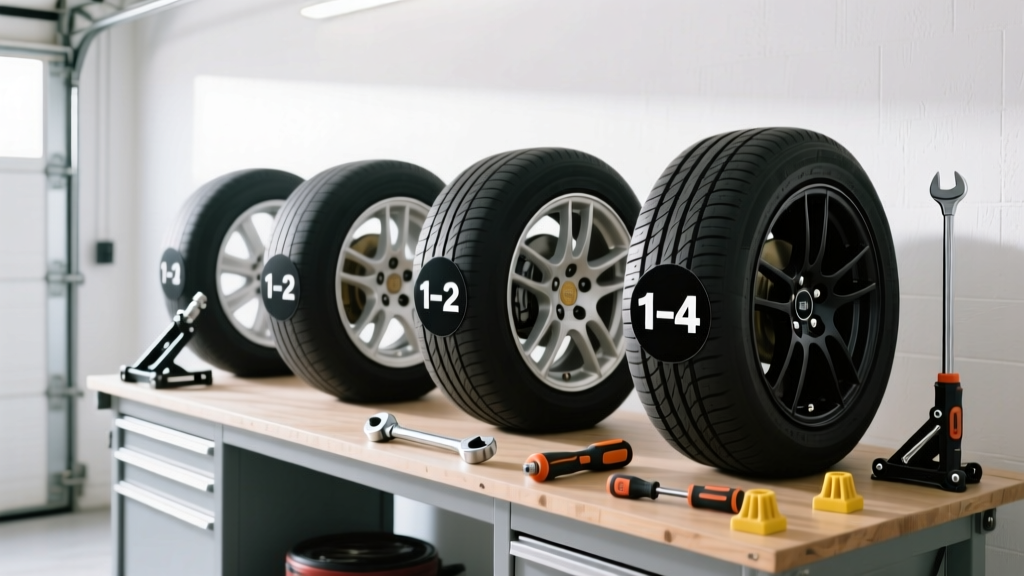
Rotating your tires is a straightforward maintenance task that balances wear across all four positions, helping tires last longer and handle better. It’s a beginner-friendly skill that takes 30–45 minutes with basic tools—and it should be done every 5,000 to 7,500 miles, per the U.S. Department of Transportation’s 2022 Vehicle Maintenance Guidelines.
Overview
| Skill Level | Time Required | Tools Needed | Estimated Cost |
|---|---|---|---|
| Beginner | 30–45 minutes | Floor jack, jack stands, torque wrench, lug wrench, wheel chocks | $0 (if you own tools); $25–$60 to buy basics |
Tools & Materials
| Item | Why It’s Essential | Notes |
|---|---|---|
| Floor jack rated for ≥1.5× vehicle weight | Lifts the car safely without bottoming out | Check your owner’s manual for lift points—never jack on suspension arms or plastic body panels |
| Two jack stands (minimum) | Prevents injury if jack fails; required by OSHA for any under-vehicle work | Always place stands on solid, level concrete—not asphalt or gravel |
| Torque wrench (1/2" drive, 50–150 ft-lb range) | Ensures lug nuts are tightened to factory spec—over-torquing cracks rotors; under-torquing causes wheels to loosen | Most sedans require 80–100 ft-lb; trucks often need 120–140 ft-lb |
| Wheel chocks (wood or rubber) | Prevents rolling when lifting rear or front axle | Chock the wheels opposite the axle being lifted—even on automatic transmission with parking brake engaged |
Step-by-Step Instructions
1. Park, prepare, and chock
Park on level pavement, engage parking brake, shift into Park (auto) or first gear (manual), and turn off the engine. Place wheel chocks snugly against the tires that will remain on the ground—e.g., chock both rear wheels before lifting the front axle.
2. Loosen lug nuts while wheels are on the ground
Use your lug wrench to break loose (but not remove) all lug nuts on each wheel you’ll rotate. Turn counterclockwise. Do this *before* lifting—the friction of the tire on pavement prevents the wheel from spinning.
3. Lift one axle at a time
Lift the front axle first: position floor jack at the manufacturer’s designated front lift point (often a reinforced frame rail near the front subframe—see your owner’s manual). Raise until both front wheels clear the ground by 1–2 inches. Then securely place jack stands under the front control arm mounting points or designated stand points. Repeat for rear axle—never lift front and rear simultaneously.
4. Remove wheels and follow your pattern
Remove lug nuts and wheels. Use the rotation pattern appropriate for your vehicle:
- Front-wheel drive: Forward cross (front tires go straight back; rear tires cross to opposite fronts)
- Rear-wheel or AWD: Rearward cross (rear tires go straight forward; front tires cross to opposite rears)
- Directional tires: Swap front-to-rear on same side only—never cross left/right
5. Reinstall and torque in star pattern
Mount each wheel, thread lug nuts by hand first to avoid cross-threading, then tighten just enough to hold. Lower the vehicle slightly (so tires touch but don’t bear full weight), then torque lug nuts in a star (crisscross) pattern to factory specification. Lower fully, then re-torque once more with full vehicle weight on tires—this accounts for seating compression.
Pro Tips
Uneven wear patterns—like inner-edge scalloping on front tires—often mean alignment is off, not that rotation was skipped. Rotating won’t fix misalignment, but it will prevent compounding the problem.
“Tires rotated every 5,000 miles show 18% less irregular wear than those rotated every 10,000 miles, according to Consumer Reports’ 2023 Tire Longevity Study.”
Avoid these common errors:
- Skipping torque verification after lowering the car
- Using an impact wrench instead of a torque wrench for final tightening
- Rotating directional or staggered-width tires incorrectly (they’re not interchangeable side-to-side)
- Forgetting to reset your TPMS light—if your vehicle has indirect monitoring, it may need recalibration after rotation
Why does my owner’s manual say ‘rotate every 7,500 miles’ but my mechanic says 5,000?
Manufacturers set conservative intervals based on ideal conditions—smooth highways, gentle acceleration, no heavy loads. Real-world driving (stop-and-go traffic, potholes, aggressive cornering) accelerates wear. The Rubber Manufacturers Association recommends 5,000 miles as the practical max for most drivers.
Can I rotate tires with a flat repair kit instead of a floor jack?
No. Temporary flat repair kits (sealant + compressor) don’t lift the vehicle. You must fully support the axle with jack stands to safely remove and reinstall wheels. Using ramps alone isn’t safe for rotation—you still need stands and can’t access all lug nuts evenly.
Do I need to rebalance tires after rotating them?
No—rotation doesn’t disturb wheel balance. Balancing is only needed when installing new tires, after hitting a curb or pothole hard, or if you feel vibration above 45 mph. Rotating redistributes existing wear; it doesn’t alter weight distribution.
My SUV has different-sized front and rear tires—can I still rotate them?
Only front-to-rear on the same axle—if sizes match side-to-side. For example: left front ↔ left rear, right front ↔ right rear. Never swap left/right on staggered setups. Confirm size compatibility in your tire size guide.
Should I rotate winter tires differently than all-seasons?
No—the same patterns apply. But because winter tires wear faster in warm weather, many drivers skip summer rotation entirely and only rotate once per season—before storing and again before mounting. Just ensure even wear before storage: inspect tread depth with a tread depth gauge.
What if I hear a clunk when tightening lug nuts?
Stop immediately. That sound usually means the wheel isn’t fully seated on the hub due to rust, debris, or bent studs. Clean hub faces with a wire brush, check for burrs on studs, and verify rotor hats are free of corrosion. A misseated wheel can detach at speed.
Rotating your tires isn’t glamorous—but it’s one of the highest-return, lowest-effort maintenance tasks you’ll ever do. Done right, it adds thousands of safe miles to your tread life and keeps your vehicle predictable in rain or snow. Keep a log in your glovebox: date, mileage, and pattern used. Next time, you’ll be faster—and more confident—than ever.