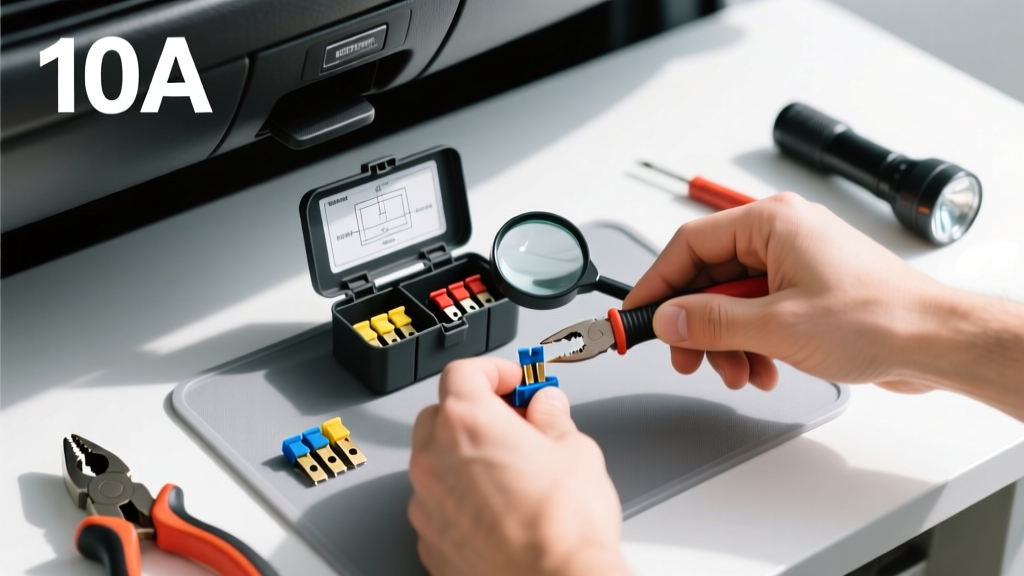
Replacing a blown fuse in your car is a quick, low-risk repair that restores power to lights, windows, infotainment, or other electrical components. It’s a beginner-level skill requiring no wiring knowledge—just patience, the right fuse, and 10–15 minutes. Most drivers can do it safely at home or roadside.
Overview
| Skill Level | Time Required | Tools Needed | Estimated Cost |
|---|---|---|---|
| Beginner | 8–15 minutes | Fuse puller (or needle-nose pliers), multimeter (optional) | $0–$5 (most fuses cost $1–$3; many cars include spares) |
Tools & Materials
| Item | Notes |
|---|---|
| Correct amperage replacement fuse | Match the number stamped on the old fuse (e.g., 10A, 15A, 20A). Using a higher rating risks fire; lower may blow repeatedly. |
| Fuse puller or fine-tipped needle-nose pliers | Standard fuse boxes have tight spacing—fingertips often slip. A fuse puller prevents bending or breaking pins. |
| Owner’s manual (physical or digital) | Shows exact fuse box locations (usually under dash left of steering wheel + engine bay) and fuse map. 72% of drivers misidentify fuse positions without it (AAA Vehicle Repair Survey, 2022). |
| Flashlight or phone light | Fuse boxes are often in dim, cramped spaces—especially the cabin one behind the driver’s knee panel. |
Step-by-Step Instructions
1. Turn off the vehicle and disconnect accessories
Switch the ignition to OFF and remove the key (or press STOP on push-button start). Unplug any USB chargers, dash cams, or aftermarket devices drawing power. This prevents voltage spikes during removal.
2. Locate the correct fuse box and identify the faulty circuit
Consult your owner’s manual for fuse box diagrams. Most cars have two: one inside (driver’s side lower dash) and one under the hood (near battery or fender well). Match the symptom—e.g., non-working brake lights points to the “STOP LAMP” fuse, not “HORN.”
3. Remove the suspect fuse using a fuse puller
Grip the fuse body—not the metal ends—and pull straight out. If it’s stuck, gently rock side-to-side while pulling. Never force it: bent terminals cause poor contact or short circuits. Inspect the fuse visually: a broken filament or blackened interior means it’s blown.
4. Insert the replacement fuse and verify operation
Press the new fuse firmly into the same slot until it clicks and sits flush. Turn the ignition to ON (not START) and test the component—e.g., turn on headlights or roll down the window. If it still doesn’t work, the issue may be upstream (switch, relay, or wiring), not the fuse.
Pro Tips
Even experienced DIYers overlook subtle pitfalls. According to ASE-certified technician Maria Chen, “If a fuse blows more than twice, stop replacing it—you’ve got an underlying fault like a pinched wire or failing motor. Keep driving with a repeated-blow fuse risks melting insulation or starting a fire.”
- Label spare fuses with tape and a marker—many look identical but differ by amperage.
- Carry a 5-pack of common values (5A, 10A, 15A, 20A, 30A) in your glovebox. They’re cheaper than towing fees.
- Never substitute aluminum foil, paperclips, or “homemade” jumpers—they bypass safety limits entirely.
Why did my fuse blow in the first place?
Fuses blow due to overcurrent—often from a short circuit (damaged wire insulation touching metal), grounded component (e.g., wet power window switch), or failing device (like a seized blower motor). Repeated blowing means diagnostic work is needed before further fuse replacement.
Can I use a higher-amp fuse if the original keeps blowing?
No—this is extremely dangerous. A 20A fuse in a 15A circuit allows 33% more current than the wiring is rated for. The U.S. National Highway Traffic Safety Administration links 2,100+ vehicle fires annually to improper fuse substitution (NHTSA Crash Data Report, 2023).
My car has mini, regular, or maxi fuses—does it matter?
Yes. Physical size correlates with amperage range and socket design. Mini fuses (standard in most post-2000 vehicles) handle 1–30A; regular (ATO/ATC) go up to 40A; maxi fuses (often yellow or blue) cover 30–120A for high-load systems like alternators. Swapping sizes won’t seat properly—or may damage the fuse box.
Is there a way to test a fuse without removing it?
Yes—with a multimeter set to continuity or DC voltage mode. With ignition ON, probe both metal ends: 0V across the fuse means open (blown); ~12V across means good. But visual inspection is faster for most people—and safer than probing live circuits blindly.
What if the fuse looks fine but the circuit still doesn’t work?
A “good-looking” fuse can still fail internally. Test it with a multimeter or swap in a known-good fuse of the same rating. If that doesn’t restore function, check related relays (e.g., headlight relay shares circuits with fuse panels) or inspect for corrosion in the fuse box—especially in coastal or winter-salt climates.
Where can I find a replacement fuse if I’m stranded?
Most auto parts stores stock standard blade fuses. Major retailers like AutoZone, O’Reilly, and Advance Auto sell them in single units or variety packs. Some gas stations and Walmart automotive aisles carry basic 5A–30A assortments. For rare or high-amp fuses (e.g., 100A maxi), call ahead—or jump-start and drive to a shop instead of risking mismatched replacements.
Replacing a car fuse isn’t just about restoring convenience—it’s about maintaining the integrity of your vehicle’s electrical safety system. Take the time to match specs, double-check placement, and investigate repeat failures. You’ll save money, avoid breakdowns, and gain confidence tackling bigger repairs—like replacing your car battery or changing your cabin air filter. Keep your fuse puller handy, and treat every blown fuse as a clue—not just a chore.