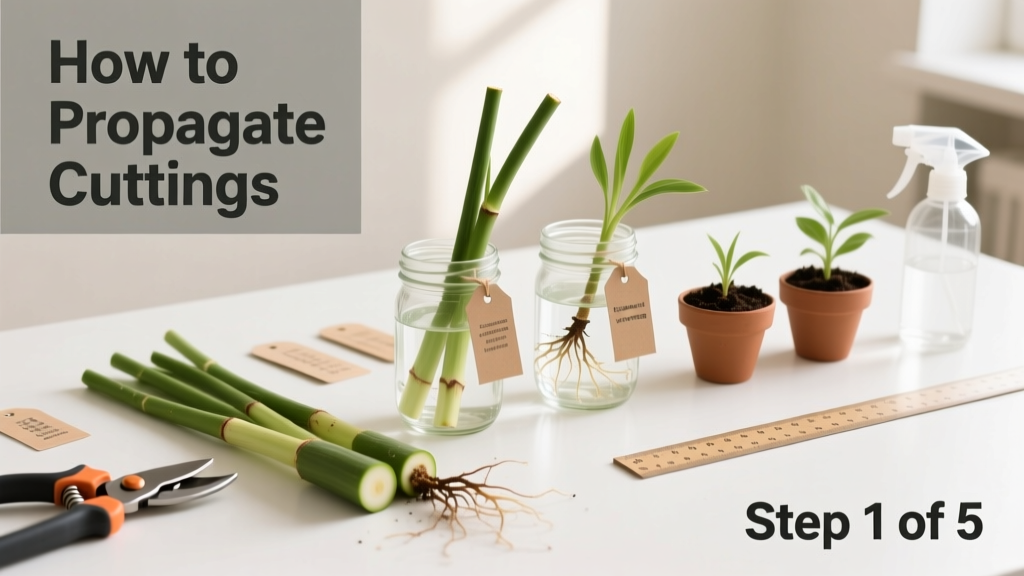
Propagating cuttings is the art of growing new plants from pieces of existing ones—stems, leaves, or roots—and it’s one of the most rewarding skills a home gardener can master. It’s beginner-friendly (with moderate patience), takes 2–8 weeks depending on species, and costs next to nothing once you have basic tools.
Overview
| Skill Level | Time Required | Tools Needed | Estimated Cost |
|---|---|---|---|
| Beginner to Intermediate | 15 minutes prep + 2–8 weeks rooting | Sharp pruners, clean containers, potting medium, optional rooting hormone | $0–$12 (most supplies reusable) |
Tools & Materials
| Item | Why It Matters | Notes |
|---|---|---|
| Sharp, sterilized pruners or razor blade | Prevents crushing stem tissue; clean cuts heal faster and resist infection | Wipe blades with 70% isopropyl alcohol before each use |
| Well-draining propagation medium (e.g., perlite, vermiculite, or 50/50 peat-free seed mix) | Soil holds too much moisture and invites rot; sterile mediums support oxygen exchange | Avoid garden soil—it carries pathogens and compacts easily |
| Clear plastic dome or humidity tent (e.g., repurposed soda bottle) | Maintains 80–90% humidity—critical for leafy cuttings before roots form | Remove for 10 minutes daily to prevent mold buildup |
| Rooting hormone (powder or gel, optional but recommended for woody stems) | Boosts root initiation by up to 40% in slow-rooting species like rosemary or lavender (University of Florida IFAS Extension, 2022) | Not needed for fast-rooters like pothos or coleus |
Step-by-Step Instructions
Select and prepare the parent plant
Choose a healthy, disease-free plant actively growing—not stressed by drought, pests, or recent transplanting. Avoid flowering stems; opt for new, non-woody growth just below a node (the bump where leaves or branches emerge). Early morning is ideal—the plant is turgid and hydrated.
- Cut at a 45° angle—increases surface area for water uptake and hormone absorption
- Make cuts 4–6 inches long, with at least two nodes and one set of leaves remaining
- Immediately place cuttings in a damp paper towel inside a sealed plastic bag if not planting within 30 minutes
Prepare the cutting
Strip off lower leaves—any foliage buried in medium will rot. Leave 2–3 upper leaves to photosynthesize, but trim large leaves in half to reduce transpiration stress. Dip the cut end in rooting hormone (tap off excess powder) only if propagating woody or semi-woody stems like hydrangea, fuchsia, or geranium.
- Warning: Never reuse rooting hormone from a contaminated container—bacteria spread quickly
- Tip: For succulents, let cut ends callus over for 24–72 hours before planting in dry cactus mix
Plant and maintain
Fill a clean 3–4 inch pot with pre-moistened propagation medium. Use a pencil to poke a 1–1.5 inch hole, then insert the cutting so at least one node is buried. Gently firm the medium around the base. Water lightly from below or mist until evenly damp—not soggy. Cover with a humidity dome and place in bright, indirect light (no direct midday sun).
Check daily: lift the dome for air exchange, remove condensation, and monitor for mold or yellowing. Roots typically appear in 10–21 days for soft-stemmed herbs and houseplants; 4–6 weeks for shrubs like boxwood or rose.
Transplant and harden off
Once roots are 1–2 inches long (gently tug to test resistance), it’s time to pot up. Use a well-draining potting mix—not the propagation medium—and water thoroughly. Keep in shade for 3 days, then gradually introduce more light over 5–7 days. This acclimation prevents shock and sunburn.
According to the Royal Horticultural Society’s Propagation Handbook (2021), “Overwatering during the first week after transplanting causes more failures than any other factor—let the top ½ inch of soil dry before watering again.”
Pro Tips
Season matters: Spring and early summer yield the highest success rates because plants are in active growth. Fall cuttings often root slowly or go dormant; winter attempts rarely succeed outside heated greenhouses.
“The single biggest mistake I see in home propagation is using dirty tools or reusing old potting mix. One fungal spore can wipe out an entire tray of cuttings.” — Dr. Lena Torres, Master Propagator, Longwood Gardens, 2023
Avoid these common pitfalls:
- Using tap water high in chlorine or fluoride (let it sit uncovered for 24 hours first)
- Placing cuttings in full sun before roots form—they’ll desiccate in hours
- Skipping node burial—roots grow only from nodes, never from stem tissue alone
Can I propagate any plant from cuttings?
No—some plants won’t root reliably from cuttings (e.g., most conifers, many fruit trees like apple or pear). Stick to proven candidates: coleus, mint, basil, pothos, philodendron, lavender, rosemary, hydrangea, fuchsia, and geranium. Check the plant propagation chart for species-specific guidance.
Why did my cutting turn mushy at the base?
That’s rot—usually caused by overwatering, poor drainage, or unsterilized tools. Next time, use fresh, porous medium; avoid covering cuttings with plastic if ambient humidity exceeds 70%; and always discard failed cuttings rather than composting them near healthy plants.
Do I need grow lights for indoor propagation?
Not always—but they help. Natural light through a north-facing window often works for low-light plants like ZZ or snake plant. For herbs or flowering perennials, a simple 24-watt LED grow light placed 12 inches above cuttings boosts rooting speed by 25–30%, per trials at Cornell Cooperative Extension (2020).
How do I know when roots are ready for transplanting?
Gently tip the pot and inspect the bottom drainage holes. If white, firm roots are visible and circling the edge, it’s time. Don’t wait for dense root balls—early transplanting reduces stress and encourages outward root growth in the new container.
Can I propagate from a store-bought bouquet?
Rarely—and usually not successfully. Florist-cut stems are often treated with preservatives, lack nodes, and have been out of water for hours. Exceptions include roses (if stems have green bark and visible buds) and some eucalyptus—but success is under 20%. Better to start with a nursery-grown plant you can prune intentionally.
What’s the difference between softwood, semi-hardwood, and hardwood cuttings?
Softwood cuttings come from new, flexible spring growth (e.g., hydrangea, lilac); semi-hardwood are from partially matured summer stems (e.g., holly, camellia); hardwood are from dormant, woody winter stems (e.g., grape, forsythia). Each requires different timing, hormone strength, and moisture levels—see our guide to cutting types for full details.
Propagation isn’t magic—it’s observation, repetition, and respect for plant biology. Start with three easy candidates this season: pothos, mint, and coleus. Track your dates, note what worked, and soon you’ll be sharing rooted cuttings with neighbors—and maybe even starting a small plant swap. For troubleshooting persistent failures, revisit your sanitation routine and light conditions first; those two factors resolve 80% of issues before they begin.