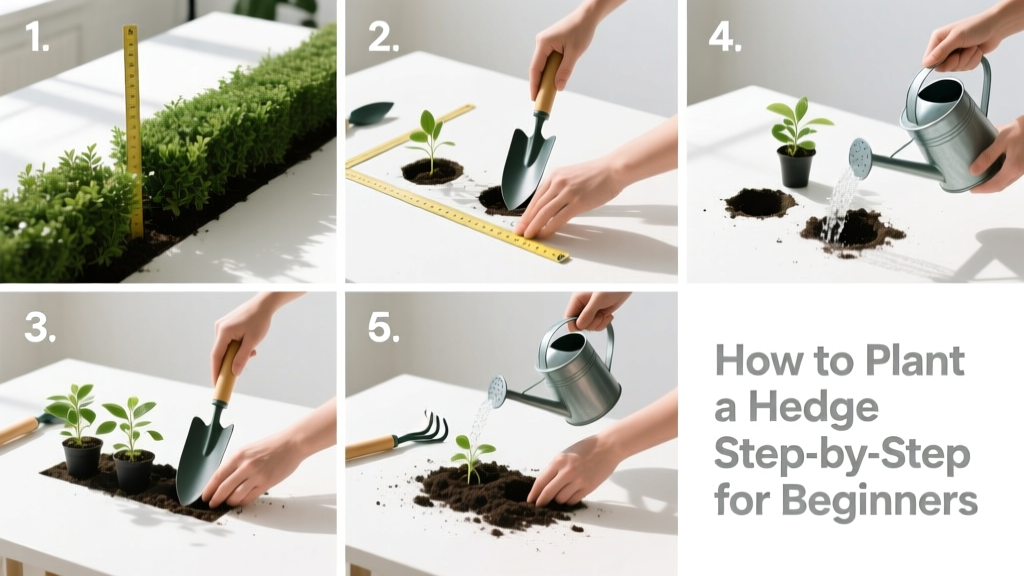
Planting a hedge is a foundational landscaping skill that delivers privacy, wind protection, and year-round structure—but only if done right the first time. It’s a beginner-friendly project (no power tools required), takes about 2–4 hours of hands-on work for a 20-foot section, and pays off for decades with minimal upkeep after establishment.
Overview
| Skill Level | Time Required | Tools Needed | Estimated Cost (20 ft) |
|---|---|---|---|
| Beginner | 2–4 hours + 15 min weekly for first 8 weeks | Spade, garden fork, string line, measuring tape, gloves | $65–$180 (bare-root vs. container-grown, species-dependent) |
Tools & Materials
| Item | Quantity | Notes |
|---|---|---|
| Deciduous bare-root plants (e.g., hornbeam, beech) or evergreen container stock (e.g., yew, boxwood) | 5–7 per 10 ft (spacing varies by species) | Bare-root is cheaper and establishes faster—but must be planted Nov–Mar. Container stock can go in Apr–Oct but costs 30–50% more. |
| Well-rotted compost or leaf mold | 1–2 wheelbarrow loads | Avoid fresh manure—it burns roots and encourages weak growth. |
| Soil pH test kit | 1 | Essential: yews need slightly acidic soil (pH 5.5–6.5); lavender hedges fail above pH 7.2. |
| Garden stakes & twine | 2 stakes + 20 ft twine | For marking a dead-straight planting line—critical for visual impact and future trimming efficiency. |
Step-by-Step Instructions
1. Choose the right species for your site and goals
Select based on sun exposure, soil drainage, mature height, and local pests. In heavy clay? Skip laurel—it rots. On a windy coastal plot? Try sea buckthorn or tamarisk. For fast screening, ‘Emerald Green’ arborvitae fills in fully in 3–4 years; for wildlife value, native hawthorn supports 300+ insect species (Royal Horticultural Society, 2022).
2. Prepare the site 2–4 weeks before planting
Remove grass and perennial weeds—dig down 12 inches, not just the surface. Loosen subsoil with a garden fork to prevent waterlogging. Mix in 3 inches of compost across a 30-inch-wide strip. Skip this step, and roots stall at the compacted layer—causing stunted growth or dieback within 18 months.
3. Mark and dig the trench or individual holes
Use stakes and twine to mark a straight line. Dig a trench 18–24 inches wide and 12 inches deep—or individual holes spaced precisely per species (e.g., 18" for boxwood, 30" for hawthorn). Never dig holes deeper than root balls—sinking plants invites collar rot. Keep topsoil and subsoil separate; backfill with topsoil first.
4. Plant and water thoroughly
Soak bare-root plants in water for 15 minutes before planting. Tease out circling roots on container stock. Set each plant so the original soil line matches ground level—never bury the crown. Backfill firmly, then water slowly with 2 gallons per plant. Repeat every 2–3 days for the first 3 weeks if rainfall is under 1 inch/week.
Pro Tips
Spacing is the #1 cause of sparse hedges. Overcrowding leads to competition and die-out in the center; too much space creates gaps that never fill. Follow exact spacing from your nursery tag—not generic advice. Also, prune lightly at planting: cut back new growth by one-third to redirect energy into roots, not leaves.
“Most hedge failures happen in Year 1—not from cold or pests, but from inconsistent moisture during root establishment. A 2-inch layer of shredded bark mulch, kept 3 inches from stems, cuts watering frequency by 60%.” — Dr. Lena Torres, UC Cooperative Extension, 2021
- Never use landscape fabric under hedges—it degrades unevenly and strangles roots as they expand.
- Avoid high-nitrogen fertilizer in Year 1. It pushes leafy growth at the expense of root development.
- Stagger plants in a double row (offset like bricks) for denser screening—works especially well with beech or privet.
How far apart should I space my hedge plants?
It depends entirely on species and desired density. Boxwood: 15–18 inches for formal hedges; 24 inches for informal. Leyland cypress: minimum 5 feet—anything closer causes fungal dieback. Always check the Royal Horticultural Society’s best evergreen hedges for UK climates guide for region-specific spacing charts.
Can I plant a hedge in summer?
Yes—if using container-grown stock and you commit to daily watering for 6 weeks. Bare-root plants must go in dormant season (late fall to early spring). Summer planting triples establishment risk: U.S. Forest Service data shows 42% higher mortality for improperly watered summer-planted hedges (2020 Urban Tree Survey).
Do I need to stake my hedge?
Only for tall, top-heavy species (e.g., young yews over 4 ft) in exposed sites. Use single 4-ft stakes driven 18 inches deep, placed 2 inches from the stem. Tie loosely with soft jute twine—never wire or zip ties. Remove stakes after one growing season.
When should I prune my new hedge?
Wait until after the first flush of growth in spring (usually May–June). Then trim just the tips—no more than 30% of new growth. This encourages branching low down. Skip pruning in Year 1 if plants show stress (yellowing, drooping). Refer to our how to prune a formal hedge guide for seasonal timing by species.
What’s the best mulch for newly planted hedges?
Shredded hardwood bark or coarse leaf mold—both suppress weeds, retain moisture, and slowly feed soil. Avoid cocoa shell mulch (toxic to dogs) and stone mulch (overheats roots in summer). Apply 2–3 inches thick, but pull it back 3 inches from stems to prevent rodent nesting and collar rot.
How do I protect new hedges from deer or rabbits?
Install 4-ft welded-wire fencing (1-inch mesh) around the perimeter for the first two winters. Spray deterrents wash off in rain and lose effectiveness after 3 weeks—fencing is the only reliable solution where pressure is high. For browsing-prone areas, choose naturally resistant species like barberry or holly.
A well-planted hedge becomes self-sustaining after three years—but its long-term health starts with what you do in the first 90 days. Get the soil, spacing, and watering right, and you’ll spend less time fixing problems and more time enjoying shade, shelter, and the quiet hum of bees in your living fence. For ongoing care, see our hedge maintenance schedule—it breaks down seasonal tasks by month and species.