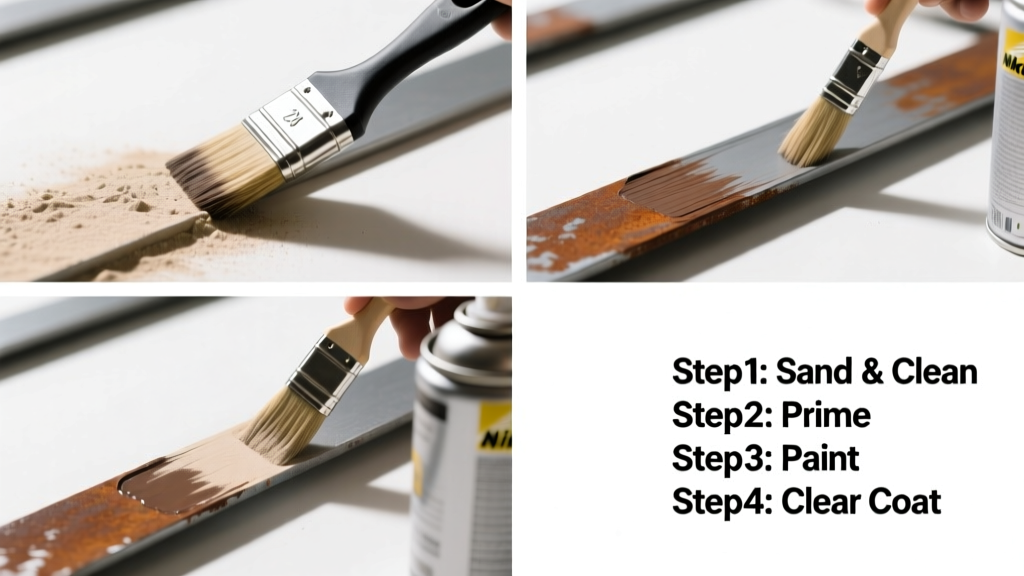
Painting metal isn’t just about slapping on color—it’s about creating a bonded, corrosion-resistant finish that lasts years, not months. This is an intermediate DIY skill requiring attention to surface prep but no special equipment. Plan for 6–8 hours total (mostly drying time), spread over two days.
Overview
| Skill Level | Time Required | Tools Needed | Estimated Cost |
|---|---|---|---|
| Intermediate | 6–8 hours (over 2 days) | Sanding block, wire brush, tack cloth, paintbrush or spray gun | $25–$45 (depending on project size and paint quality) |
Tools & Materials
| Category | Item | Notes |
|---|---|---|
| Cleaning | Mineral spirits or denatured alcohol | Avoid water-only cleaning—it leaves residues that weaken adhesion |
| Prep | 120- and 220-grit sandpaper + sanding block | Or use a wire wheel attachment on a drill for heavy rust |
| Primer | Zinc-rich or iron oxide-based metal primer (e.g., Rust-Oleum Stops Rust Primer) | Do not skip—this layer bonds paint to metal and inhibits rust |
| Paint | 100% acrylic latex or oil-based enamel formulated for metal | Oil-based offers better durability outdoors; acrylic dries faster indoors |
| Protection | Nitrile gloves, N95 mask, ventilation fan | VOCs in primers and oil paints require airflow and skin protection |
Step-by-Step Instructions
1. Assess and clean the surface
Start by identifying rust level: light surface rust (reddish dust) needs wire brushing; heavy pitting requires grinding or chemical rust remover. Wipe the entire surface with mineral spirits using a lint-free rag—this removes oils, waxes, and invisible contaminants that cause peeling. Let dry 15 minutes.
- Warning: Never use vinegar or baking soda solutions—they leave alkaline residues that interfere with primer adhesion.
- Tip: For galvanized metal (shiny silver coating), skip acid washes—use only TSP substitute or white vinegar *diluted 1:10*, then rinse and dry thoroughly.
2. Sand and profile the metal
Sand with 120-grit in one direction until dull and uniformly matte—no shiny spots. Then switch to 220-grit for a smooth finish. Focus especially on edges and corners where paint tends to lift. Wipe again with tack cloth—not a rag—to remove all dust.
- Warning: Skipping sanding on smooth or previously painted metal causes 73% of premature paint failures, per the SSPC (Society for Protective Coatings) 2022 Field Survey.
- Tip: Use a sanding sponge for curved surfaces like chair legs or pipe rails—it conforms without gouging.
3. Apply metal-specific primer
Stir (don’t shake) the primer for 2 minutes. Apply in thin, even coats using a synthetic-bristle brush or HVLP spray. Let dry to touch (usually 30–60 min), then lightly scuff with 220-grit before recoating if needed. Two thin coats beat one thick one—prevents runs and improves coverage.
4. Paint and cure
Apply your topcoat within 48 hours of priming (check label—some primers have a 72-hour window). Use the same technique: thin, overlapping passes. Allow full cure time—acrylics need 7 days, oil-based 14 days—before exposing to rain or abrasion.
According to the U.S. Department of Commerce’s National Institute of Standards and Technology (NIST, 2021), properly prepped and primed metal paint systems last 3–5× longer than unprimed applications—especially in humid or coastal environments.
Pro Tips
Seasoned metal refinisher Marla Chen, who restores vintage steel doors for historic districts in Chicago, shares this hard-won insight:
"If you’re painting outdoors, never start when humidity exceeds 85% or temperature drops below 50°F—even if the can says ‘low-temp formula.’ Condensation forms under wet paint, trapping moisture that guarantees blistering within weeks."
- Common mistake: Using interior wall paint on exterior metal—it lacks UV inhibitors and flex agents, leading to chalky fading in under 6 months.
- Common mistake: Over-thinning spray paint to ‘get more coverage’—this sacrifices film thickness and rust resistance.
- Pro tip: For wrought iron railings, apply primer with a 1.5" angled sash brush—it gets into tight scrolls without loading up on ridges.
Can I paint over rust without removing it?
Only if using a true rust-converting primer (e.g., Rust Converter by Rust-Oleum), which chemically transforms rust into a stable black polymer. But this only works on *surface* rust—not flaky, deep corrosion. Always test first on a hidden area. For structural pieces like gate hinges or load-bearing brackets, remove all rust mechanically.
Do I need to prime galvanized metal?
Yes—but wait until the zinc coating has weathered for 6–12 months, or use a galvanized-metal primer like Rust-Oleum Galvanizing Compound. Fresh galvanizing contains zinc hydroxide that repels paint unless neutralized first.
Why did my paint bubble after drying?
Bubbling almost always means trapped moisture or solvent. Causes include painting over damp metal, applying too thick a coat, or sealing primer before it fully off-gassed. Always allow full dry time between layers—and never paint in direct sun on hot metal surfaces.
Can I use spray paint instead of brush-on?
Absolutely—and often preferred for even coverage on complex shapes. Choose a spray labeled “for metal” and hold 10–12 inches from the surface. Apply 2–3 light coats instead of one heavy pass. Let each coat flash (dry to touch) before the next. Avoid cheap hardware-store brands—their pigments settle and clog nozzles mid-spray.
How long before I can handle the painted item?
You can carefully handle after 4–6 hours (touch-dry), but avoid contact with abrasive surfaces or moisture for at least 72 hours. Full hardness and chemical resistance take 7–14 days depending on paint type and ambient conditions.
What’s the best paint for outdoor metal furniture?
For longevity, choose an oil-based enamel like Benjamin Moore Iron Ore or Sherwin-Williams All Surface Enamel. These resist UV fading, chalking, and thermal expansion better than acrylics. If you prefer low-VOC, go with 100% acrylic latex rated for metal and exterior use—like Behr Premium Plus Ultra Exterior Metal Paint.
With careful prep and the right materials, painted metal holds up beautifully—whether it’s a backyard swing set, a vintage filing cabinet, or a steel front door. For more on surface prep, see our how to remove rust from metal guide. And if you're tackling aluminum gutters or downspouts, check out our how to paint aluminum gutters tutorial for material-specific tips.