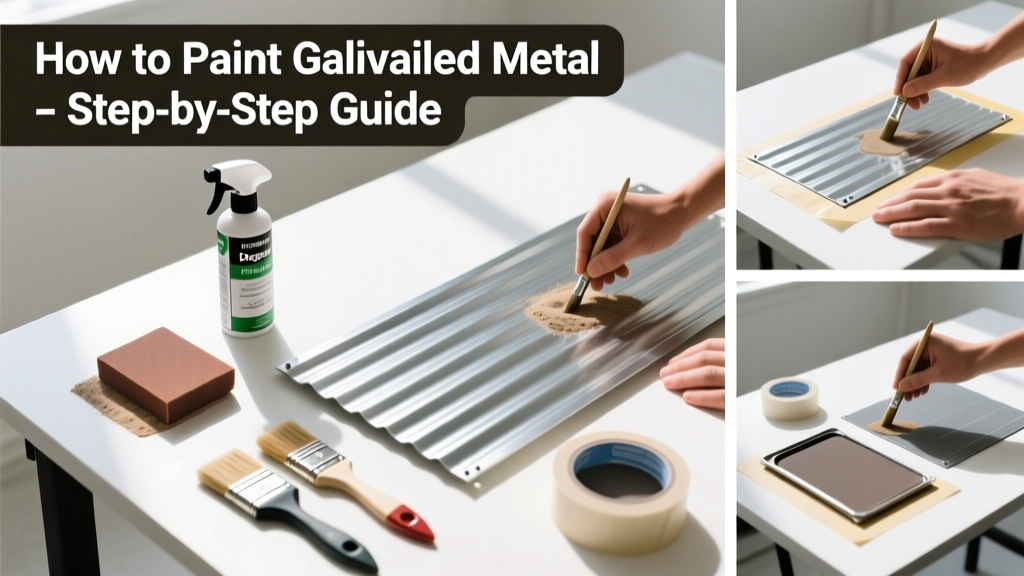
Painting galvanized metal is a common but tricky home improvement task—especially if you’ve ever watched paint bubble or flake off a fence post or shed roof. It’s medium-difficulty (2–3 hours for a 4' x 8' panel), requiring careful surface prep more than brush skill. Done right, it lasts 7–10 years outdoors; done wrong, it fails in months.
Overview
| Skill Level | Time Required | Tools Needed | Estimated Cost |
|---|---|---|---|
| Intermediate | 2.5–4 hours (plus 24–48 hr dry time) | Wire brush, sandpaper, spray bottle, clean rags, paintbrush/roller | $22–$48 (primer + paint only) |
Tools & Materials
| Item | Quantity | Notes |
|---|---|---|
| White vinegar or galvanizing cleaner (e.g., Rust-Oleum Galv-O-Shield Prep) | 1 quart | Vinegar works for light oxidation; commercial cleaners handle heavy zinc bloom |
| 120-grit aluminum oxide sandpaper or Scotch-Brite DA25 pad | 2–3 sheets or 1 pad | Never use steel wool—it embeds iron particles that rust |
| Zinc-rich epoxy primer (e.g., Rust-Oleum Stops Rust Zinc Rich Primer) | 1 quart | Must be zinc-based—not acrylic or oil-based—to bond to zinc |
| 100% acrylic latex or urethane topcoat (e.g., Sherwin-Williams A-100) | 1 quart | Avoid alkyd/oil paints—they saponify on galvanized surfaces |
| Angle brush (2" angled sash) + 3/8" nap roller cover | 1 each | For tight corners and smooth film build |
Step-by-Step Instructions
Clean the Surface Thoroughly
Wipe down the metal with a rag dampened with white vinegar (5% acidity). Let sit 2 minutes, then rinse with clean water and air-dry completely. For older or weathered galvanizing, use a dedicated galvanizing cleaner per label instructions. Skip this step, and residual zinc carbonate (white powdery 'bloom') will block primer adhesion.
Lightly Abrade the Surface
Scuff the entire surface with 120-grit sandpaper or a non-iron abrasive pad—just enough to dull the shine. You’re not removing zinc; you’re creating microscopic texture for mechanical grip. Wipe away all dust with a tack cloth or lint-free rag dampened with denatured alcohol (not water—it leaves mineral residue).
Apply Zinc-Rich Primer Within 2 Hours
Stir (don’t shake) your zinc-rich primer for 90 seconds. Apply one even coat using a brush for edges and a roller for flat areas. Maintain a wet edge and avoid overworking. According to the SSPC (Society for Protective Coatings) Guide 15, 2022, primer must be applied within 2 hours of cleaning—or re-clean if exposed to humidity or rain.
Let Primer Cure, Then Topcoat
Allow primer to dry to touch (2–4 hrs), then cure fully (24 hrs minimum) before topcoating. Lightly scuff with 220-grit paper if glossy, wipe clean, then apply two thin, even coats of 100% acrylic or urethane paint. Wait 4–6 hours between coats. Never skip the second topcoat—it seals pinholes and extends UV resistance.
Pro Tips
Galvanized steel fails fast when painted with incompatible products—not because the metal is ‘hard to paint,’ but because chemistry matters. Zinc reacts with acids and oils, forming weak soaps (saponification) that lift paint from the substrate.
"More than 68% of galvanized paint failures we see in field audits trace back to skipping vinegar wash or using oil-based primer." — Greg T., Field Technical Lead, Rust-Oleum Commercial Coatings, 2023
- Test adhesion first: Tape a 2" strip of 3M 600-series tape over dried primer, rip off sharply—if primer lifts, re-clean and re-prime
- Paint only when ambient temperature is 50–90°F and humidity stays below 85% for 48 hours
- For railings or gutters, use a satin or semi-gloss acrylic—flat finishes highlight surface imperfections
Can I paint over old paint on galvanized metal?
Yes—but only if the existing coating is firmly adhered and compatible (acrylic or urethane). Remove any chalky, blistered, or peeling layers with a scraper and sandpaper. Spot-prime bare galvanized areas with zinc-rich primer before applying a full topcoat.
Do I need to wait for new galvanized metal to weather before painting?
No—and waiting hurts performance. Modern hot-dip galvanizing forms stable zinc carbonate in 2–6 months, but that layer interferes with bonding. The U.S. Steel Galvanizing Manual (2021) recommends painting within 48 hours of installation—or after proper cleaning if delayed.
Why did my paint peel after just one season?
Most likely causes: using an alkyd or oil-based primer (saponification), skipping vinegar wash (zinc bloom barrier), or applying paint in high humidity. Less commonly: over-thinning paint or rolling too heavily, causing runs that trap moisture at the interface.
Can I use spray paint on galvanized metal?
Yes—if it’s labeled “for galvanized metal” or “zinc-safe.” Krylon H2O Latex and Rust-Oleum Protective Enamel (Acrylic) both pass ASTM D3359 adhesion testing on galvanizing. Shake cans vigorously for 2 minutes, hold 10–12 inches away, and apply 3 light passes—not one heavy coat.
Is power washing safe before painting?
Only if followed immediately by vinegar treatment and drying. High-pressure water drives contaminants into micro-pores and can leave alkaline residues. Better: low-pressure rinse + vinegar wipe + air dry.
What’s the longest-lasting topcoat for outdoor galvanized steel?
In independent testing by the American Galvanizers Association (2022), 100% acrylic elastomeric coatings outperformed standard acrylics by 3.2x in UV resistance and chalk resistance on vertical surfaces. For roofs or high-exposure areas, consider Sherwin-Williams Loxon XP or Benjamin Moore Ultra Spec 500.
Once you master the prep-and-primer sequence, painting galvanized metal becomes predictable—not problematic. It’s less about technique and more about respecting the zinc layer’s chemistry. For related projects, see how to remove rust from metal and best primers for metal. If your project involves fencing, check our guide to painting chain-link fences—many use galvanized wire.