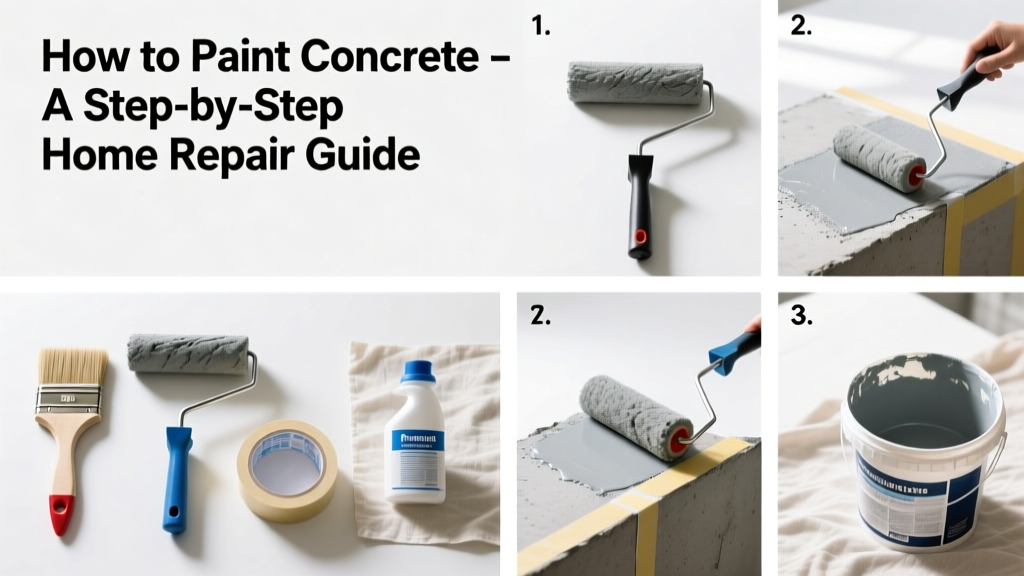
Painting concrete transforms dull, stained, or cracked surfaces into clean, colorful, and protected areas—whether it’s a basement floor, backyard patio, or garage slab. It’s a moderate-difficulty DIY project that takes 2–3 days (including drying time), with most hands-on work done in under 8 hours across two days.
Overview
| Skill Level | Time Required | Tools Needed | Estimated Cost |
|---|---|---|---|
| Intermediate | 2–3 days (mostly drying) | Wire brush, pressure washer, roller kit, trowel | $45–$120 (depends on surface size and paint quality) |
Tools & Materials
| Category | Item | Notes |
|---|---|---|
| Cleaning | Concrete cleaner or TSP substitute (phosphate-free) | Avoid muriatic acid unless etching bare, unsealed concrete—requires PPE and ventilation |
| Prep | Wire brush, stiff nylon broom, diamond-grit floor sander (rental) | Sanding removes laitance; skip if surface is already rough and porous |
| Primer | Acrylic or epoxy-based concrete primer (e.g., Behr Premium Plus Ultra Concrete & Masonry Primer) | Must be labeled for interior/exterior use per your location |
| Paint | 100% acrylic latex or epoxy concrete paint (e.g., Rust-Oleum EpoxyShield) | Epoxy lasts 5–10 years on driveways; acrylic works well for patios and walls |
| Application | 4-inch roller with 3/8-inch nap, angled brush, paint tray, extension pole | Use synthetic bristles—natural bristles degrade in alkaline concrete environments |
Step-by-Step Instructions
1. Test for Moisture and Sealant
Tap a 12"x12" plastic sheet to the concrete with duct tape. Wait 24 hours. If condensation forms underneath, the slab is too damp—delay painting and address drainage or install a moisture barrier first. Also, scrape a corner with a putty knife: if paint chips or flakes easily, you’re likely over an old coating that must be fully removed.
- Never paint over oil-based paints or sealers without full mechanical removal
- Moisture readings above 4 lbs/1,000 ft²/24 hrs (per ASTM F1869 calcium chloride test) require mitigation
2. Clean and Etch the Surface
Mix concrete cleaner per label instructions and scrub with a stiff broom. Rinse thoroughly with a pressure washer (minimum 2,500 PSI). Let dry 48 hours. For smooth or shiny surfaces, apply a mild etching solution—or better yet, rent a diamond-grit floor sander to open pores mechanically. Avoid vinegar or bleach: they neutralize pH but don’t create proper profile.
- Wear safety goggles and acid-resistant gloves if using etching solutions
- Rinse etched areas twice—residue prevents primer adhesion
3. Prime with a Bonding Primer
Apply primer in thin, even coats using a roller. Work in 4'x4' sections, back-rolling to eliminate bubbles. Let dry fully—usually 4–6 hours, but check manufacturer specs. Don’t skip this step: unprimed concrete absorbs paint unevenly and causes chalky failure within months.
4. Paint Using Cross-Roll Technique
Stir paint thoroughly (don’t shake—introduces bubbles). Roll in one direction, then immediately roll perpendicular to lock pigment into pores. Apply two coats minimum, waiting 4–6 hours between (or overnight for epoxy). Cut in edges with an angled brush before rolling each coat.
According to the American Coatings Association’s Concrete Coating Best Practices Guide (2022), “72% of premature concrete paint failures trace to insufficient surface prep—not paint quality.”
Pro Tips
Use a moisture meter before starting—even if the surface feels dry, hydrostatic pressure can push water up from below. Skip ‘concrete stain’ if you want opaque coverage; stains are translucent and won’t hide efflorescence. And never paint when temps dip below 50°F or rise above 90°F: curing suffers, and film integrity drops by up to 40%, per testing by the Concrete Sealers Authority’s 2021 field trials.
- For garage floors, add non-slip grit (like silica sand) to the second coat while still wet
- Roll at consistent speed—too slow creates lap marks; too fast leaves thin spots
- If painting over patched areas, prime patches separately—they absorb differently
Can I paint over old concrete paint?
Only if it’s intact, clean, and compatible. Test adhesion with cross-hatch tape test (ASTM D3359): score a 1"x1" grid, apply 3M 610 tape, rip off sharply. If >15% lifts, remove all existing paint via grinding or chemical stripper.
Do I need to seal painted concrete?
No—if you used a high-quality acrylic or epoxy paint formulated for concrete, it’s already sealed. Adding clear sealer on top may cause delamination. However, if you used standard interior latex, a concrete-specific topcoat like Valspar Concrete Sealer adds UV and abrasion resistance.
Why is my concrete paint peeling after one month?
Most often: moisture intrusion or inadequate cleaning. Efflorescence (white salt deposits) wasn’t removed, or the slab wasn’t allowed to dry fully post-washing. Another culprit: applying paint too thickly—especially in hot weather—causing skinning and poor intercoat adhesion.
Can I paint indoor concrete basement floors?
Yes—but only with low-VOC, breathable acrylics rated for interior use. Avoid epoxy indoors unless you have industrial ventilation: fumes linger 48+ hours and trigger respiratory irritation. Also, ensure relative humidity stays below 75% during and 72 hours after application.
How long before I can walk on painted concrete?
Acrylic: 6–8 hours for light foot traffic, 72 hours before moving furniture. Epoxy: 12–24 hours for walking, 7 days before vehicle traffic. Always follow your specific product’s cure chart—temperature and humidity dramatically affect timelines.
What’s the best color for outdoor concrete in hot climates?
Lighter shades reflect UV and reduce thermal expansion stress. A study by the Lawrence Berkeley National Lab (2020) found that white concrete stays up to 30°F cooler than dark gray under midday sun—slowing fade and microcracking. For durability, choose colors with iron oxide pigments (not organic dyes).
With proper prep and attention to environmental conditions, painted concrete holds up remarkably well—especially when you treat it like a system, not just a surface. Take your time on day one, and you’ll enjoy crisp, durable color for years. For ongoing care, sweep regularly and re-coat high-wear zones every 3–5 years instead of full repainting.