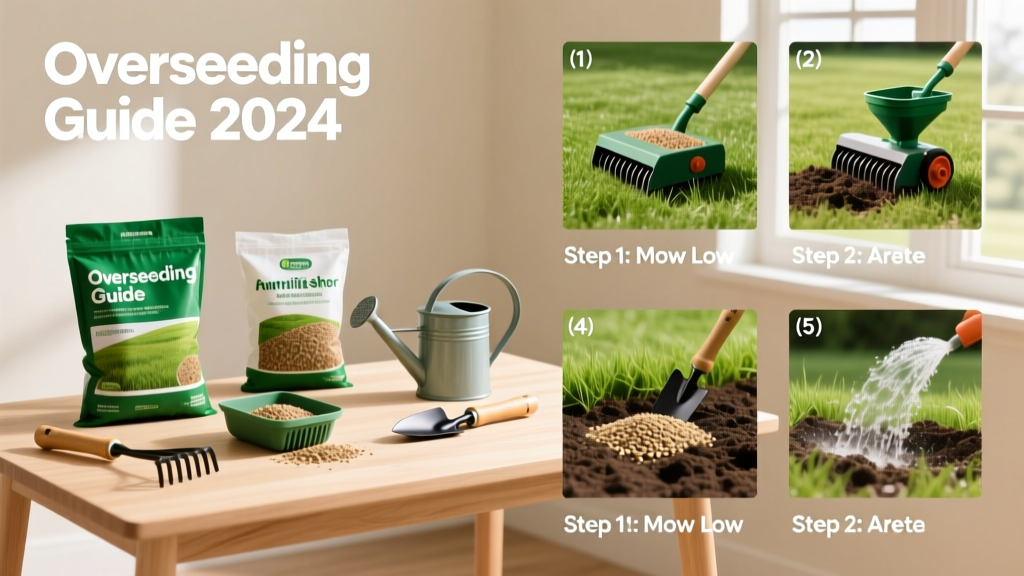
Overseeding is the process of spreading grass seed over an existing lawn to fill in thin spots, improve density, and introduce more resilient turf varieties. It’s a moderate-skill task that takes 2–3 hours of active work plus 2–4 weeks of follow-up care—and it delivers measurable results when timed right (late summer to early fall is ideal in most U.S. zones).
Overview
| Category | Details |
|---|---|
| Skill Level | Beginner to intermediate — requires attention to timing and soil prep, but no special certifications |
| Time Required | 2–3 hours setup + 2–4 weeks of watering and monitoring |
| Tools Needed | Drop or broadcast spreader, rake, garden hose with sprinkler, stiff broom or push broom |
| Estimated Cost | $35–$85 (seed, starter fertilizer, optional compost; excludes aerator rental) |
Tools & Materials
| Item | Purpose & Notes |
|---|---|
| Grass seed (cool-season: Kentucky bluegrass, perennial ryegrass, fine fescue) | Use a blend labeled “overseeding mix” — avoid cheap “economy” blends with filler seed. For warm-season lawns (e.g., Bermuda), wait until late spring and use certified Tifway 419 or similar. |
| Starter fertilizer (low N, high P, e.g., 10-20-10) | Phosphorus supports root development in new seedlings. Skip high-nitrogen formulas—they burn tender shoots. |
| Core aerator (rental or manual) | Not mandatory—but improves seed-to-soil contact by 70% according to the University of Minnesota Extension’s 2022 Turfgrass Field Guide. Rent one if your soil compacts easily (clay or high-traffic areas). |
| Drop or broadcast spreader (calibrated) | Calibration prevents patchy growth. Test on a 10×10 ft area first using the seed bag’s rate chart. |
| Compost or topdressing (optional) | ¼-inch layer helps retain moisture and protects seed—but skip if your lawn has active fungal issues like brown patch. |
Step-by-Step Instructions
Mow and Dethatch (1–2 days before seeding)
Cut grass to 1.5–2 inches—short enough to expose soil but not scalp crowns. Then remove excess thatch (>½ inch thick) with a dethatcher or power rake. If you hear a hollow thud when tapping the lawn with a screwdriver, that’s a sign of compaction—not thatch—so skip dethatching and go straight to aeration.
- Tip: Bag clippings after mowing—you want light reaching the soil surface, not smothering new seed.
- Warning: Never dethatch during drought or extreme heat. Wait for 3–5 days of forecasted rain or consistent irrigation windows.
Aerate (same day as mowing, or next morning)
Run a core aerator across the entire lawn in two directions (north-south, then east-west). Pull 2–3 inch plugs spaced 2–4 inches apart. Leave plugs on the lawn—they’ll break down naturally in 1–2 weeks. Don’t drag or sweep them unless they’re blocking walkways.
- Tip: Water the lawn deeply 24 hours before aeration—it softens soil and boosts plug removal efficiency.
- Warning: Avoid aerating within 6 months of applying a pre-emergent herbicide. It breaks down the barrier and invites weeds.
Apply Seed and Starter Fertilizer
Fill your spreader with half the recommended seed rate. Walk north-south, overlapping edges by 50%. Empty and refill with the remaining seed, then walk east-west. Immediately after, apply starter fertilizer at label rate—never more. Lightly rake or broom seed into soil crevices (don’t bury deeper than ¼ inch).
- Tip: Use a drop spreader for slopes >5%—broadcast spreaders blow seed downhill.
- Warning: Don’t mix seed and fertilizer in the same hopper. Uneven distribution ruins germination rates.
Water Gently and Consistently
Water 2–3 times daily for the first 10–14 days—just enough to keep the top ½ inch moist (not soggy). Early morning is best; avoid evening watering after seedlings emerge to reduce fungal risk. After 3 weeks, taper to once-daily deep watering. Hold off on mowing until seedlings reach 3 inches tall.
- Tip: Place shallow tuna cans around the yard while watering to measure output—aim for ¼ inch per session.
- Warning: Skipping even one day of surface moisture in week one drops germination by up to 40%, per Penn State’s 2021 Turf Research Trials.
Pro Tips
Timing beats technique every time. In northern regions, aim for August 15–September 15. In transition zones (e.g., Missouri, Virginia), target September 1–20. Warm-season lawns like zoysia or bermuda should be overseeded with annual ryegrass only for winter color—not permanent renovation.
“Most failed overseeding jobs trace back to poor soil contact—not bad seed. If seed isn’t touching mineral soil, it won’t sprout—even with perfect watering.” — Dr. Nick Christians, Iowa State University Turf Program, 2020
Common mistakes include skipping soil testing (pH below 6.0 or above 7.2 slows germination), using old seed (germination drops 10–15% per year past expiration), and walking on newly seeded areas before the first mow.
Can I overseed without aerating?
Yes—but only if your soil is sandy, loose, and free of compaction. In clay or heavily trafficked lawns, skipping aeration cuts seed-to-soil contact from ~85% to under 40%. A vigorous raking with a steel-tine rake helps, but it’s no substitute for core aeration.
How much seed do I need per square foot?
Cool-season grasses: 3–5 lbs per 1,000 sq ft for thin lawns; 6–8 lbs for bare patches. Warm-season overseeding (winter ryegrass): 10–12 lbs/1,000 sq ft. Always check the seed bag’s “overseeding rate”—not the “new lawn” rate, which is double.
Should I use straw or erosion blanket?
Only on slopes >15% or in windy, exposed yards. Use wheat straw—never hay (it carries weed seeds). Apply just 1 bale per 1,000 sq ft, loosely scattered so 50% of soil remains visible. Remove it after 3–4 weeks as seedlings grow through.
When can I apply weed killer?
Wait until you’ve mowed the new grass 3–4 times (usually 6–8 weeks). Pre-emergents like prodiamine are safe after 3 months; post-emergents like 2,4-D require 4 weeks post-emergence and full leaf coverage. Never spray during heat waves above 85°F.
Why did my overseeded patches turn yellow after 2 weeks?
Most often, it’s nitrogen deficiency—not disease. Starter fertilizer runs out by week 3. Apply a slow-release, low-burn nitrogen (e.g., 19-0-5) at half label rate. Also rule out iron chlorosis (yellow leaves with green veins) common in alkaline soils—treat with chelated iron spray.
Do I need to reseed every year?
No. Healthy, dense lawns need overseeding every 2–3 years. But if you see >15% bare soil or persistent thinning in high-traffic zones, consider annual light overseeding combined with topdressing—a practice used by municipal golf courses in Minnesota and Michigan to extend turf life by 4–7 years.
Overseeding isn’t magic—it’s maintenance with intention. Do it right once, and your lawn will reward you with deeper roots, better drought tolerance, and fewer weeds all season long. For related help, see how to fix bare spots in lawn and best grass seed for shade.