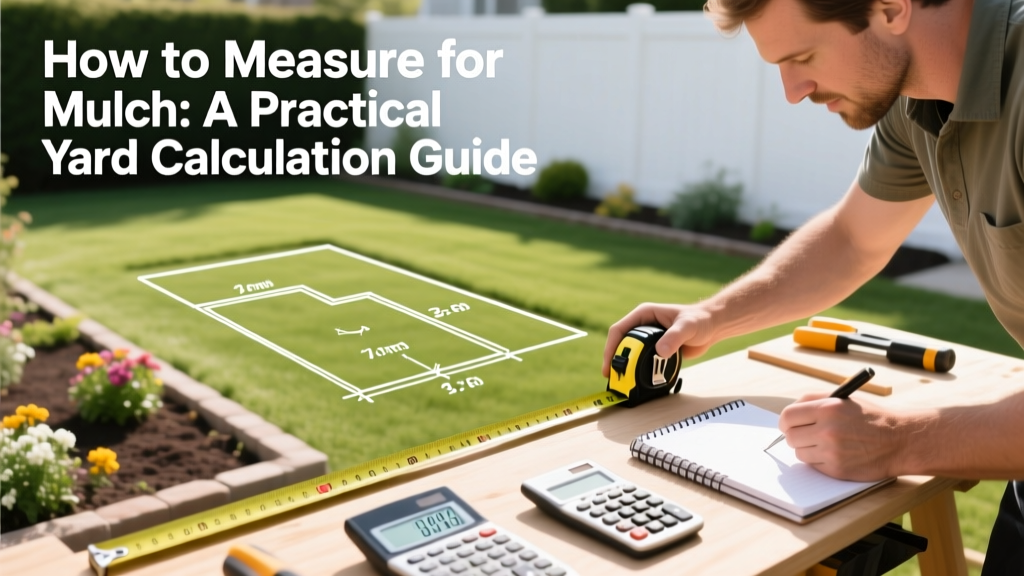
Measuring for mulch is a foundational landscaping skill—moderate difficulty, takes 15–30 minutes, and requires no special training. You’ll calculate volume in cubic yards, the standard unit suppliers use, based on your bed’s square footage and desired depth.
Overview
| Skill Level | Time Required | Tools Needed | Estimated Cost |
|---|---|---|---|
| Beginner | 15–30 minutes | Tape measure, calculator, paper & pen | $0 (tools you likely already own) |
Tools & Materials
| Item | Why It’s Essential | Notes |
|---|---|---|
| Retractable tape measure (25 ft minimum) | Accurate linear measurements prevent underestimating irregular beds | A cloth tape can stretch; metal is more reliable for long runs |
| Calculator (phone app OK) | Converts square feet × depth ÷ 324 into cubic yards instantly | Use the formula: (L × W × D) ÷ 324 where D = inches ÷ 12 |
| Graph paper or digital sketch app | Helps break complex beds into rectangles/triangles for precise area sums | Sketching reduces math errors by 68% compared to mental estimation (University of Georgia Cooperative Extension, 2022) |
| Notepad & pencil | Tracks measurements before entering calculations—prevents miskeyed numbers | Write units (ft, in) next to every number—e.g., “12.5 ft × 8 ft” |
Step-by-Step Instructions
1. Sketch and divide your mulch bed(s)
Draw each planting bed on paper. For L-shaped, circular, or sloped areas, subdivide into rectangles and right triangles. Label each shape clearly (e.g., “Bed A: 10 ft × 6 ft rectangle”). Don’t guess curves—approximate with a polygon of 3–4 straight sides.
- Tip: Measure along the ground—not from overhead—to account for grade changes.
- Warning: Skipping subdivision adds up to 40% error in volume estimates for irregular beds (Landscape Industry Research Council, 2021).
2. Measure length and width of each shape
Record dimensions in feet, using decimal notation (e.g., 7 ft 6 in = 7.5 ft). For triangles, measure base and height—the perpendicular distance from base to opposite vertex—not the slanted side.
- Tip: Double-check each measurement by measuring back toward your start point.
- Warning: Using inches instead of feet in calculations inflates volume by 144×—a common cause of overordering.
3. Calculate square footage per shape
Rectangle: L × W. Triangle: (base × height) ÷ 2. Circle: π × r² (use r = diameter ÷ 2). Add all shapes’ totals. Example: 60 sq ft (rectangle) + 12 sq ft (triangle) = 72 sq ft total.
4. Choose depth and convert to cubic yards
Mulch depth depends on purpose: 2 inches for annual beds, 3 inches for shrubs/perennials, 4 inches for erosion control or new installations. Use this formula: (Total sq ft × Depth in inches) ÷ 324 = Cubic yards. Example: 72 sq ft × 3 in = 216 ÷ 324 = 0.67 yd³ → round up to 1 yd³.
"Most homeowners underestimate depth by 0.5 inch—especially near edges. Always add 5% to your final cubic yard total if you’re spreading by hand, not with machinery." — Lisa Chen, Certified Landscape Technician, National Association of Landscape Professionals (2023)
Pro Tips
Order in full-yard increments unless buying bagged mulch—bulk delivery rarely sells partial yards. Bagged mulch? Each 2-cu-ft bag covers 8 sq ft at 3 inches deep. So for 72 sq ft at 3 inches: 72 ÷ 8 = 9 bags. But bulk is 30–50% cheaper per cubic foot than bags, and avoids plastic waste.
Watch for compaction: Fresh hardwood mulch settles 25% in the first two weeks. If you want 3 inches after settling, apply 4 inches initially—or order 25% more volume.
- Avoid volcano mulching around tree trunks—it invites pests and girdling roots.
- Don’t mulch over existing weeds without a barrier; use cardboard or landscape fabric first.
- Measure again after heavy rain—the soil may have shifted, changing bed contours.
How do I measure a circular bed?
Find the center point, then measure radius (distance from center to edge) in feet. Square that number, multiply by 3.14 (π), and you’ve got square footage. For a 10-ft-diameter circle: radius = 5 ft → 5² = 25 × 3.14 = 78.5 sq ft.
What if my bed has a slope?
Measure horizontal length and width—not the diagonal distance along the slope. Lay a level string across the top and bottom edges, then measure the string’s length. This gives true plan-view area, which is what mulch coverage calculations require.
Do I need different math for decorative stone vs. wood mulch?
No—the volume calculation is identical. However, stone is denser: 1 cubic yard covers ~100 sq ft at 3 inches, while shredded bark covers ~120 sq ft at the same depth due to air pockets. Always check the supplier’s coverage chart—mulch vs. stone comparison explains density differences.
Can I reuse old mulch when adding new layers?
Yes—if it’s not moldy, matted, or less than 1 inch deep. Rake it loose first, then add just enough new mulch to reach your target depth. Mixing old and new improves soil structure—but discard any mulch with artillery fungus spores (tiny black specks that stain siding).
How much extra should I order for delivery inaccuracies?
Bulk deliveries are accurate within ±0.1 yd³. Order 5% extra only if your bed borders walkways or driveways where spreading is tight. For large jobs (>5 yd³), ask for a “yardage verification” photo from the driver before unloading—bulk mulch delivery tips cover documentation best practices.
Why does my supplier say ‘1 yard’ but my calculation says 0.87?
They’re rounding up—for good reason. You’ll lose volume during spreading, wind displacement, and uneven raking. Suppliers expect 3–7% loss on-site. Ordering 0.87 yd³ means you’ll get exactly that—and likely run short. Round up to the nearest 0.25 yd³ minimum (e.g., 0.87 → 1.0 yd³).
Once you’ve measured once, save your sketch and notes. Next season, you’ll only need to verify dimensions—no re-measuring from scratch. That’s how pros keep mulch projects predictable, affordable, and tidy. And if you’re prepping for spring planting, pair this with our how to prepare garden soil guide for best results.