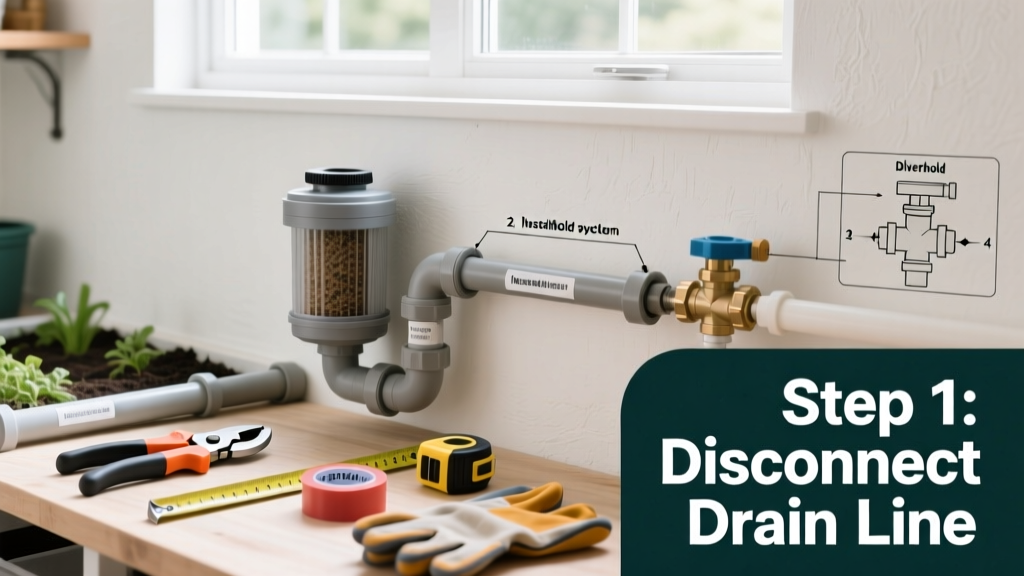
Installing a greywater system lets you safely reuse water from your bathroom sinks, showers, and laundry to irrigate non-edible plants—cutting household water use by up to 30%. This is an intermediate DIY project: expect 12–24 hours of hands-on work over 2–3 days, depending on pipe access and landscape layout. Permits and local code compliance are non-negotiable—start there before buying a single fitting.
Overview
| Skill Level | Time Required | Tools Needed | Estimated Cost |
|---|---|---|---|
| Intermediate (basic plumbing & trenching experience) | 12–24 hours across 2–3 days | Wrenches, pipe cutters, level, shovel, drill, multimeter (for pump systems) | $280–$1,200 (gravity-fed vs. pumped; excludes permit fees) |
Tools & Materials
| Category | Item | Notes |
|---|---|---|
| Plumbing | 3/4" PVC or HDPE tubing (schedule 40), 90° and 45° elbows, T-fittings, ball valves, hose clamps | HDPE preferred for burial—UV-resistant and flexible; avoid PVC below grade unless sleeved |
| Filtration | Mesh filter (200–300 micron), inline sediment trap | Required by California Plumbing Code §1603.2; clean weekly during first month |
| Drainage | Pop-up emitters (4–6 per zone), mulch basins (12"–24" deep, lined with geotextile) | Emitters must be buried ≥2" under mulch; never within 5 ft of building foundations or edible plants |
| Permitting | Site plan, plumbing schematic, soil percolation test report (if required) | According to the International Plumbing Code (IPC) 2021, all greywater systems >250 gal/day require engineered design review |
Step-by-Step Instructions
1. Confirm legality and secure permits
Call your local building department and health authority. In Arizona, Idaho, New Mexico, Texas, and Washington, simple L2L systems are exempt from permits—but only if they meet strict criteria: no storage, no pumps, gravity flow only, and discharge into mulch basins—not drip lines. In California, even L2L requires a signed affidavit and site inspection. Never skip this step: unpermitted systems can void home insurance and trigger fines up to $5,000 (California Department of Housing and Community Development, 2022).
2. Map your greywater sources and landscape zones
Identify which fixtures feed your system: shower drains and washing machine outputs are ideal (low soap load, no solids). Avoid kitchen sinks (grease, food particles) and dishwashers (high salt, bleach). Sketch a plan showing pipe runs from source to each planting zone—keep slopes at 1/8"–1/4" per foot for gravity flow. Measure distances: every 25 ft of horizontal run adds ~1.5 psi head loss. Use a laser level or string line to verify elevation drop.
3. Install the diverter valve and primary line
Cut into the existing drain line *after* the P-trap (never before—it breaks the air seal and risks sewer gas entry). Install a three-way diverter valve with accessible service ports. Connect the greywater outlet to 1" HDPE using Fernco couplings rated for underground use. Wrap all buried joints with self-fusing silicone tape—then bury in 6" of sand to prevent abrasion. Test for leaks at 30 PSI using a hand pump before backfilling.
4. Build mulch basins and connect emitters
Dig basins 18" wide × 18" long × 12" deep at the base of target trees or shrubs. Line with 4 oz geotextile fabric, fill with 6" of 1/2"–1" river rock, then add 6" of arborist wood chips (not bark mulch—too hydrophobic). Run 3/4" lateral lines from the main line into each basin, terminating in pop-up emitters set flush with the rock layer. Anchor lines with steel landscape staples every 3 ft. Cover emitters with 2" of mulch—never soil.
Pro Tips
Greywater isn’t ‘dirty water’—it’s a resource with strict chemistry rules. Soap choice matters more than you think: sodium-based surfactants (like sodium lauryl sulfate) build up in soil and damage structure over time. Switch to potassium-based soaps (e.g., Dr. Bronner’s Pure-Castile Liquid) or plant-based detergents labeled ‘greywater-safe.’
“Over 70% of greywater system failures stem from improper filtration—not pipe leaks. A clogged 200-micron screen reduces flow by 90% in under 10 days if you’re using standard detergent.” — Mike D’Antonio, Certified Greywater Installer, Greywater Action Network, 2023
Common mistakes include: connecting to a septic tank’s inlet (illegal and dangerous), using black polyethylene pipe above ground (UV degradation in <6 months), and installing emitters near fruit trees (IPC prohibits greywater contact with edible parts). Always label pipes with purple “GW” tape per ASSE 1052 standards.
Can I use greywater on vegetables?
No. The Uniform Plumbing Code (UPC §1603.4) explicitly bans subsurface greywater application within 5 feet of edible root crops or above-ground produce. You may irrigate perennial fruit trees (citrus, figs) if emitters are buried and mulch is maintained—but never tomatoes, lettuce, or strawberries.
Do I need a pump?
Only if your landscape is uphill from the source or exceeds 150 ft of total pipe run. Most residential L2L systems rely on gravity: a 24" vertical drop from washer drain to basin provides enough pressure for 4–6 emitters. If you add a pump, use a 12V DC demand pump (e.g., Zoeller R50) with built-in thermal cutoff—AC pumps risk electrical hazards in wet mulch zones.
How often should I maintain the system?
Weekly for the first month: inspect filters, check emitter pop-up action, and stir mulch to prevent crusting. Quarterly: flush laterals with vinegar solution (1 part white vinegar to 4 parts water) to dissolve soap scum. Annually: excavate one basin to assess rock porosity and replace degraded geotextile. According to the U.S. EPA, well-maintained greywater systems last 12–15 years—versus 5–7 for neglected ones.
What soap additives should I avoid?
Avoid boron (in some dishwasher detergents), chlorine bleach, sodium hypochlorite, and synthetic fragrances. Boron accumulates in soil and is toxic to citrus and avocado roots at levels >0.5 ppm. Sodium chloride (salt) degrades soil structure—opt for sodium-free, low-sodium, or potassium-based alternatives. Check ingredient lists for ‘sodium carbonate’, ‘sodium silicate’, or ‘sodium tripolyphosphate’—all red flags.
Can I tie multiple fixtures together?
You can combine shower and laundry flows *only if* your local code allows it—and only with a properly sized surge tank and secondary filtration. The 2023 California Greywater Design Manual warns against mixing high-flow (shower) and high-lint (laundry) streams without a 50-gallon settling tank and dual-chamber filter. Most inspectors reject combined systems without engineered plans.
Is rainwater harvesting better than greywater?
They serve different purposes. Rainwater is potable-grade with proper treatment and ideal for indoor reuse (toilet flushing, laundry). Greywater is lower-effort, higher-volume, and purpose-built for landscape irrigation—but requires stricter soap management. Homes in arid zones (e.g., Tucson, AZ) see 40% greater water savings pairing both systems (rain barrel installation guide). For urban lots with limited roof area, greywater delivers more consistent year-round supply.
A properly installed greywater system pays for itself in 3–5 years through reduced water bills and landscape resilience—especially as drought surcharges climb. It’s not about perfection; it’s about intentionality: choosing the right soap, inspecting filters like clockwork, and respecting the boundary between wastewater and resource. Once you’ve routed that first gallon from shower to sycamore, you’ll see your yard—and your water bill—differently. For help sizing your system, refer to our free greywater volume calculator, or consult a licensed installer if your slope exceeds 15% or your soil is heavy clay.