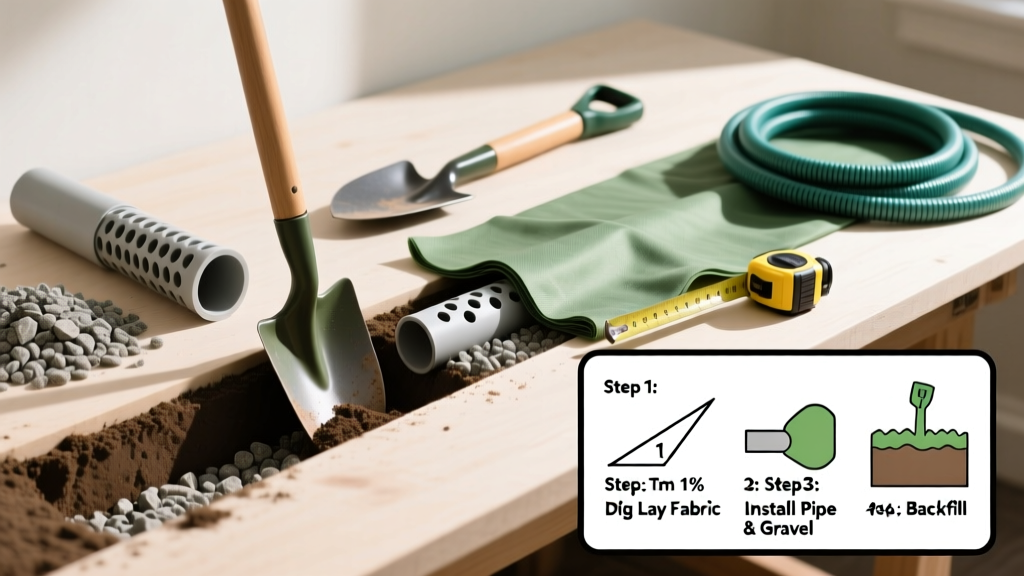
Installing a French drain is a foundational landscape drainage skill that redirects groundwater away from foundations, patios, or soggy lawn zones. It’s intermediate difficulty—requiring digging stamina and basic grading knowledge—but entirely doable in one weekend with proper prep. Most homeowners complete a 30-foot residential drain in 12–16 hours across two days.
Overview
| Skill Level | Time Required | Tools Needed | Estimated Cost (30 ft) |
|---|---|---|---|
| Intermediate | 12–16 hours | Shovel, trenching shovel, laser level or string line & line level, tape measure, wheelbarrow | $180–$260 |
Tools & Materials
| Category | Item | Notes |
|---|---|---|
| Drainage | 4-inch perforated PVC pipe (SCH 40, slotted bottom half only) | Avoid corrugated black pipe—it collapses under soil load per ASTM D3034 standards |
| Filter | Geotextile fabric (non-woven, 3.5 oz/yd² minimum) | Must wrap pipe *and* line trench—never skip this; silt clogs pipes in <18 months without it (University of Minnesota Extension, 2022) |
| Aggregate | Washed #57 gravel (¾" to 1¼" stones) | Never use pea gravel—it migrates and bridges; #57 allows optimal flow and compaction resistance |
| Backfill | Topsoil or sod-friendly fill | Keep top 6" free of gravel to support grass or mulch |
Step-by-Step Instructions
Dig the Trench
Mark your route with spray paint or stakes—start at the problem area (e.g., foundation wall) and slope toward daylight or a dry well. Dig a trench 18–24" wide and 24" deep. Maintain a consistent 1% slope: drop 1" per 8 feet of run. Use a laser level or string line with line level to verify grade every 6 feet. Remove all roots and sharp rocks—they puncture fabric and pipe.
Lay Filter Fabric & Gravel Base
Unroll geotextile fabric along the trench floor and 12" up each side. Overlap seams by 6" and pin edges temporarily with landscape staples. Pour 2" of washed #57 gravel into the bottom—level it with a straight 2×4. This base supports the pipe and prevents settling.
Install Perforated Pipe
Place 4" SCH 40 PVC pipe with holes facing *downward* (this captures water from below, not surface runoff). Ensure all couplings are solvent-welded—not taped or friction-fit. Leave the upstream end open and cap the downstream end *only if* discharging into a dry well; otherwise, leave it open to daylight. Slope must be uninterrupted—no dips or rises.
Wrap & Backfill
Fold fabric over the pipe, sealing seams with 3" overlaps. Cover with 6–8" of gravel—enough to fully bury the pipe plus 2" extra. Tamp lightly. Then add 6" of topsoil or loam. If planting turf, lay sod or seed immediately; if mulching, use landscape fabric beneath mulch to prevent washout.
Pro Tips
Most failed French drains stem from poor slope or skipped fabric—not pipe quality. The U.S. EPA estimates that improperly graded drains account for 68% of premature failures (EPA Stormwater Management Guide, 2021). Always test flow before final backfill: pour 5 gallons of water into the upstream end and watch for steady exit at the outlet.
"If your trench holds standing water after rain, your slope is too shallow—or you’ve hit a clay lens. Re-dig that section with 1.5% grade and add a 12"-deep gravel break layer." — Greg Lauer, Certified Irrigation Designer & 28-year drainage contractor
- Never connect roof downspouts directly to a French drain—the surge volume overwhelms gravel porosity
- For clay soils, double the gravel depth to 12" and add a second fabric layer above the gravel before topsoil
Can I install a French drain next to my foundation?
Yes—but keep the trench *at least* 12" away from the footing. Dig no deeper than the bottom of the footing, and never undermine it. A foundation-integrated drain requires interior perimeter systems instead; consult a structural engineer if your basement has active hydrostatic pressure.
Do I need a dry well at the end?
No—if you have natural daylight (e.g., a sloped yard dropping away from the house), discharge openly there. Dry wells are only needed where no gravity outlet exists. Size them per local code: typical 4' × 4' × 4' concrete or stone-lined pits filled with #3 gravel.
What’s the difference between a French drain and a curtain drain?
A French drain intercepts subsurface water *before* it reaches a structure—usually installed parallel to a foundation or slope crest. A curtain drain runs *perpendicular* to a hillside to block lateral flow. Both use the same materials, but placement and orientation differ radically.
Can I use flex pipe instead of rigid PVC?
Only for short, non-load-bearing sections (e.g., under walkways with minimal soil cover). Rigid SCH 40 PVC resists crushing under 24" of compacted backfill; flex pipe deforms and restricts flow within 3 years in most residential applications (ASTM F818 testing).
How often does a French drain need maintenance?
Every 5–7 years: flush the pipe inlet with a garden hose and check outlet flow. If water pools upstream, excavate the first 5 feet and inspect for root intrusion or sediment buildup. Clean fabric isn’t replaceable—prevention via proper installation is your best maintenance.
Will a French drain fix my wet basement?
It helps—but only if the issue is exterior groundwater. If water enters through cracks or mortar joints, pair the drain with exterior foundation waterproofing (exterior waterproofing) and proper gutter maintenance. For interior seepage, also consider a sump pump system (sump pump installation).
A properly installed French drain reduces hydrostatic pressure on foundations by up to 40%, according to the Insurance Institute for Business & Home Safety’s 2023 report on residential drainage. It won’t eliminate every moisture issue—but it solves the most common cause of foundation dampness and landscape erosion. Take your time on slope and fabric, and you’ll have a working system that lasts 30+ years.