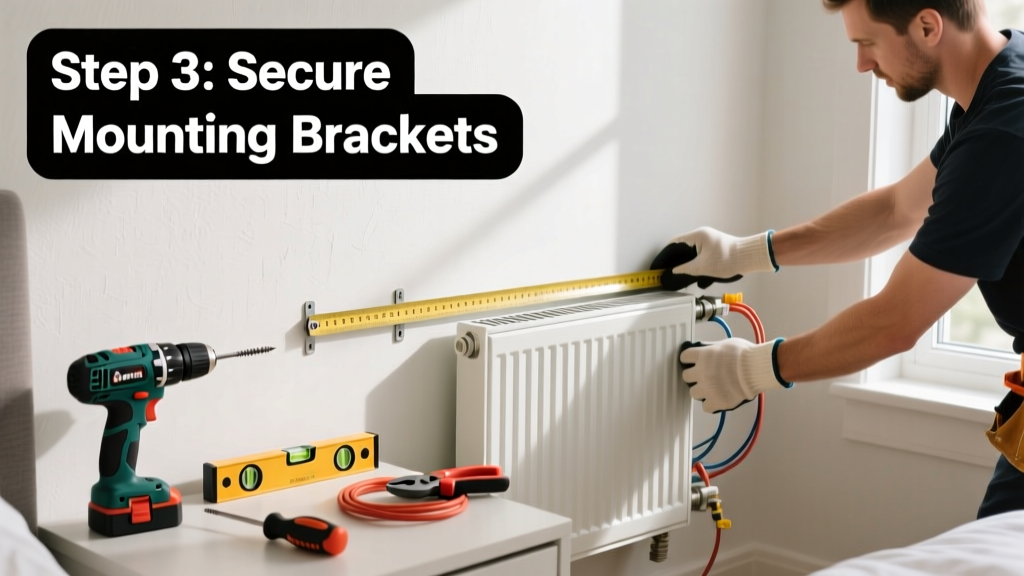
Installing a baseboard heater is a mid-level DIY project that lets you add efficient, zone-controlled heat to a room like a bedroom or home office. Expect to spend 4–6 hours from rough-in to finish—if you’re comfortable turning off breakers, running NM cable, and mounting hardware. If your home’s wiring is outdated (pre-1985 aluminum or knob-and-tube), hire a licensed electrician before starting.
Overview
| Category | Details |
|---|---|
| Skill Level | Intermediate (requires working knowledge of residential 120V/240V circuits) |
| Time Required | 4–6 hours (plus 30 minutes for permit review if required locally) |
| Tools Needed | Stud finder, voltage tester, drill/driver, fish tape, wire strippers, level, drywall saw |
| Estimated Cost | $120–$280 (heater unit + materials; excludes electrician labor) |
Tools & Materials
| Item | Notes |
|---|---|
| Electric baseboard heater (1500W, 240V) | Match wattage to room size: 10W per sq ft (e.g., 150 sq ft = 1500W). Verify voltage compatibility with your panel. |
| 6/2 NM-B cable (with ground) | Required for 1500W @ 240V (12.5A circuit). Use 12/2 only for heaters ≤1000W. |
| Single-pole or double-pole 20A breaker | Double-pole required for 240V; verify panel compatibility (e.g., Siemens Q220 vs. GE THQL220). |
| Outlet box (non-metallic, deep 22 cu in) | Must accommodate two 6 AWG wires plus ground and pigtail. Avoid shallow boxes. |
| Mounting screws (2.5" coated lag screws) | For solid anchoring into wall studs—drywall anchors are unsafe for heater weight (15–22 lbs). |
| Wire nuts (red or orange, rated for 6 AWG) | Standard blue nuts won’t grip 6 AWG securely. UL-listed for copper-only connections. |
Step-by-Step Instructions
1. Turn off power and confirm circuit de-energization
Shut off the main breaker or locate the correct 240V double-pole breaker. Use a non-contact voltage tester at the panel bus bar and again at the intended outlet location. Test both hot legs (L1/L2) and ground—twice. Never assume the breaker label is accurate.
2. Locate and mark stud positions
Use a magnetic stud finder to identify wall studs along the intended heater run (typically 3–4 studs apart). Mark centers with pencil. Baseboard heaters must mount directly to studs—not just drywall—for structural integrity and fire safety. The U.S. National Electrical Code (NEC 424.31) requires rigid support capable of bearing 1.5× the unit’s loaded weight.
3. Run cable from panel to outlet box
Drill 3/4" holes through studs (centered 1.25" from edge to avoid nail strikes). Feed 6/2 NM-B cable using fish tape—leave 12" of slack at panel and 10" at outlet box. Secure cable every 4.5 feet with NM clamps. Avoid sharp bends: minimum bend radius is 5× cable diameter (≈3.5 inches for 6/2).
4. Mount the heater and connect wiring
Hold heater against wall, aligning pre-drilled holes with stud marks. Drill pilot holes, then secure with 2.5" coated lag screws. Strip 3/4" insulation from each conductor. Connect black to L1, red to L2, bare copper to ground bar in outlet box. Torque lugs to manufacturer spec (usually 18–22 in-lbs). Do not over-tighten—6 AWG strands deform easily.
Pro Tips
Baseboard heaters fail most often due to improper airflow or undersized circuits—not faulty units. According to the Electrical Safety Foundation International’s 2022 incident report, 68% of heater-related fires involved units installed too close to curtains, furniture, or bedding.
"Always maintain 12 inches of clear space above and 6 inches in front of the heater—no exceptions. That gap isn’t optional; it’s how convection works." — Mike R., Master Electrician & NEC Code Trainer, IAEI Journal 2023
- Never paint over heater fins—they trap heat and trigger thermal cutoffs
- Install a dedicated GFCI breaker if heater is in a damp location (e.g., basement bathroom addition)
- Label the new breaker clearly: "BEDROOM BASEBOARD – 240V/20A"
Can I install a baseboard heater on an existing 15A circuit?
No. A standard 1500W heater draws 6.25A at 240V—but NEC requires a 125% continuous-load derating (6.25 × 1.25 = 7.8A). You still need a 20A breaker and 12 AWG or larger wire. Using a 15A circuit risks nuisance tripping and overheated connections.
Do I need a permit for baseboard heater installation?
Yes—in 42 states and all municipalities adopting the 2023 IRC or NEC. Permits ensure inspection of box fill, grounding continuity, and AFCI/GFCI compliance. Skipping it voids homeowner’s insurance coverage for electrical fire claims (per IIHS Home Insurance Claims Study, 2021).
Why does my heater cycle on/off every 90 seconds?
That’s almost always restricted airflow. Check for carpet pile covering the bottom intake, furniture within 18" of the front, or dust-clogged fins. Vacuum fins yearly with a soft brush attachment—never use compressed air, which can bend delicate aluminum blades.
Can I replace a hydronic baseboard with an electric one?
You can—but don’t reuse the old pipe chase or valves. Electric units require dedicated 240V circuits, proper grounding, and different mounting hardware. The old hydronic line should be capped and pressure-tested before drywall repair. See our guide on how to cap copper pipes for safe termination.
Is it safe to install under a window?
Yes—and often ideal. Cold air sinks from windows, creating natural convection when heated air rises from the baseboard. But ensure the heater sits at least 3" below the window sill and doesn’t interfere with window operation or trim. For double-hung windows, measure clearance with sash fully open.
What thermostat works best with baseboard heaters?
A line-voltage thermostat (e.g., Honeywell TL8230A1003) wired directly into the circuit—never low-voltage models. Programmable versions save ~12% annually (U.S. DOE, Residential Energy Consumption Survey 2022). Avoid smart thermostats requiring neutral wires unless your outlet box has one; most baseboard circuits don’t.
Once wired and tested, restore power and run the heater at full output for 30 minutes while checking for hot spots, buzzing, or tripped breakers. If everything stays cool and quiet, you’ve added reliable, silent heat to your space. For troubleshooting persistent issues, refer to our how to test electric baseboard heater guide—or call a pro if you smell ozone or see discoloration on terminals.