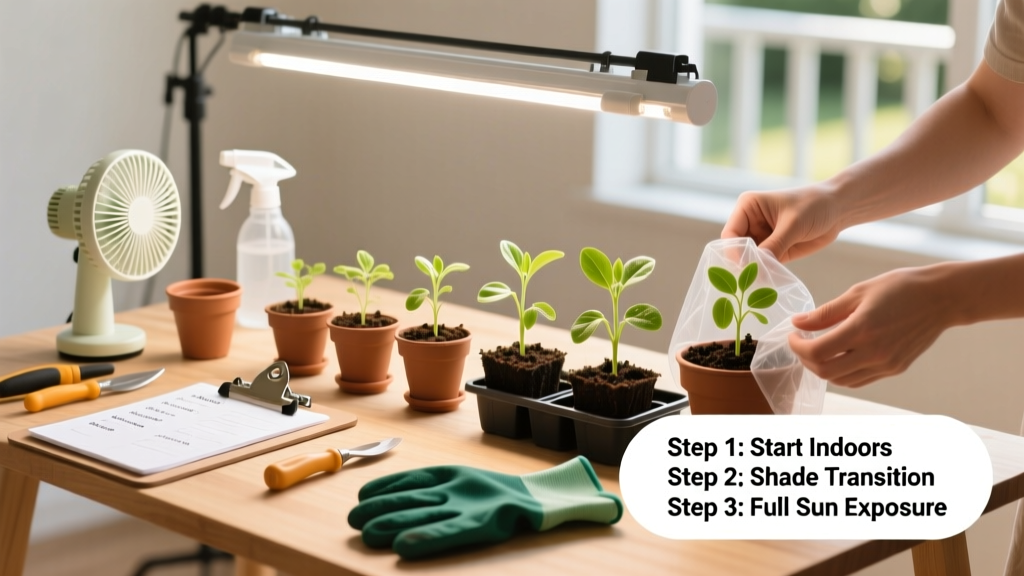
Hardening off seedlings is the essential 7–10 day process of gradually acclimating indoor-grown plants to outdoor sunlight, wind, and temperature swings—so they survive transplanting without wilting, scorching, or stunting. It’s a beginner-friendly skill that takes just 10–15 minutes per day, but skipping it risks losing up to 40% of your seedlings to environmental stress (University of Minnesota Extension, 2022).
Overview
| Skill Level | Time Required | Tools Needed | Estimated Cost |
|---|---|---|---|
| Beginner | 7–10 days | Seedlings, sheltered outdoor space, thermometer | $0–$5 (mostly free if you already have seedlings) |
Tools & Materials
| Item | Purpose | Notes |
|---|---|---|
| Sturdy seedling trays or pots | Hold plants during transition | Avoid flimsy peat pots—they dry out too fast outdoors |
| Shaded, sheltered patio or covered porch | First exposure zone | Must block direct sun and strong wind—e.g., north side of garage or under eaves |
| Outdoor thermometer | Track minimum temps | Critical if night temps dip below 50°F for cold-sensitive crops like tomatoes or basil |
| Row cover fabric or old sheet | Emergency frost protection | Lightweight spunbond fabric (like Reemay) works best; avoid plastic—it traps condensation |
| Watering can with fine rose | Gentle hydration | Seedlings dry faster outside—check soil moisture twice daily during peak exposure |
Step-by-Step Instructions
Day 1–2: First Outdoor Exposure
Place seedlings in full shade for 1–2 hours midday. Choose a calm, overcast day if possible. Keep them away from reflective surfaces (like white walls or concrete) that amplify heat. Water thoroughly before moving—and again after returning indoors. Warning: Never set seedlings directly on hot pavement or in full sun on Day 1—even 15 minutes can cause irreversible leaf burn.
Day 3–4: Increase Time & Add Dappled Light
Extend outdoor time to 3–4 hours. Move them to a spot with morning sun only (east-facing, filtered by tree branches or lattice). Still avoid midday sun. If leaves look limp by hour 3, bring them in early—this signals stress, not just thirst. Tip: Group seedlings by species sensitivity—tomatoes tolerate more sun than lettuce; keep them separate until Day 5.
Day 5–7: Introduce Full Morning Sun & Gentle Wind
Move to a location with 4–6 hours of direct morning sun and light air movement. Keep them out for 6 hours, then bring in before afternoon heat peaks. Check undersides of leaves for aphids—they often colonize stressed plants during this phase. Warning: Don’t leave overnight unless nighttime lows stay above 55°F for warm-season crops—or above 45°F for hardy greens like kale and spinach.
Day 8–10: Overnight Trial & Final Prep
If forecasts show no frost and lows above your crop’s threshold, leave seedlings out overnight. Cover with row cover if temps dip within 5°F of their minimum tolerance. On Day 10, water deeply in the morning, then transplant the next day. Tip: Transplant in late afternoon or on a cloudy day to reduce evaporative stress—your seedlings will use 30% less water their first 48 hours in the ground (how to transplant seedlings).
Pro Tips
Timing matters more than duration. According to Cornell Cooperative Extension’s 2023 Vegetable Program, “Seedlings hardened off during consistent 60–75°F days with low wind develop thicker cuticles and higher chlorophyll density—measurably increasing photosynthetic efficiency by day 12 post-transplant.”
“Skipping hardening off doesn’t just cause wilting—it reprograms gene expression related to stress response. Plants that skip this step take 7–10 days longer to resume normal growth.” — Dr. Laura Sager, Horticultural Physiology Lab, University of Wisconsin-Madison, 2021
Common mistakes include rushing the schedule (especially during warm spells), forgetting to water more frequently outdoors, and assuming cloudy days mean no sun exposure needed—UV intensity remains high even when temperatures feel mild. Also, don’t fertilize during hardening off: it encourages tender new growth that burns easily.
Can I harden off seedlings in a cold frame?
Yes—and it’s one of the most effective methods. Open the lid incrementally: start with 1 inch for 2 hours on Day 1, then increase opening width and duration daily. Cold frames provide wind protection while still exposing plants to ambient light and temperature shifts. Just monitor internal temps: if it climbs above 85°F, prop the lid fully open or shade with cheesecloth.
What if my seedlings get sunburned?
Minor bleaching (light yellow patches on upper leaves) usually recovers in 3–4 days if you immediately move them back to full shade and water at the base—not overhead. Severely scorched leaves won’t heal, but new growth will be resilient. Don’t prune damaged leaves yet—they shield developing buds from further UV exposure.
Do herbs like basil and cilantro need hardening off?
Yes—especially basil, which suffers irreversible chilling injury below 50°F. Cilantro tolerates cooler temps but bolts quickly if shocked by sudden heat or wind. Both benefit from a full 10-day schedule, with extra attention to soil moisture: their shallow roots dry out in minutes outdoors.
Can I harden off during rain?
Light rain is fine—and even beneficial—for Days 5–10, as it mimics natural conditions and rinses dust from leaves. But avoid heavy downpours during Days 1–3: saturated soil + cool temps = damping-off disease. If rain is forecast, delay outdoor time that day or move trays under a covered area with open sides.
My seedlings are leggy—can I still harden them off?
Absolutely—but add gentle brushing: run your hand lightly over tops for 30 seconds, twice daily, starting Day 1. This triggers ethylene signaling that thickens stems (per USDA ARS trials, 2020). Pair with reduced indoor watering 3 days before starting hardening off to encourage root resilience.
Should I stop watering completely to toughen them up?
No—this is dangerous. Underwatering causes cellular damage and reduces cold tolerance. Instead, water deeply but less frequently: aim for soil that’s moist 1 inch down, not soggy or dusty-dry. The goal is physiological adaptation—not dehydration stress.
Hardening off isn’t about making seedlings “tough”—it’s about giving them time to build the right tools: thicker epidermis, adjusted stomatal timing, and balanced hormone levels. Do it right, and you’ll see stronger root growth, earlier flowering, and fewer pest issues all season. For companion planting strategies that support newly transplanted seedlings, check our guide on best companion plants for tomatoes—and remember, healthy starts begin long before the trowel hits the soil.