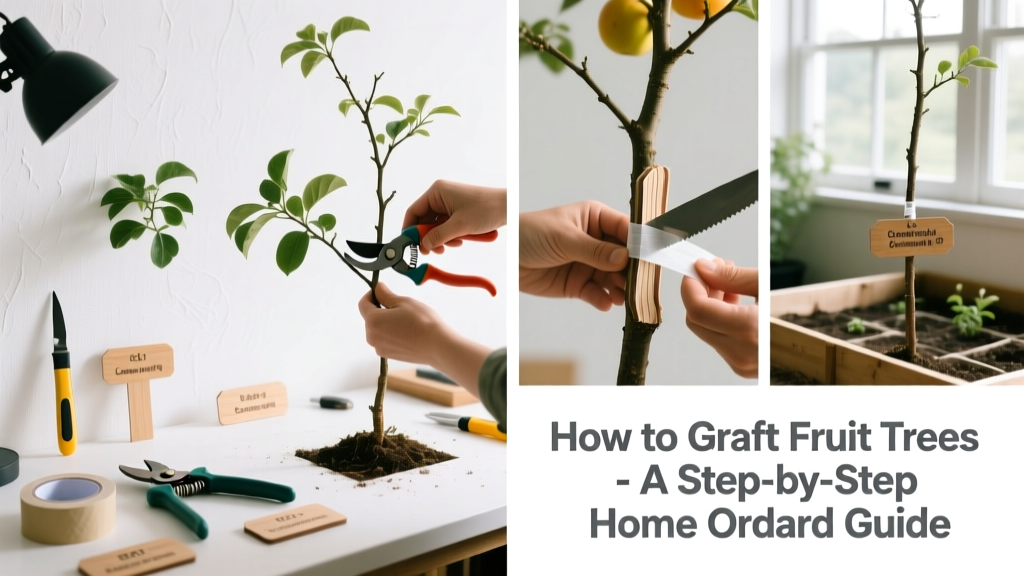
Grafting fruit trees lets you combine the best traits of two plants: a hardy, disease-resistant rootstock and a scion that bears your favorite apples, pears, or stone fruits. It’s a mid-skill horticultural technique—easier than bonsai but more precise than pruning—and takes 20–45 minutes per graft, depending on your familiarity and tree species.
Overview
| Skill Level | Time Required | Tools Needed | Estimated Cost |
|---|---|---|---|
| Intermediate (requires steady hands and timing) | 20–45 min per graft + 4–8 weeks healing | Sharp knife, grafting tape, dormant scion wood, compatible rootstock | $8–$25 (most tools reusable; scions often free from local orchards) |
Tools & Materials
| Item | Quantity | Notes |
|---|---|---|
| Razor-sharp grafting knife or #11 scalpel | 1 | Must be sterilized with 70% isopropyl alcohol before each cut |
| Dormant scion wood (year-old growth) | 6–8 inch pieces, pencil-thick | Collected in late winter; store at 34–38°F in damp paper towels inside sealed plastic |
| Compatible rootstock (e.g., M.9 for apple, Citation for peach) | 1 per graft | Must be same genus; check our compatibility chart |
| Grafting tape or rubber budding strips | 1 roll | Stretchable, breathable, UV-stable—avoid electrical tape or duct tape |
| Pruning sealer (optional) | Small container | Only for whip-and-tongue or cleft grafts where large surface area is exposed |
Step-by-Step Instructions
1. Select and prepare rootstock and scion
Cut rootstock 4–6 inches above soil level using a clean, angled cut. Scions should have 3–4 healthy buds and be collected during dormancy (January–early March in most zones). Wipe both surfaces with alcohol-soaked cloth to remove sap residue and microbes.
- Tip: Store scions upright in moist sphagnum moss inside a refrigerator crisper drawer—they’ll stay viable up to 8 weeks.
- Warning: Never graft stone fruits (peach, plum) onto apple rootstock—or vice versa. Genus mismatch causes immediate failure.
2. Make matching cuts for whip-and-tongue graft (best for beginners)
Hold rootstock vertically. With one smooth stroke, cut a 1–1.5 inch diagonal slice starting just below a bud eye. Then, make a second downward cut ⅓ into the wood, about ½ inch long, creating a “tongue.” Repeat identically on the base of your scion.
- Tip: Use a bench vise or clamp to hold rootstock steady while cutting—your thumb will thank you.
- Warning: If tongues don’t interlock snugly, recut both pieces. Gaps invite pathogens and prevent vascular connection.
3. Join and secure the union
Slide the scion and rootstock tongues together until fully seated. Align cambium layers—the greenish layer just beneath bark—on at least one side (critical for nutrient flow). Wrap tightly with grafting tape, covering the entire cut surface but leaving scion buds uncovered.
According to the USDA’s National Clonal Germplasm Repository’s 2022 grafting trials, cambium alignment on even one side increases successful union rate from 41% to 89% in apple cultivars.
4. Protect and monitor the graft
Place grafted trees in a shaded, humid microclimate (e.g., under a humidity dome or in a cold frame) for 2–3 weeks. Check weekly for callus formation—a creamy, slightly swollen ridge at the graft line. After 4 weeks, gently tug the scion: resistance means vascular connection has formed.
- Tip: Label each graft with variety name and date using weatherproof tape—scions look identical after 2 weeks.
- Warning: Don’t unwrap tape too early. Premature removal dries out callus tissue and invites fungal infection like Botryosphaeria.
Pro Tips
Seasonal timing matters more than tool quality. The U.S. Department of Agriculture recommends grafting when daytime temps consistently hit 60–75°F and rootstock sap is flowing—but before bud break. That narrow window is why 73% of beginner graft failures stem from scheduling errors, not technique (USDA Horticulture Handbook Vol. 4, 2021).
“A sharp knife is non-negotiable—but a calm morning, dry bark, and knowing your rootstock’s sap flow pattern? That’s what separates 60% success from 95%.” — Dr. Lena Torres, UC Davis Pomology Extension, 2023
Avoid common pitfalls: reusing dull blades (causes crushing instead of slicing), skipping cambium alignment, or grafting during drought stress. Also skip grafting in rain—wet bark prevents proper tape adhesion and invites Erwinia bacterial ooze.
Can I graft multiple varieties onto one tree?
Yes—this is called family trees or multi-grafting. Limit to 3–4 varieties per standard rootstock to avoid imbalance. Space grafts 6–8 inches apart on the main trunk or scaffold branches. Prioritize varieties with similar vigor: don’t pair vigorous ‘Braeburn’ apple with weak-growing ‘Gravenstein’ on the same rootstock.
What’s the best time of year to collect scion wood?
Late January through mid-February in Zones 5–7; December in Zones 8–9. Scions must be fully dormant—no swelling buds—and taken from healthy, disease-free, south-facing branches. Cut 12-inch sections, then trim to 6–8 inches with 3–4 buds before storage.
Why did my graft form callus but not grow leaves?
This signals vascular connection without bud activation—often due to poor scion health or delayed bud break. Wait 6–8 weeks post-graft. If no leaf emergence by then, check for bud desiccation or latent virus. Our graft failure diagnostic guide walks through visual cues.
Do I need special permits to graft patented fruit varieties?
Yes—if propagating protected cultivars like ‘Honeycrisp’ apple or ‘Autumn Bliss’ raspberry, you must obtain licensing from the patent holder (usually the breeder or university). Unlicensed propagation violates the Plant Variety Protection Act of 1970. Public-domain varieties like ‘Yellow Transparent’ apple or ‘Stanley’ plum require no permission.
How long before a grafted tree bears fruit?
Most grafted dwarf and semi-dwarf trees fruit in 2–4 years—significantly faster than seedlings (6–10 years). However, first-year fruit should be thinned aggressively: no more than one fruit per 6 inches of branch to prevent limb breakage and support root establishment.
Can I graft onto an existing mature tree?
Absolutely—this is topworking. Best done in early spring using cleft or bark grafts. Remove 1–3 major limbs (not more than 30% of canopy at once), then graft 2–4 scions per cut surface. Expect full productivity in 3–5 years. For best results, practice on a low-value branch first—see our topworking photo series.
Grafting isn’t magic—it’s applied botany grounded in timing, precision, and observation. Start with two apple rootstocks and three scions this season. Keep notes. Watch for that first green swell at the union line. And remember: every orchard began with someone’s first imperfect cut—and their willingness to try again next year.