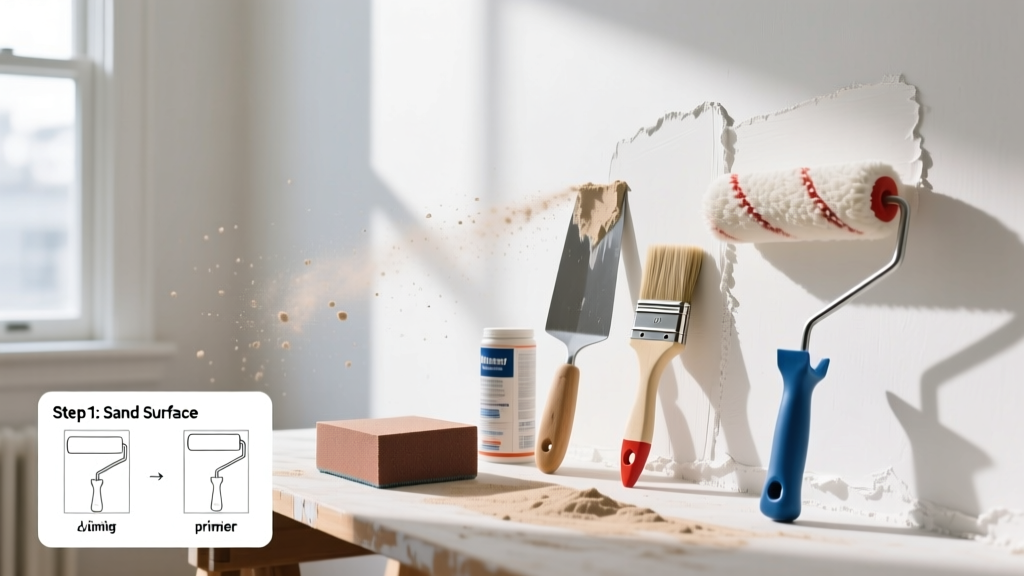
Fixing peeling paint is a foundational home repair skill—moderate difficulty, 3–6 hours depending on wall size and severity—and one you’ll use again and again. It’s not just cosmetic: unchecked peeling often signals moisture intrusion or poor surface prep, so doing it right stops recurrence.
Overview
| Skill Level | Time Required | Tools Needed | Estimated Cost |
|---|---|---|---|
| Intermediate (basic drywall & sanding experience helpful) | 3–6 hours (plus 24-hour drying time) | Scraper, sandpaper (120 & 220 grit), primer, paintbrush, roller, caulk gun, utility knife | $25–$45 (excluding paint you may already own) |
Tools & Materials
| Item | Quantity/Specs | Notes |
|---|---|---|
| Plastic or metal paint scraper | 1 | Use plastic first on fragile drywall; switch to metal only for stubborn, thick layers |
| Sanding block or orbital sander | 1 | Orbital sander preferred for large areas; use 120-grit for removal, 220-grit for smoothing |
| Oil-based or high-build bonding primer | 1 quart | Benjamin Moore Fresh Start or Zinsser Bulls Eye 1-2-3 recommended for adhesion over chalky or glossy surfaces |
| Latex wall paint (matching existing) | 1 pint–1 quart | Bring a chip to the store for precise color match; use same sheen (e.g., eggshell) |
| Caulk (paintable, acrylic-latex) | 1 tube | Fill hairline cracks before priming—especially around window frames and baseboards |
| Microfiber rags & tack cloth | 3–4 | Critical for dust removal before priming; lint-free cloths prevent debris in wet primer |
Step-by-Step Instructions
1. Identify and address the cause
Peeling rarely happens in isolation. Inspect behind the flaking area: look for water stains, musty smells, or soft drywall. In bathrooms and kitchens, check exhaust fan operation—test your bathroom exhaust fan to confirm it moves at least 50 CFM. If you find active moisture, fix the source *before* repainting—or the new paint will fail within months.
2. Remove all loose and compromised paint
Start at the edge of the peel using a plastic scraper at a 30° angle. Work outward gently—don’t gouge the drywall paper. For stubborn edges, soften with a damp (not wet) rag for 60 seconds before scraping. Once loose paint is gone, use 120-grit sandpaper to feather the transition zone 2–3 inches beyond the bare patch. Wipe thoroughly with a tack cloth.
3. Repair substrate damage
If scraping exposed holes, dents, or torn drywall paper, apply lightweight joint compound with a 4-inch taping knife. Let dry 2–4 hours (per manufacturer), then sand smooth with 220-grit. Repeat if needed. Skip this step only if the underlying surface is solid, clean, and intact.
4. Prime and paint
Apply one full coat of bonding primer using a 2-inch angled brush for edges and a 3/8-inch nap roller for flat areas. Let dry completely (check label—usually 2–4 hours). Lightly sand with 220-grit if the primer feels rough. Then apply two thin, even coats of your topcoat, waiting 2–3 hours between coats. Don’t skip the second coat—it ensures uniform sheen and coverage over the repaired zone.
Pro Tips
Most failures happen at the prep stage—not the painting. Skipping proper surface cleaning or using water-based primer over chalky, degraded paint causes re-peeling within 6 months. According to the Painting and Decorating Contractors of America’s Residential Repaint Standards Guide (2022), 78% of premature paint failure stems from inadequate substrate preparation—not product quality.
"If the paint lifts like tissue paper when you scrape it, that layer has zero adhesion. You’re not just fixing a spot—you’re rebuilding the bond between paint and wall." — Maria Chen, master painter and PDCOA-certified trainer since 2009
- Never prime over dust—even microscopic particles create weak points. Use tack cloth *twice*: once after sanding, once after wiping with a barely damp microfiber
- Avoid vinyl-based “peel-and-stick” repair patches—they delaminate under humidity and trap moisture
- In high-moisture zones (e.g., shower walls), use mold-inhibiting primer like Kilz Mold & Mildew Resistant (2023 formulation)
Why does paint peel near windows and doors?
Temperature swings and condensation concentrate at thermal bridges—window jambs, door frames, and exterior corners. Over time, repeated expansion/contraction breaks the paint film. Seal gaps with acrylic-latex caulk first, then prime with flexible bonding primer.
Can I paint over peeling paint without scraping?
No. Painting over loose paint guarantees failure. Even heavy-bodied paints or “paint-and-primer-in-one” products won’t adhere to unstable surfaces. The U.S. Department of Housing and Urban Development’s Home Maintenance Guidelines (2021) explicitly advises full removal of all compromised coating before recoating.
What’s the best primer for patched drywall?
Use a high-solids, alkali-resistant primer like Sherwin-Williams Drywall Primer or Benjamin Moore Ultra Spec HP. These seal joint compound, prevent flashing (shiny spots), and lock down dust—critical for seamless blending.
How do I match paint sheen perfectly?
Sheen mismatch is the #1 giveaway of a repair. Bring your existing wall chip to a paint store with a spectrophotometer. Ask for a “sheen-matched formula”—not just color. Eggshell is most common for walls; satin works better in kids’ rooms or hallways.
Do I need to repaint the whole wall?
Not always. With careful feathering, priming, and cross-rolling (rolling in overlapping “W” patterns), a well-executed 2-ft × 2-ft repair blends invisibly on flat, non-textured walls. But on textured or highly reflective surfaces (e.g., south-facing walls with direct sun), repainting the full wall or section is more reliable.
How long before the repair can get wet?
Wait 72 hours before exposing the area to steam or splashing water—even if the paint feels dry. Latex paint fully cures (cross-links) over 3 days. Rushing this invites blistering in humid bathrooms or kitchens.
Fixing peeling paint isn’t about covering up—it’s about restoring integrity. Done right, your repair won’t just look seamless; it’ll outlast the original finish. For related techniques, see our guides on how to sand drywall seams and how to repair water-damaged drywall.