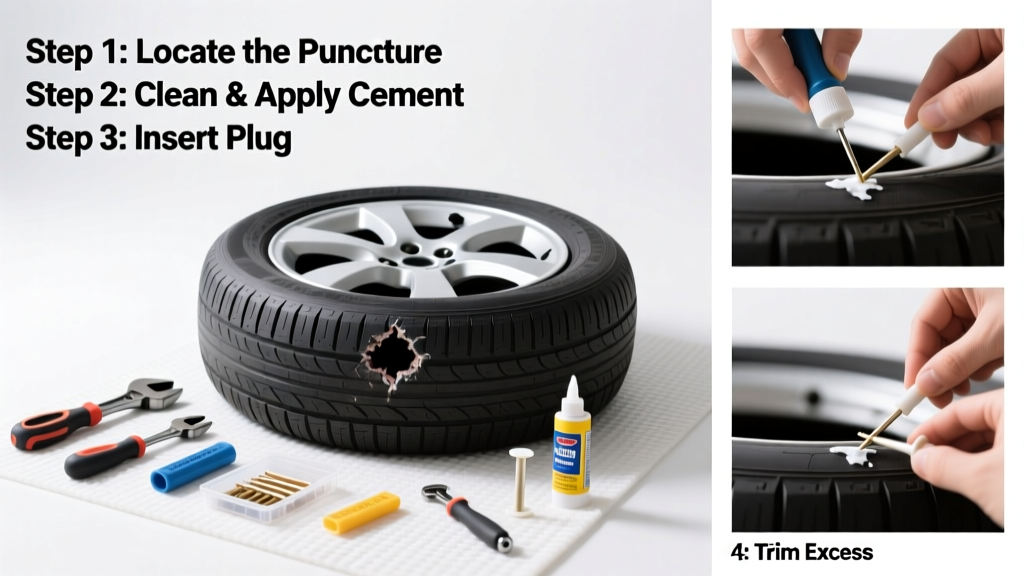
Fixing a flat tire with a rubber plug is a reliable, temporary repair method for small punctures (up to 1/4 inch) in the tread area. It’s an intermediate-skill task that takes 15–25 minutes with practice—and it’s far cheaper and faster than towing or buying a new tire.
Overview
| Skill Level | Time Required | Tools Needed | Estimated Cost |
|---|---|---|---|
| Intermediate (requires hand-eye coordination and patience) | 15–25 minutes per tire | Tire plug kit, jack, lug wrench, reamer, pliers, air gauge, pump | $12–$28 (kit only; most kits include 6–12 plugs and tools) |
Tools & Materials
| Item | Quantity | Notes |
|---|---|---|
| Rubber tire plug (vulcanizing type) | 1 per puncture | Pre-cut, coated in vulcanizing cement—never use dry, uncoated plugs |
| Tire plug insertion tool (T-handle or screwdriver-style) | 1 | Must grip plug firmly without slipping during insertion |
| Reaming tool (round, tapered file) | 1 | Cleans and slightly enlarges hole to accept plug; critical for seal integrity |
| Vulcanizing cement (included in most kits) | 1 small tube | Activates rubber bonding; skip this step and the plug will likely fail within 50 miles |
| Portable air compressor or floor pump | 1 | You’ll need to reinflate to 3–5 PSI above target pressure after plugging |
| Soapy water spray bottle | 1 | For final leak check—bubbles reveal escaping air |
Step-by-Step Instructions
1. Confirm the puncture is repairable
Only plug punctures located in the tread—never the sidewall, shoulder, or within 1/2 inch of tread grooves. Measure the hole: if larger than 1/4 inch (6 mm), don’t plug it. Remove nails or screws carefully with pliers—don’t twist or push deeper. If the tire has multiple punctures less than 16 inches apart, or shows cord exposure or bulges, replace it instead.
2. Jack up the vehicle and remove the wheel
Use your owner’s manual to locate proper jacking points. Loosen lug nuts ¼ turn before lifting. Raise until the tire clears the ground by 2–3 inches. Fully remove lug nuts and wheel. Place the wheel on a clean, flat surface—tread facing up.
3. Locate and prepare the puncture
Spray soapy water around the suspected area—the leak will bubble. Mark it with chalk or tape. Use the reaming tool to rotate gently into the hole 6–8 times, removing debris and creating uniform texture. Wipe away dust with a clean rag. Apply a pea-sized dab of vulcanizing cement inside the hole and on the plug—let it get tacky (30 seconds), not dry.
4. Insert and seat the plug
Thread one end of the plug through the eye of the insertion tool. Push the tool straight into the hole until 1/4 inch of plug remains visible. Twist the tool 90° clockwise while pulling straight out—this leaves the plug anchored inside. Trim excess plug flush with the tread using a utility knife (don’t cut below tread depth). Let the cement cure 1–2 minutes before inflating.
- Tip: If the plug pulls out easily, the hole wasn’t reamed deeply enough—or the cement wasn’t applied.
- Warning: Never plug a tire that’s been driven on while flat—even briefly. Internal sidewall damage is invisible but catastrophic.
Pro Tips
Plugging works best when combined with a patch on the inside—but that requires tire removal from the rim, which isn’t feasible roadside. For true long-term safety, get the tire professionally patched from the inside within 100 miles. According to the Rubber Manufacturers Association’s 2022 Field Service Guidelines, plug-only repairs are rated for up to 8,000 miles only if performed correctly and limited to tread-area punctures under 1/4 inch.
"A plug without internal patching is a field expedient—not a permanent fix. Treat it as a 'get-home' solution, not a replacement for proper repair." — Mike Rafferty, ASE Master Technician & former Michelin Technical Trainer, 2023
- Always carry a second plug and extra cement—humidity or cold can reduce adhesion.
- Store your plug kit in a dry place: moisture degrades vulcanizing agents.
- Never plug radial tires with bias-ply plugs—they expand differently and fail prematurely.
Can I plug a tire without removing it from the car?
Yes—you can plug while the tire is mounted, as long as you have access to the puncture and can hold the wheel steady. But it’s harder to ream cleanly and insert straight. For best results, remove the wheel.
How long does a plugged tire last?
A properly installed plug holds for months or thousands of miles—but the RMA recommends replacing or professionally repairing the tire within 100 miles. Don’t use plugged tires for high-speed highway driving longer than necessary.
Why did my plug leak after installation?
Most often, it’s due to insufficient reaming (leaving smooth, glazed rubber), skipping vulcanizing cement, or inserting at an angle. Less commonly, the puncture was too large or in a non-repairable zone.
Can I plug a tire twice?
Technically yes—if punctures are spaced at least 16 inches apart and both are in the tread. But the U.S. Department of Transportation advises against more than one repair per tire. Two plugs compromise structural integrity.
Do I need to rebalance the tire after plugging?
No—plugs add negligible weight (<0.3 oz). However, if you removed the wheel and drove on it before plugging, inspect for bent rims or uneven wear before reinstalling.
Is plugging legal for commercial vehicles?
No. FMCSA Regulation §393.75 prohibits plug-only repairs on trucks, buses, or trailers. Those require internal patching or replacement.
A well-executed plug gets you moving again safely—and builds confidence for future roadside fixes. Once you’ve done it twice, you’ll notice how much faster and smoother it goes. Keep your kit stocked, practice on a junk tire first, and remember: changing a flat and reinflating with a portable compressor are skills that pair perfectly with plugging. For deep cuts, sidewall damage, or repeated flats, consult a trusted shop—some problems aren’t DIY-friendly.