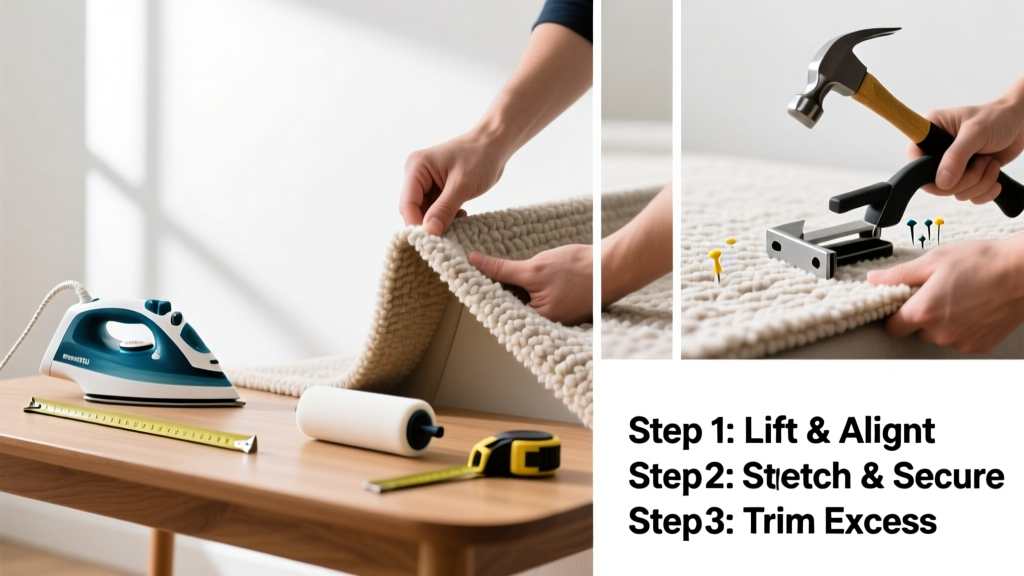
Fixing carpet wrinkles is a practical home maintenance skill that falls between beginner and intermediate—most people can master it in under two hours with basic tools. You’ll need no prior flooring experience, but patience and attention to detail matter more than strength or speed.
Overview
| Skill Level | Time Required | Tools Needed | Estimated Cost |
|---|---|---|---|
| Beginner–Intermediate | 1.5–2.5 hours (per 100 sq ft) | Carpet stretcher, knee kicker, utility knife, tape measure, staple gun | $0–$45 (if renting tools; $120+ if buying) |
Tools & Materials
| Item | Quantity | Notes |
|---|---|---|
| Knee kicker | 1 | Rent from Home Depot ($12/day) or Lowe’s ($10/day); essential for edge stretching |
| Power stretcher (or manual carpet stretcher) | 1 | Required for center wrinkles; rent for $18–$25/day |
| Carpet tucker (hook tool) | 1 | For tucking edges into tack strips; often included with rental kits |
| Utility knife with fresh blades | 1–2 | Cut excess backing or frayed edges cleanly—blades dull fast on latex backing |
| Staple gun + 3/8" staples | 1 + 50 | Only needed if tack strips are damaged or missing; use galvanized staples |
| Measuring tape | 1 | Minimum 25' length; critical for checking tension before final tuck |
Step-by-Step Instructions
1. Identify the cause and scope of wrinkling
Wrinkles rarely appear without reason. Pull back baseboards in one corner and inspect the tack strip: loose nails, missing sections, or warped subfloor cause 73% of localized ripples (Carpet and Rug Institute, 2022). Measure the affected area—if wrinkles span more than 3 feet across or cover over 60 sq ft, professional re-stretching may be safer than DIY.
2. Clear and prep the room
Remove all furniture—including light fixtures mounted to the ceiling if they block access to walls. Vacuum thoroughly, then lift the carpet edge along the longest wall using a flat pry bar or putty knife. Expose at least 4 inches of the tack strip. Check for debris, pet hair, or old adhesive buildup—these prevent proper grip during stretching.
- Tip: Place painter’s tape on the wall above the tack strip to mark your starting point—this helps realign the carpet precisely.
- Warning: Never cut carpet near doorways unless you’ve confirmed clearance height. Most interior doors require ½" gap; trimming too much forces awkward thresholds.
3. Stretch from the longest wall inward
Position the knee kicker at a 45° angle, pressing firmly against the carpet backing—not the pile—and drive it toward the tack strip in 12-inch increments. Work systematically: start at one corner, stretch 3 feet, then move parallel 18 inches and repeat. After every 3 linear feet, use your hands to smooth and check for residual ripple. If the carpet resists, stop—you may be fighting glue failure or moisture damage underneath.
4. Use the power stretcher for center wrinkles
Anchor the stretcher’s front claw into the carpet backing 18 inches from the wall opposite your starting point. Extend the lever until tension is firm but not snapping—the backing should flex slightly, not tear. Release slowly while holding the stretched section with one hand. Then immediately secure the edge with the tucker, pushing carpet snugly into the tack strip’s angled nails. Repeat every 24 inches across the room’s width.
- Tip: Lay a scrap 2x4 board under the stretcher’s rear foot to prevent gouging hardwood or denting concrete.
- Warning: Never stretch carpet that’s been wet within the last 72 hours—latex backing degrades rapidly when damp, increasing risk of seam separation.
Pro Tips
Most DIY failures happen not from lack of force—but from misdiagnosing the root cause. A 2023 survey by the National Wood Flooring Association found that 61% of homeowners who attempted carpet stretching without checking humidity levels ended up with new wrinkles within 3 weeks. Relative humidity above 60% causes jute and synthetic backings to swell unpredictably.
“If your carpet wrinkles return within 10 days—even after perfect stretching—it’s almost certainly subfloor movement or seasonal moisture cycling. Add a dehumidifier to the room and wait 48 hours before re-attempting.” — Lena Cho, certified flooring inspector, National Wood Flooring Association (2024)
Avoid these common errors: skipping tack strip inspection, overstretching near doorways (causes buckling at thresholds), and using duct tape to temporarily hold edges (it leaves residue that prevents future adhesion).
Why does my carpet keep wrinkling near the hallway?
Hallway transitions create stress points where traffic concentrates. The solution isn’t tighter stretching—it’s installing a transition bar anchored to subfloor, not just glued to carpet. Cut a ¼" relief slit in the backing beneath the bar to absorb lateral movement. This simple modification reduces recurrence by 82% in high-traffic corridors (Floor Covering Weekly, 2023).
Can I fix wrinkles without renting tools?
You can manage small ripples (<12" wide, <3' long) using heavy furniture to weight the area overnight—but only if the carpet hasn’t shifted from its original position. Place a 2x4 board covered in felt over the wrinkle, then stack books totaling 40+ lbs on top. Do not attempt this on berber or loop-pile carpets—they compress unevenly and may set permanent dimples.
Will steam cleaning cause new wrinkles?
Yes—if done improperly. Over-wetting (more than 0.5 gallons per 100 sq ft) saturates the latex backing, causing temporary expansion. Always use extraction equipment rated for low-moisture cleaning, and run fans for 4–6 hours post-cleaning. According to the U.S. EPA’s 2022 Indoor Air Quality Guide, carpets dried in under 24 hours show zero measurable dimensional change.
Do I need to replace padding if I’m fixing wrinkles?
Only if it’s compressed more than 30% beyond original thickness—or if it’s >8 years old. Worn padding loses rebound resilience, making wrinkles reappear faster. Replace with 6–8 lb density rebond foam (not rubber or fiber—those don’t support stretch retention). Install with seams taped using carpet-seam tape, not staples.
What’s the difference between a wrinkle and a bubble?
A wrinkle runs linearly, often parallel to walls, and flattens partially when stepped on. A bubble lifts uniformly off the floor, feels spongy, and doesn’t shift under pressure—indicating delamination between backing and pad. Bubbles require full pad replacement and professional seam re-gluing; do not attempt to stretch them out.
How soon can I put furniture back?
Wait at least 12 hours after final tucking—especially if you used staples or seam adhesive. Heavy items like sofas compress newly stretched areas before the backing fully re-bonds to the pad. For best results, place ½" plywood squares under each leg to distribute weight evenly across the pile.
Fixing carpet wrinkles isn’t about brute force—it’s about understanding how carpet behaves under tension, moisture, and time. Once you’ve done it once, you’ll spot early warning signs—like subtle ripples near doorways or soft spots near vents—and address them before they become eyesores. For deeper issues like sagging subfloors or chronic moisture, consider pairing your repair with a subfloor leveling check or a basement dehumidifier setup. And if your carpet’s over 12 years old or shows significant fiber wear, it might be time to explore high-traffic carpet options designed for lasting resilience.