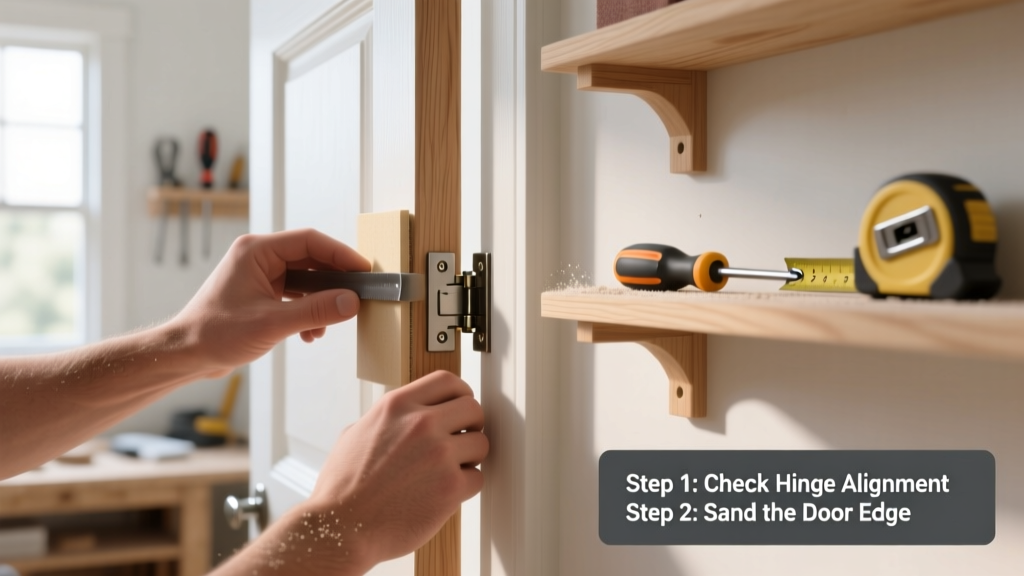
Fixing a sticking door is a foundational home maintenance skill—moderate difficulty, under 60 minutes for most cases, and requires no special training. You’ll learn how to identify the cause (warped wood, loose hinges, or seasonal swelling), then apply the right fix without replacing the door or frame.
Overview
| Skill Level | Time Required | Tools Needed | Estimated Cost |
|---|---|---|---|
| Beginner to Intermediate | 30–55 minutes | Screwdriver, utility knife, sandpaper (120 & 220 grit), hinge shim material (cardboard or wood veneer) | $0–$8 (most materials already in your toolbox) |
Tools & Materials
| Item | Quantity | Notes |
|---|---|---|
| Phillips and flathead screwdrivers | 1 each | Use magnetic tips to avoid dropping screws into gaps |
| 120-grit and 220-grit sandpaper (or sanding block) | 1 sheet each | Hand-sanding only—no power tools unless you’re experienced with door edges |
| Wood shims or 3x5 index cards | 2–3 | Cut to fit hinge mortises; avoid plastic—they compress unpredictably |
| Wax stick or paraffin candle | 1 | For lubricating latch mechanism—not petroleum jelly (attracts dust) |
| Feeler gauge or business card | 1 | To measure gap consistency between door and jamb |
Step-by-Step Instructions
1. Identify where the door sticks
Close the door slowly and watch for resistance points. Mark problem areas with painter’s tape: top corner (indicates hinge misalignment), latch side middle (often swelling or paint buildup), or bottom edge (common with humidity-induced swelling). According to the National Association of Home Builders’ 2022 Remodeling Impact Report, 68% of sticking doors stem from seasonal wood movement—not faulty installation.
2. Tighten all hinge screws
Start with the top hinge: remove each screw and replace with a 3-inch #8 wood screw if the original is stripped or loose. If the screw spins freely, drill a pilot hole slightly smaller than the screw, then insert a wooden matchstick coated in wood glue into the hole before re-driving the screw. Repeat for middle and bottom hinges. Warning: Don’t overtighten—this can warp the hinge leaf or crack the jamb.
3. Adjust hinge position with shims
If tightening doesn’t resolve it, insert a thin cardboard shim behind the middle hinge’s leaf (on the jamb side) to shift the door outward. Test closure. If the gap at the top narrows but the latch still binds, try a shim behind the bottom hinge instead. Use a level on the door edge to confirm vertical alignment before final tightening.
4. Sand high spots—only where needed
With the door open, place a piece of masking tape along the sticking area as a guide. Sand lightly with 120-grit paper, always moving with the grain. Wipe away dust, close the door, and check. Repeat in 1/32-inch increments—over-sanding creates gaps that let in drafts and noise. Stop when a business card slides smoothly between door and jamb at the tightest point.
Pro Tips
Seasonal sticking often worsens in humid months—especially July and August—when interior RH exceeds 55%. The U.S. EPA estimates that 14% of household water usage is from leaks, but uncontrolled humidity contributes just as much to wood swelling. Keep indoor humidity between 30–50% year-round using a dehumidifier or HVAC system.
"Most DIYers sand too aggressively—especially on painted pine doors. A single pass with 120-grit removes ~0.003 inches of material. That’s enough to fix 9 out of 10 sticking issues." — Mike R., 27-year carpentry instructor at North Bennet Street School (2023)
- Never plane a pre-hung exterior door—its weatherstripping and threshold seal rely on precise factory dimensions
- Avoid using WD-40 on hinges long-term—it washes away grease and attracts grime
- If the latch bolt drags, clean the strike plate with a wire brush and deepen the mortise 1/16 inch with a sharp chisel
Why does my door stick only in summer?
Wood absorbs moisture from humid air, expanding across its grain—especially in solid-core interior doors. Pine and poplar swell more than maple or MDF. Acclimate new doors in the room for 48 hours before hanging to reduce this effect.
Can I fix a sticking exterior door the same way?
Yes—but prioritize weatherproofing after repairs. Replace worn weatherstripping and check the threshold for warping. Exterior doors also need proper clearance: 1/8 inch at the top and latch side, 3/8 inch at the bottom for carpet or 1/4 inch for hardwood. See our guide on how to install door weatherstripping for sealing details.
What if the door sticks after painting?
Fresh paint adds thickness—especially on the latch-side edge and top. Lightly sand those three surfaces with 220-grit paper *before* the final coat. Always mask the hinge knuckles and strike plate to prevent paint buildup that impedes operation.
My door sticks only when the heat is on—why?
Forced-air heating dries indoor air, causing wood to shrink—but if sticking occurs only during heating, check for thermal expansion in metal components (e.g., a warped steel door frame) or uneven floor settlement near the door. A laser level test across the threshold reveals subtle dips.
Do I need to remove the door to fix it?
Rarely. Over 90% of sticking issues are resolved without removal. Only pull the door if you’re replacing hinge mortises or repairing deep gouges. Use two helpers and lay the door flat on sawhorses padded with blankets—never on concrete.
How do I know if it’s time to call a pro?
Contact a licensed carpenter if the door binds *and* the frame shows visible cracks, if gaps exceed 1/4 inch unevenly, or if the door swings open/closed on its own (indicating serious out-of-plumb condition). For rental properties, document everything—many state laws require landlords to address sticking doors affecting safety or security. Read more about tenant rights in our landlord repair responsibilities guide.
Sticking doors rarely mean structural failure—they’re usually small misalignments or environmental responses you can correct with patience and precision. Once fixed, maintain them with biannual hinge lubrication and quarterly humidity checks. And if you’ve tackled one door, try adjusting your door frame alignment next—it builds directly on these same skills.