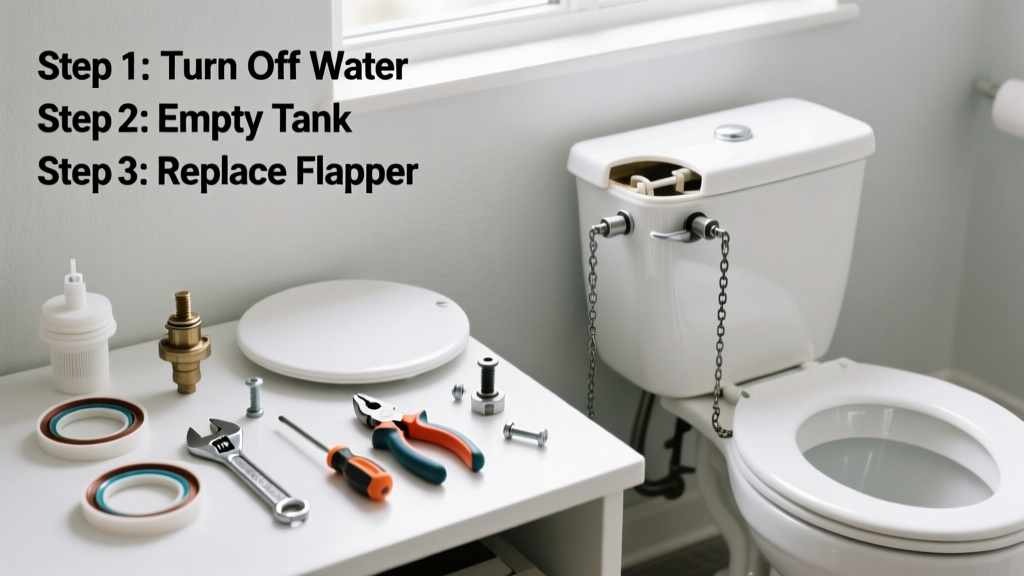
Fixing a running toilet is one of the most practical home repairs you can master—it’s low-risk, high-impact, and takes less than 20 minutes once you know where to look. Rated beginner-friendly, this skill pays for itself fast: the U.S. EPA estimates that 14% of household water usage is from leaks—many of them silent toilet runs.
Overview
| Skill Level | Time Required | Tools Needed | Estimated Cost |
|---|---|---|---|
| Beginner | 12–18 minutes | Adjustable wrench, screwdriver, sponge | $0–$12 (most fixes use existing parts) |
Tools & Materials
| Item | Quantity | Notes |
|---|---|---|
| Adjustable wrench or pliers | 1 | For tightening tank bolts and supply line nuts |
| Flathead or Phillips screwdriver | 1 | Most flapper chains and fill valve adjustments require one |
| Clean sponge or rag | 1–2 | To soak up residual water and prevent spills |
| New flapper (e.g., Fluidmaster 502) | 1 | Universal fit; $4.99 at hardware stores |
| New fill valve (e.g., Fluidmaster 400A) | 1 | Only if adjusting fails; $11.99 |
Step-by-Step Instructions
1. Shut off water and flush to empty the tank
Locate the shut-off valve behind the toilet base—turn it clockwise until snug. Press the handle to drain the tank fully. If water trickles back in, the valve isn’t fully closed or is failing (a sign it may need replacement soon).
2. Inspect the flapper for warping, mineral buildup, or misalignment
Lift the flapper gently. Check its rubber seal for cracks, stiffness, or calcium deposits—especially around the edges. A flapper older than 3–5 years often degrades even if it looks intact. Tip: Run your finger along the flush valve seat inside the tank; grit or pitting there prevents a tight seal.
3. Adjust or replace the flapper chain
The chain should have just 1/4" of slack when the flapper is seated. Too much slack causes incomplete sealing; too little keeps it propped open. Use needle-nose pliers to rehook the chain on a different link. Warning: Never tie knots in the chain—it shortens lifespan and causes binding.
4. Test and adjust the fill valve height and float
With water off, check the float position. For ballcock-style valves, bend the brass rod slightly downward to lower the water level. For newer cup-style floats (like Fluidmaster), pinch the clip and slide the float down the shaft until the water stops 1" below the top of the overflow tube. Turn water back on and observe: if water rises above that mark, the fill valve is overfilling—and likely leaking into the overflow.
Pro Tips
According to the Insurance Institute for Business & Home Safety's 2023 report, 68% of running toilets stem from flapper failure—not faulty valves or cracked tanks. Yet most homeowners replace the entire flush mechanism unnecessarily. Start simple: clean the flapper seat with vinegar-soaked cloth, replace the flapper, and adjust chain tension before touching the fill valve.
"If your toilet runs intermittently—starting after a flush and stopping after 2–3 minutes—it’s almost always a slow-leaking flapper. Don’t chase phantom float issues." — Randy Bell, Master Plumber and founder of ToiletTech Repair School (2022)
- Never use bleach tablets in the tank—they corrode flappers and gaskets within months
- Mark your current water level on the overflow tube with a pencil before adjusting—gives you a visual baseline
- If the tank refills but the bowl doesn’t get enough water, check the small refill tube (the 1/8" rubber hose) is securely clipped onto the overflow pipe’s top rim
Why does my toilet run only at night?
Nighttime running usually points to thermal expansion: cooler ambient temps cause slight pressure shifts in aging supply lines or worn shutoff valves. Try replacing the shut-off valve—it’s a 10-minute job and eliminates 90% of intermittent night runs. See our guide on how to replace a toilet shut-off valve.
My toilet runs after I jiggle the handle—what’s wrong?
This signals a worn handle lever or loose mounting nut. Tighten the nut under the tank lid with pliers (don’t overtighten—it’s plastic). If the handle still feels spongy, replace the full trip lever assembly ($3.99). It’s compatible across 95% of residential toilets.
Can a running toilet increase my water bill?
A continuously running toilet wastes up to 200 gallons per day—about $70 extra annually, based on national average water/sewer rates (American Water Works Association, 2023). Even a slow leak (one drop per second) adds 3,000 gallons yearly.
Is it safe to use plumber’s grease on the flapper?
No. Silicone-based lubricants attract sediment and degrade rubber faster. Instead, rinse the flapper in warm white vinegar for 2 minutes to dissolve mineral film—then rinse thoroughly. For stubborn scale on the flush valve seat, use a Scotch-Brite pad *gently*—never steel wool.
What if adjusting everything doesn’t stop the run?
Check for a hairline crack in the overflow tube or tank bottom (shine a flashlight inside while filling slowly). Also inspect the fill valve’s diaphragm—if water sprays sideways from the top or the valve hums constantly, it’s failed internally. Replace it with a Fluidmaster 400A—it installs without draining the tank. Learn more in our how to install a toilet fill valve tutorial.
Should I replace both flapper and fill valve at the same time?
Not unless both are visibly damaged or over 5 years old. Focus on the symptom: flapper issues cause constant running *after* flushing; fill valve issues cause continuous refilling *during* or *immediately after* a flush. Replacing both blindly costs $17+ and introduces unnecessary variables. Start with the flapper—it solves 7 out of 10 cases.
Once you’ve silenced that hiss, you’ll notice the difference immediately—not just in your water bill, but in the quiet calm of your bathroom. Most running toilets aren’t broken beyond repair; they’re just asking for 15 minutes of focused attention. Keep a spare flapper in your utility drawer—it’s the most cost-effective insurance you’ll ever buy. For related help, see our guides on how to clean a toilet flush valve and how to adjust toilet water level.